组成图示
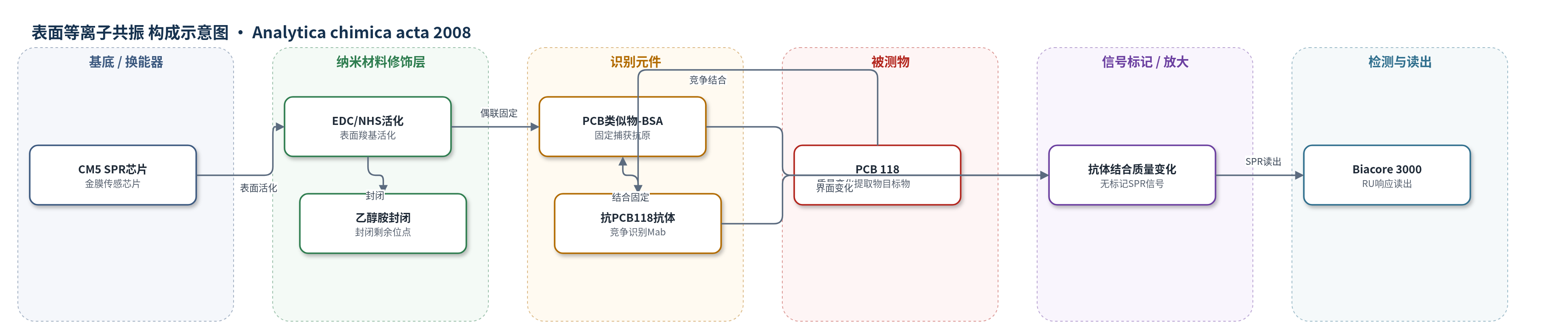
点击图片查看大图 · 依据论文自动绘制
传感器类型
表面等离子共振(SPR)生物传感器
检测对象
二噁英样多氯联苯(DL-PCBs,重点为 2,3′,4,4′,5-五氯联苯 PCB 118);样品基质:零售鱼肌肉组织净化提取物(DMSO 溶解)
检测原理
该法为无标记竞争型 SPR 免疫分析。CM5 芯片表面经 EDC/NHS 活化后,通过氨基偶联固定 PCB 类似物-BSA 偶联物,并用乙醇胺封闭剩余位点。检测时,抗 PCB 118 单克隆抗体(Mab)先与鱼提取物中的 PCB 118 或其他交叉反应 DL-PCBs 结合;随后混合液注入芯片,未被目标物占据的 Mab 与固定抗原结合。SPR 通过监测金膜表面抗体结合引起的折射率/质量变化,以响应单位(RU)记录信号。PCB 118 浓度越高,可结合到芯片的 Mab 越少,RU 越低。校准曲线按四参数 logistic 模型拟合,方法无需酶标记或化学放大,依靠抗体-抗原特异性结合和 SPR 直接质量传感实现定量。
检测灵敏度
定量限: 1 ng PCB 118 g−1(20 g 鱼样);LOQ: 100 ng mL−1;定量范围: 100–600 ng mL−1;校准曲线拟合范围: 50–600 ng mL−1;与ELISA相关系数: r = 0.99;与HRGC/HRMS PCB 118相关系数: r = 0.99;与TEQ(TEF1998)相关系数: r = 0.89;与TEQ(TEF2005)相关系数: r = 0.87
效应效果
BIA 对 PCB 118 特异性高,交叉反应:PCB 77 40.3%、PCB 156 33.2%、PCB 105 10.3%、PCB 114 9.8%,其余低于 2.7%。稀释可消除基质效应;加标回收率氧化铝柱 51.8–77.2%、活性炭柱 33.4–85.4%,稀释后提高。4 天重复测定 CV 4.4–5.9%。7 份鱼样 BIA 与 ELISA r = 0.99,斜率接近 1、截距接近 0;10 份鱼样 BIA 与 HRGC/HRMS PCB 118 r = 0.99,与 TEF1998 TEQ r = 0.89,与 TEF2005 TEQ r = 0.87。方法约 12 min/循环,可自动化,适合 HRGC/HRMS 前筛查。
传感器的构成
- 基底/换能器:CM5 金膜 SPR 传感芯片,提供表面等离子共振信号读出
- 活化层:EDC/NHS 混合液活化芯片表面羧基,用于共价偶联
- 识别元件固定层:PCB analogue–BSA conjugate(PCB 类似物-牛血清白蛋白偶联物)固定于芯片,作为捕获抗原
- 封闭层:ethanolamine(乙醇胺)封闭剩余活化位点,减少非特异结合
- 识别元件:anti-PCB 118 monoclonal antibody(抗 PCB 118 单克隆抗体,Mab),与样品中 PCB 118 竞争结合
- 信号读出:Biacore 3000 SPR 仪器,记录响应单位(RU)变化
中文摘要
二噁英样多氯联苯(DL-PCBs)常构成鱼类样品中二噁英毒性当量(TEQ)的主要贡献,因此开发快速筛查零售鱼中 DL-PCBs TEQ 浓度的方法具有重要意义。本研究建立了一种基于表面等离子共振(SPR)传感器的快速生物传感器免疫分析(BIA),采用 Biacore 3000 检测 DL-PCBs。该 BIA 对鱼类中通常含量最高的 DL-PCB 异构体 2,3′,4,4′,5-五氯联苯(PCB 118)具有高度特异性。鱼组织提取物先经多层硅胶柱和氧化铝柱净化,再行测定。方法定量限为每克样品 1 ng PCB 118。稀释和回收试验表明,通过稀释样品可最大限度降低基质效应。7 份零售鱼样品 BIA 结果与使用同一单克隆抗体的酶联免疫分析(ELISA)结果一致;10 份零售鱼样品 BIA 所得 DL-PCBs TEQ 浓度与高分辨气相色谱-高分辨质谱(HRGC/HRMS)结果相关良好(r = 0.89)。因此该方法可用于零售鱼中 DL-PCBs TEQ 浓度的筛查。
英文摘要
Dioxin-like polychlorinated biphenyls (DL-PCBs) often make up the majority of the toxic equivalent (TEQ) contribution of dioxins found in fish samples. For the purpose of making risk assessments, it is therefore important to develop screening methods for determining TEQ concentrations of DL-PCBs in retail fish. We have developed a rapid biosensor immunoassay (BIA) for DL-PCBs that uses a surface plasmon resonance sensor (Biacore 3000). The BIA is highly specific for 2,3',4,4',5-pentachlorobiphenyl (PCB 118) that is generally the most abundant DL-PCB isomer found in fish. The fish extracts were first cleaned up on a multilayer silica gel column followed by an alumina column, then subjected to the assay. The quantitative limit of the assay was 1 ng PCB 118 per gram of tested sample. Dilution and recovery tests using purified fish extracts suggested that the matrix effect was minimized in the assay by diluting the analyzed samples. The assay results for retail fish samples (n=7) agreed well with those obtained by an enzyme-linked immunoassay (ELISA) using the same monoclonal antibody: ELISA has been already validated for determining DL-PCBs in fish samples, so BIA performs well in this analysis. Finally, BIA results for the TEQ concentrations of DL-PCBs in retail fish samples (n=10) correlated well with those obtained by high-resolution gas chromatography coupled to high-resolution mass spectrometry (r=0.89). Our method is therefore useful for screening retail fish to determine the TEQ concentrations of DL-PCBs.