组成图示
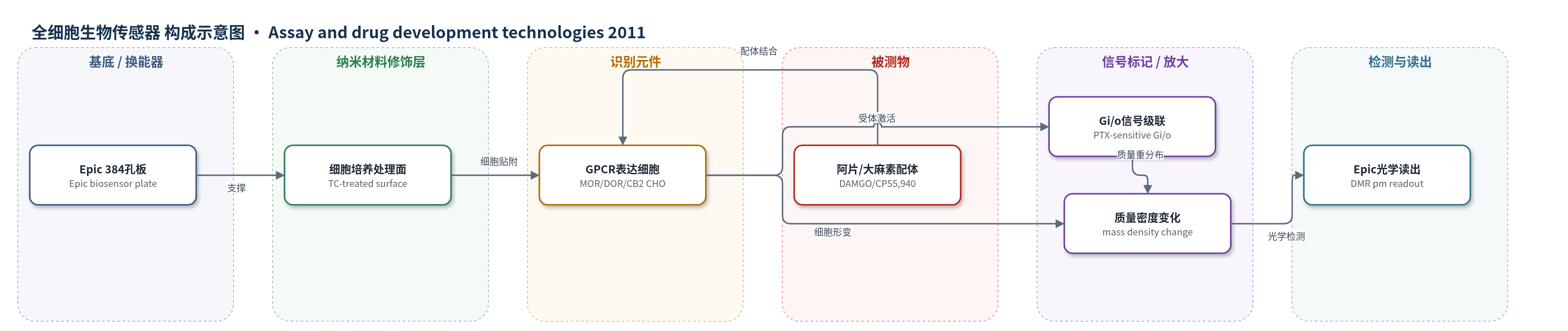
点击图片查看大图 · 依据论文自动绘制
传感器类型
全细胞生物传感器
检测对象
阿片受体激动剂/拮抗剂(opioid agonists/antagonists,如DAMGO、morphine、deltorphin II)、大麻素受体激动剂/反向激动剂(cannabinoid agonists/inverse agonists,如CP 55,940、AM630);样品基质:细胞培养检测缓冲液AB(Hanks缓冲盐、20 mM HEPES、0.1% BSA)中的转染细胞体系
检测原理
配体与细胞膜上的MOR、DOR或CB2等GPCR结合后,触发Gi/o依赖的受体激活与下游信号级联。该过程引起细胞膜附近细胞骨架、膜微区或细胞整体构象改变,使生物传感器表面约150 nm范围内细胞组分的质量密度/折射率发生变化。Epic光学系统通过无标记方式连续监测该界面质量重分布,输出以皮米(pm)表示的pDMR或nDMR信号。信号幅值随配体浓度增加而增大,可拟合EC50;拮抗剂或百日咳毒素可阻断信号,MEK1/2抑制剂等可改变特定配体诱导的响应,从而反映不同配体激活的通路差异。
检测灵敏度
原文未报告LOD、线性范围、灵敏度斜率或相关系数。
效应效果
DMR显示良好亚型选择性:MOR/DOR拮抗剂分别阻断DAMGO和deltorphin II信号,百日咳毒素完全阻断MOR、DOR及CB2信号;亲本CHO对CP 55,940和AM630无显著响应。DAMGO最大pDMR约175 pm,deltorphin II约250 pm;CP 55,940 EC50 1.7 nM、最大约110–129 pm,AM630 EC50 18 nM、最大约-80 pm。多数化合物DMR效价较GTPγS高约10倍,DAMGO接近结合亲和力,d-propoxyphene最弱。U0126阻断AM630 nDMR(IC50 0.35 mM)但不影响CP 55,940,SL327 IC50 17 mM;latrunculin A 1 mM完全阻断。未报告RSD/回收率。作者认为DMR可识别偏向性配体及通路。
传感器的构成
- 基底/换能器:Corning Epic 384-well biosensor-containing assay plate,内置光学生物传感器,检测细胞近表面质量密度/折射率变化
- 表面处理层:tissue culture-treated surface,使细胞贴附并形成稳定细胞-传感器界面
- 识别元件:MOR/DOR/CB2 转染 CHO、SK-N-SH 或 DOR C6 细胞,细胞膜 GPCR 识别阿片/大麻素配体
- 样品介质:AB(Hanks buffered salt solution + 20 mM HEPES + 0.1% BSA),维持细胞并传递配体
- 信号标记物:无(label-free,不依赖荧光/放射性标记)
- 信号读出:Corning Epic 光学系统,以 pm 位移输出 pDMR/nDMR
中文摘要
传统上,G蛋白偶联受体(GPCR)被配体激活后产生特定下游反应,如G蛋白激活、腺苷酸环化酶调控、磷脂酶C激活或钙流改变。配体导向信号理论认为,作用于同一受体的不同配体可诱导不同下游效应,使筛选方法选择复杂。动态质量重分布(DMR)是一种无标记技术,利用光测量生物传感器附近细胞质量变化,提供包含多条通路和细胞事件的整合细胞响应。本研究在转染阿片或大麻素受体的细胞中,用DMR评估激动剂诱导的信号,发现其可被药理学上相应的受体拮抗剂及百日咳毒素阻断。与GTPγS或受体结合终点相比,不同化合物在DMR中的相对效价存在差异,提示功能选择性。初步证据显示,受体再循环抑制剂、MEK/p38 MAPK抑制剂或细胞骨架破坏剂可改变或减弱大麻素诱导响应;MEK1/2抑制剂减弱CB2反向激动剂AM630信号但不影响激动剂CP 55,940。因此,DMR不仅可识别激活特定GPCR的配体,还可判断特定配体激活的信号通路,有助于发现具有改善治疗谱的偏向性配体。
英文摘要
Classically, G protein-coupled receptor activation by a ligand has been viewed as producing a defined response such as activation of a G protein, activation or inhibition of adenylyl cyclase, or stimulation of phospholipase C and/or alteration in calcium flux. Newer concepts of ligand-directed signaling recognize that different ligands, ostensibly acting at the same receptors, may induce different downstream effects, complicating the selection of a screening assay. Dynamic mass redistribution (DMR), a label-free technology that uses light to measure ligand-induced changes in the mass of cells proximate to the biosensor, provides an integrated cellular response comprising multiple pathways and cellular events. Using DMR, signals induced by opioid or cannabinoid agonists in cells transfected with these receptors were blocked by pharmacologically appropriate receptor antagonists as well as by pertussis toxin. Differences among compounds in relative potencies at DMR versus ligand-stimulated GTPγS or receptor binding endpoints, suggesting functional selectivity, were observed. Preliminary evidence indicates that inhibitors of intermediate steps in the cell signaling cascade, such as receptor recycling inhibitors, mitogen-activated protein kinase kinase/p38 mitogen-activated protein kinase inhibitors, or cytoskeletal disruptors, altered or attenuated the cannabinoid-induced response. Notable is the finding that mitogen-activated protein kinase kinase 1/2 inhibitors attenuated signaling induced by the cannabinoid type 2 receptor inverse agonist AM630 but not that stimulated by the agonist CP 55,940. Thus, DMR has the potential to not only identify ligands that activate a given G protein-coupled receptor, but also ascertain the signaling pathways engaged by a specific ligand, making DMR a useful tool in the identification of biased ligands, which may ultimately exhibit improved therapeutic profiles.