组成图示
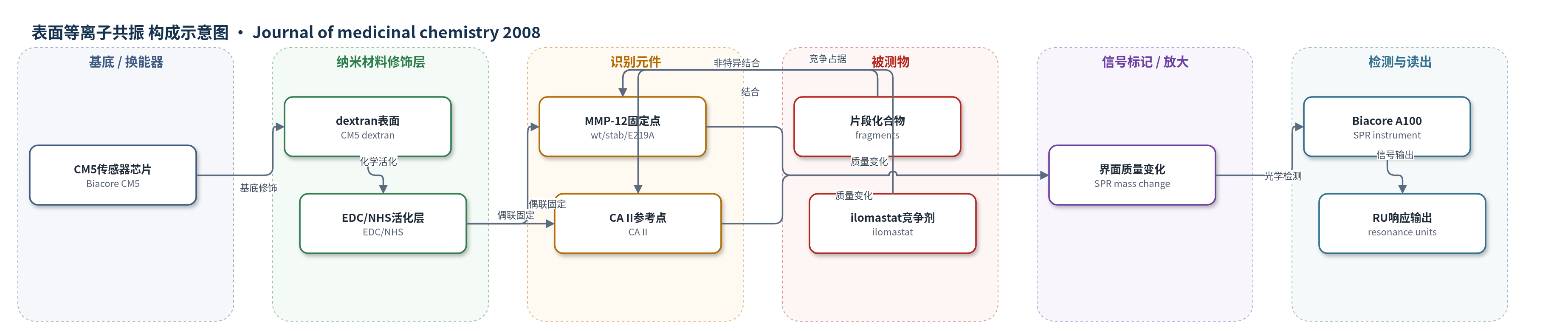
点击图片查看大图 · 依据论文自动绘制
传感器类型
表面等离子共振(SPR)生物传感器
检测对象
MMP-12片段库抑制剂(MMP-12 fragment library inhibitors / small-molecule fragments);样品基质:5% DMSO 的 Hepes 缓冲液(含 CaCl2、NaCl、Tween 20)
检测原理
MMP-12 通过 EDC/NHS 氨基偶联固定于 CM5 芯片的 dextran 表面,形成 SPR 识别界面。片段化合物以 200 µM 注入流动池,若与固定 MMP-12 结合,会在界面增加质量并改变局部折射率,使表面等离子共振角发生偏移,仪器以共振单位(RU)连续记录结合/解离曲线。直接筛选中,信号随片段浓度升高并出现饱和,提示特异性结合;竞争筛选中预先或同时加入 ilomastat 占据活性位点,若片段信号被抑制则判定为活性位点结合。CA II 参考表面用于排除仅结合锌离子的非特异片段。该方法为无标记检测,不依赖酶催化或荧光放大,信号大小主要反映结合质量与浓度。
检测灵敏度
原文未报告 LOD、线性范围、灵敏度斜率或相关系数。
效应效果
该 SPR 筛选从 245 个片段中依次获得 23 个直接命中、21 个活性位点片段、11 个对 CA II 选择性片段和 5 个可饱和片段,最终确认两种 MMP-12 抑制剂。B7 在 500 µM 抑制 100%,IC50 0.29 µM(290 nM),配体效率 0.69 kcal/mol 重原子,为竞争性抑制剂;B6 抑制 60%,IC50 355±14 µM,配体效率 0.39。ilomastat 2.5 nM 抑制 75%。方法用 CA II 排除非特异锌结合,并用 E219A 突变体和 ilomastat 稳定策略应对 MMP-12 自水解、基线漂移和表面寿命短问题。作者认为该无标记 SPR 方法可整合选择性、结合位点和动力学信息,是 NMR/X-ray 片段筛选的重要补充。
传感器的构成
- 基底/换能器:Biacore CM5 传感器芯片(CM5,含 dextran 表面),提供 SPR 光学换能与蛋白固定界面
- 活化/偶联层:EDC/NHS(1-ethyl-3-(3-dimethylaminopropyl)-carbodiimide hydrochloride / N-hydroxysuccinimide)活化 dextran 表面,实现酶氨基偶联
- 识别元件:MMP-12 野生型(wt MMP-12)、ilomastat 稳定 wt MMP-12 和 E219A 失活突变体,固定于三个检测点,作为靶标结合位点
- 参考识别元件:碳酸酐酶 II(CA II),固定于一个检测点,用于识别非特异性锌结合片段
- 表面参考/封闭:第五检测点经 EDC/NHS 活化后用 ethanolamine 灭活,作为 dextran 表面非特异结合参考
- 竞争/稳定剂:ilomastat,用于稳定 MMP-12 并占据活性位点,通过竞争实验区分活性位点结合
- 信号标记物:无外源标记,SPR 直接检测结合引起的界面质量/折射率变化
中文摘要
本研究采用生物传感器筛选策略和专门设计的片段库,鉴定了基质金属蛋白酶12(MMP-12)的小分子抑制剂。作者将三种MMP-12变体(野生型、ilomastat稳定野生型和E219A失活突变体)以及含活性位点锌离子的参考蛋白碳酸酐酶II(CA II)固定于表面等离子共振(SPR)传感器芯片上,连续监测片段与靶标及参考蛋白的相互作用。该实验设计克服了MMP-12固有的不稳定性,从而能够识别特异性结合MMP-12活性位点而不结合参考蛋白的片段。对选中的化合物进一步分析浓度依赖性和可饱和性,并通过基于活性的检测验证其MMP-12抑制作用。最终鉴定出两种有效抑制剂,其中亲和力最高的化合物被确认为竞争性抑制剂,IC50为290 nM,配体效率为0.7 kcal/mol重原子。该流程将选择性和结合位点鉴定整合到筛选过程中,且无需结构测定。
英文摘要
Small inhibitors of matrix metalloproteinase 12 (MMP-12) have been identified with a biosensor-based screening strategy and a specifically designed fragment library. The interaction between fragments and three variants of the target and a reference protein with an active-site zinc ion was measured continuously by surface plasmon resonance. The developed experimental design overcame the inherent instability of MMP-12 and allowed the identification of fragments that interacted specifically with the active-site of MMP-12 but not with the reference protein. The interaction with MMP-12 for selected compounds were analyzed for concentration dependence and saturability. Compounds interacting distinctly with the target were further evaluated by an activity-based assay, verifying MMP-12 inhibition. Two effective inhibitors were identified, and the compound with highest affinity was confirmed to be a competitive inhibitor with an IC50 of 290 nM and a ligand efficiency of 0.7 kcal/mol heavy atom. This procedure integrates selectivity and binding site identification into the screening procedure and does not require structure determination.