组成图示
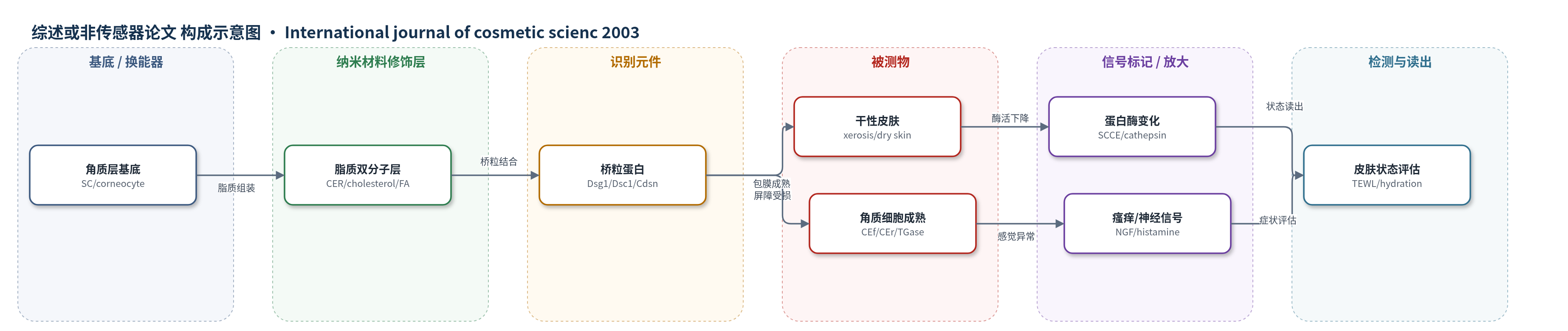
点击图片查看大图 · 依据论文自动绘制
传感器类型
综述或非传感器论文
检测对象
未报道明确检测对象;论文讨论干性皮肤角质层状态(xerosis, stratum corneum),样品基质:皮肤角质层、胶带剥离物、表皮。
检测原理
本文未报道传感器检测原理。角质层屏障状态可通过脂质相态、桥粒降解和蛋白酶活性等生物物理/生化变化反映。干燥时,神经酰胺(尤其植物鞘氨醇型)和长链脂肪酸减少,含亚油酸CER EOS不足,导致13 nm长周期相丢失、脂质堆积紊乱;角质层蛋白酶(SCCE、SCTE、cathepsin D/E等)水平和活性下降,桥粒蛋白(Dsg1、Dsc1、Cdsn)降解减少,角质细胞脱屑受阻。同时,角质细胞包膜转谷氨酰胺酶交联不足使脆弱角质细胞增多,表皮细胞因子、NGF和组胺等变化可引发瘙痒。上述变化可通过TEWL、水合、显微镜、酶活或免疫检测等评估,但并非本文报道的传感方法。
检测灵敏度
未报道。
效应效果
本文未报道传感器选择性、抗干扰、稳定性、重现性、回收率或LOD等性能指标。作为综述,其总结干性皮肤中神经酰胺、长链脂肪酸和LPP减少,桥粒蛋白升高,蛋白酶活性下降,角质细胞包膜成熟受损。外用完整脂质混合物、甘油、烟酰胺、乳酸、植物鞘氨醇、蛋白酶及蛋白酶抑制剂等可改善TEWL、水合、脱屑、屏障修复和瘙痒。临床/体外研究显示屏障功能恢复、角质层成熟改善,但缺乏与ELISA/HPLC/qPCR等方法的定量对比,应用价值主要在于干性皮肤管理和化妆品/皮肤护理策略。
传感器的构成
- 基底/换能器:未报道;非传感器论文,无具体电极或换能器材料
- 修饰层:未报道;非传感器论文,无纳米材料修饰层
- 识别元件:未报道;非传感器论文,无抗体/适配体等识别元件
中文摘要
角质层的结构、组成、形成与功能近几十年来受到深入研究。其屏障功能不仅依赖单一组分,还取决于整体结构。脂质研究进展催生了新的神经酰胺命名体系,并提出神经酰胺、胆固醇与脂肪酸相互作用的新分子模型,证实角质层中存在结晶正交晶相和凝胶六角相。含亚油酸的神经酰胺1(CER EOS)对13 nm长周期相(LPP)形成至关重要,长链脂肪酸则对形成屏障所需结晶脂质相很重要。角质细胞包膜、组成蛋白及转谷氨酰胺酶介导的成熟过程对维持皮肤状态必不可少。多种蛋白酶参与桥粒溶解,尤其是丝氨酸蛋白酶和猫胃蛋白酶样酶。角蛋白聚糖多态性可能与干性皮肤表型有关。干燥皮肤中脂质堆积紊乱、神经酰胺(尤其植物鞘氨醇型)和长链脂肪酸减少以及LPP丢失,是脂质结构扰动的主要原因。该干燥性皮肤病中桥粒溶解减少已被接受,原因是角质层蛋白酶水平和活性下降,以及表层桥粒糖蛋白升高。脆弱角质细胞增多与转谷氨酰胺酶活性降低和包膜交联减少有关。然而,干性皮肤的躯体感觉变化研究不足,瘙痒仍属薄弱领域。角质层作为天然保湿屏障的独特生物传感作用,也可能通过调控表皮细胞因子和生长因子表达与分泌,在抗衰老技术中发挥作用。本文综述角质层生物学现状和干性皮肤管理趋势。
英文摘要
The structure, composition, formation and function of the stratum corneum have been the subject of intense research over the last few decades. As has become apparent, stratum corneum barrier function is not only dependent on one single component but also on its total architecture. Recent developments in understanding lipid composition have led to a new ceramide nomenclature system, a new proposal for a molecular model of the interactions between ceramides, cholesterol and fatty acids, and the demonstration of the presence of crystalline orthorhombic and gel hexagonal lipid phases in the stratum corneum. Linoleate-containing ceramide one, now known as CER EOS, have been shown to be essential for the formation of the 13 nm long periodicity phase (LPP) observed by electron microscopy and X-ray diffraction studies, whereas long-chain fatty acids are important for the formation of the crystalline lipid phases essential for barrier function. The role of the corneocyte envelope, its constituent proteins and its transglutaminase-mediated maturation processes have been shown to be essential for good skin condition. Several proteases may have a role in corneodesmolysis, particularly serine and cathepsin-like enzymes. Novel filaggrin polymorphisms have been identified that may be involved in the expression of a dry skin phenotype. Disturbances in lipid packing states, reduction in ceramide levels (particularly the phytosphingosine-containing ceramides), reductions in the levels of long-chain fatty acids and loss of the LPP largely account for the perturbations in lipid structure that occur in dry skin. The reduced corneodesmolysis that occurs in this xerotic skin disorder is now well accepted and is caused by reductions in the levels and activities of stratum corneum proteases together with elevated levels of corneodesmosomal glycoproteins in the superficial layers of the stratum corneum. Additionally, increased levels of fragile corneocytes are associated with reduced transglutaminase activity and corneocyte envelope cross-linking events. However, in comparison with the advances in our understanding of the textural changes that occur in dry skin, the somatosensory changes are poorly understood and the itching associated with dry skin is still an under-researched area. The unique biosensor role of the stratum corneum essential for a competent natural moisturizing barrier may also have a role to play in the action of anti-ageing technologies by controlling the expression and secretion of epidermal cytokines and growth factors. Technologies to treat the surface textural skin problems, enhance the differentiation process, particularly lipid biosynthesis, and to control the somatosensory problems in dry skin have received much attention in the last decade. This paper will review the state of the art of stratum corneum biology and the trends in the management of dry skin.