组成图示
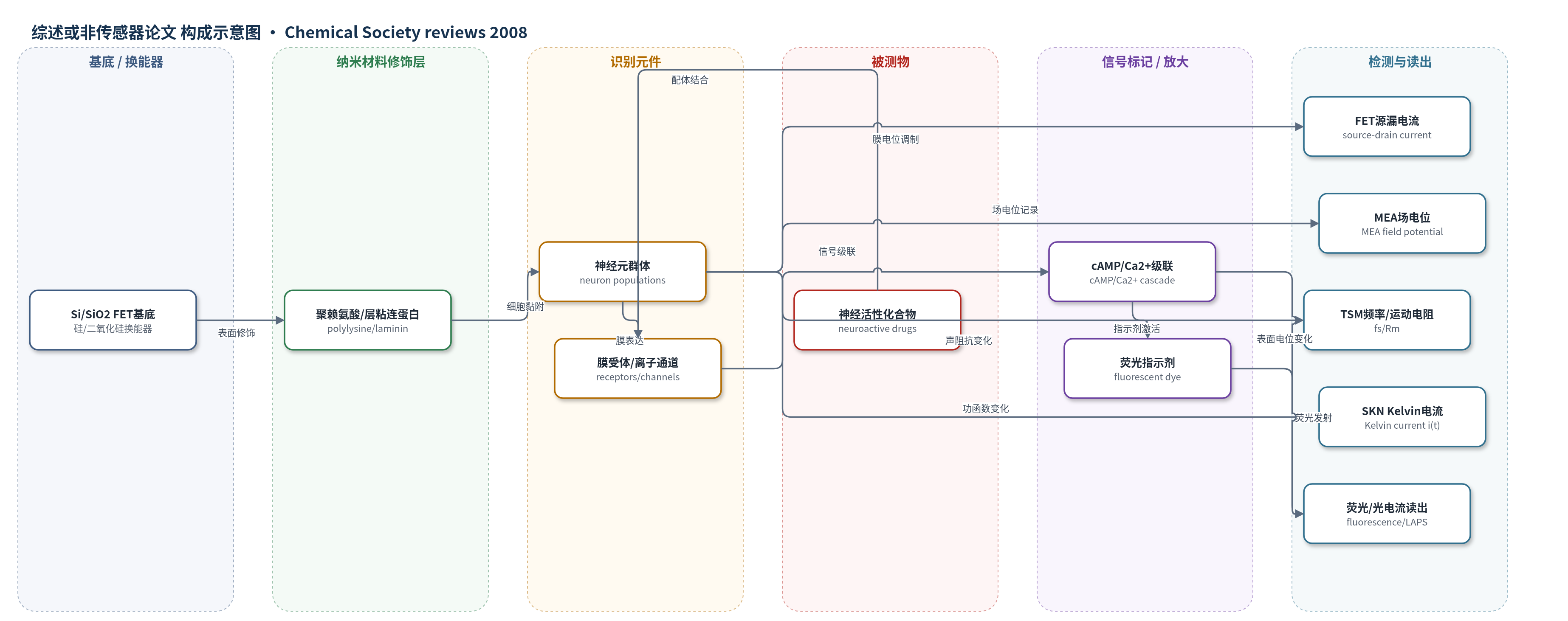
点击图片查看大图 · 依据论文自动绘制
传感器类型
综述或非传感器论文
检测对象
神经活性化合物(neuroactive compounds)、神经递质(neurotransmitters)、神经调节剂(neuromodulators)、神经毒素(neurotoxins)、抗肿瘤药物(anti-tumor drugs)、气味分子(odorants);样品基质为体外神经元培养液/细胞培养体系。
检测原理
神经元生物传感器以活神经元作为识别与放大单元。神经活性化合物、神经递质、神经毒素或药物与神经元膜受体结合后,激活离子通道和胞内信号级联,引起Na+、K+、Ca2+跨膜流动、膜电位/动作电位改变以及cAMP等第二信使变化。这些生物电与生物化学变化在传感器界面产生可检测信号:在FET中,膜电场极化SiO2层,改变半导体能带和源漏电流;在MEA中,胞外离子流和膜电容变化被高输入阻抗放大器记录为场电位;在LAPS中,表面电位改变耗尽层宽度,使光电流波动;在TSM/QCM中,细胞-界面质量、黏弹性和电双层变化改变共振频率fs和运动电阻Rm;在SKN中,神经元介电特性改变金基底功函数,Kelvin电流随之变化。细胞信号转导级联和神经元网络同步振荡提供内源性放大,多参数读出提高选择性。
检测灵敏度
原文未报告LOD、线性范围、灵敏度斜率或相关系数。
效应效果
作为综述,本文未给出统一LOD、线性范围、RSD或回收率。文中报道SKN在10^-4 M forskolin作用下测得约300 mV接触电位变化,与ELISA检测cAMP升高850%的结果相关,且不同培养可重复;相比之下随机神经元MEA常受高噪声和电极接触不均影响。TSM在9 MHz下可检测betaferon引起的fs与Rm振荡及后续阻尼,显示对神经活性药物的响应。MEA已用于神经毒素、化学剂和药物筛选,但信噪比低、有效电极少。LAPS可连续监测pH、细胞毒性和乙酰胆碱受体激活,并用于嗅觉电子鼻。作者认为此类器件可用于神经活性药物评价、神经毒性检测、再生医学、神经芯片、生物计算机和植入式假肢。
传感器的构成
- 基底/换能器:硅(Si)/二氧化硅(SiO2)场效应晶体管(FET)、互补金属氧化物半导体(CMOS)、金(Au)厚度剪切模式(TSM)电极、石英(quartz)压电晶片、金(Au)扫描Kelvin纳米探针(SKN)基底,用于承载神经元并转换电/声/光信号。
- 表面修饰层:聚赖氨酸(polylysine)、层粘连蛋白(laminin)、纤连蛋白(fibronectin)、牛血清白蛋白(BSA)、蛋白A(protein A)、抗体、环氧硅烷(epoxysilane)、十八烷基三氯硅烷(OTS)/二乙烯三胺(DETA)图案,用于促进神经元黏附、存活与网络形成。
- 识别元件:培养神经元/神经元群体(neurons/neuron populations),其膜受体、离子通道和信号转导级联作为生物识别与放大单元。
- 信号标记/离子探针:环磷酸腺苷(cAMP)、钙离子(Ca2+)、钾离子(K+)、钠离子(Na+)、多巴胺(dopamine)及荧光指示剂/报告蛋白(fluorescent indicator/reporter protein),用于标记离子流入、代谢变化或受体激活。
- 辅助电极/传感元件:参考电极、对电极、离子选择电极(ISE,pH/O2)、微电极阵列(MEA),用于记录胞外场电位、施加刺激和监测代谢产物。
- 读出系统:FET源漏电流、MEA放大器/数据采集、光寻址电位传感器(LAPS)光电流、TSM共振频率(fs)与运动电阻(Rm)、SKN Kelvin电流(i(t)),用于输出可量化信号。
中文摘要
本文是一篇关于神经元与生物传感器器件耦合以检测神经元群体特性的批判性综述。体外检测神经元群体的神经生物物理化学是新兴研究领域。文章概述了当前方法、挑战与前景,包括用于测量神经元间接触与连接性的器件、用于测定胞外代谢产物的微电极,以及用于评价神经元与小分子相互作用、毒性和抗肿瘤药物致突变性的传感器。由于神经元是电生细胞并具有识别能力,文章重点讨论基于神经细胞网络、能够电学检测神经活性化合物和特定药理活性的器件。此类器件可高灵敏度测量多种神经事件,如神经活性化合物对神经元功能的影响、神经递质和神经调节剂的作用、膜电位变化、影响动作电位传播的传递效应,以及神经化学物质对离子通道的影响。作者认为这些器件在新型神经活性药物筛选、基础神经研究、再生医学、神经芯片、生物计算机、智能假肢及神经生物学与分子电子学融合方面具有潜力。
英文摘要
The in vitro detection of the neural biophysical chemistry of populations of neurons is an important emerging area of research. This critical review describes the current methodologies, challenges and future prospects for this exciting field of research. There are different classes of techniques for the study of neuron-based systems. These include devices to measure inter-neuron contact and connectivity, microelectrodes for the determination of extracellular metabolic products, and sensors employed for the evaluation of complex neuron-small molecule interactions, toxicity, and mutagenicity of anti-tumor drugs. Since the neuron is an electrogenic cell and a complex biological entity capable of effecting recognition, the main emphasis of this article will be placed on devices based on nerve-cell networks that are able to electrically detect neuron-active compounds and specific pharmacological activity. Such neuron-based devices can be used to measure numerous neurological events with a high degree of sensitivity. Examples include the influence of different neuro-active compounds on neuronal function, the effects of neurotransmitters and neuro-modulators, changes in membrane potential, transmission effects that influence the propagation of the action potential, and the manner through which neuro-chemicals can influence ion channels. Moreover, these devices posses promising potential for the testing and development of novel neuron-active drugs and fundamental neurological research to further the understanding of brain activity. The inner workings of the human mind remain largely unknown and the key to comprehending it may rely on how molecules can initiate and influence synchronous neural oscillations, and the phenomenon of resonance in neural cells. The knowledge acquired in such detailed investigations can lead to the future development of regenerative medicines, neurochips and biocomputers, intelligent prosthetic devices and new applications that integrate neurobiology with molecular electronics (69 references).