组成图示
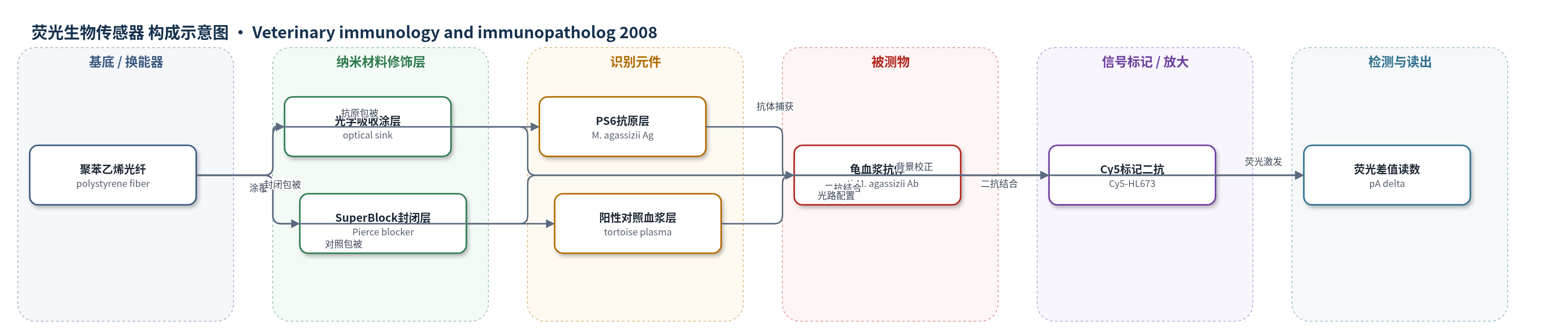
点击图片查看大图 · 依据论文自动绘制
传感器类型
荧光生物传感器
检测对象
抗阿加西丝支原体特异性抗体(anti-Mycoplasma agassizii antibodies);样品基质:龟血浆(tortoise plasma)
检测原理
该传感器采用倏逝波荧光免疫夹心原理。一次性聚苯乙烯光纤表面包被阿加西丝支原体PS6全细胞裂解抗原,作为识别捕获层。龟血浆样品中的抗M. agassizii特异性抗体与表面抗原结合,形成抗原-抗体复合物;洗涤去除未结合成分。随后加入Cy5标记的抗龟Ig小鼠单克隆抗体HL673,与已捕获的龟抗体结合。激光激发Cy5,光纤端部倏逝波检测表面附近荧光,以pA记录。mark1为样品结合后背景,mark2为二抗结合后荧光,二者差值delta反映二抗结合量,并随血浆中特异性抗体浓度增加而增大。阳性对照血浆和SuperBlock阴性对照用于验证结合与背景。
检测灵敏度
Spearman rank correlation: 0.804 (Z-value = 3.858, P < 0.0001)
效应效果
两次盲法试验共57份龟血浆,以ELISA为金标准,总体准确率84%;平均灵敏度78%、特异性73%、阳性预测值82%、阴性预测值68%。试验1中ELISA光密度与传感器荧光差值Spearman相关系数0.804(P<0.0001),500 pA阈值下22/24正确,灵敏度86%、特异性68%;最优阈值850 pA时灵敏度74%、特异性93%。试验2中阴性delta%为0.797±0.092,阳性为1.563±0.190(P=0.0002),delta%=1阈值下26/33正确,灵敏度70%、特异性78%。与ELISA(灵敏度>98%、特异性>99%)相比,传感器灵敏度/特异性较低,但约15 min完成,短于ELISA的4–5 h,适合野外快速筛查;局限是假阴性较多、光纤手工装配和荧光标记批次差异带来波动。
传感器的构成
- 基底/换能器:一次性聚苯乙烯光纤传感器(polystyrene fiber optical sensors),四通道,远端涂光学吸收层,用于倏逝波荧光检测
- 识别/捕获层:阿加西丝支原体PS6全细胞裂解抗原(M. agassizii PS6 Ag,40 mg/mL PBS)包被于光纤表面,捕获龟血浆中特异性抗体
- 阳性对照层:龟血浆(1:10 PBS稀释)直接包被光纤,提供无关龟免疫球蛋白以验证Cy5标记二抗结合
- 阴性对照/封闭层:SuperBlock(Pierce)无关蛋白封闭液包被光纤,封闭多余结合位点并作为阴性对照
- 信号标记物:Cy5标记抗龟Ig小鼠IgG单克隆抗体HL673(约8 mg/mL PBS),与捕获的龟抗体结合产生荧光
- 检测/读出模块:四通道便携式荧光检测系统,自动执行孵育、洗涤程序并记录激光激发的倏逝波荧光(pA)
中文摘要
过去二十年,疾病已成为野生动物管理中日益重要的问题。充分的监测是疾病预防与控制的基础,因此野生动物管理对诊断方法的需求不断增加。本研究旨在评估一种经改造用于快速检测龟血浆中特异性抗体的便携式生物传感器,这些抗体反映龟曾暴露于阿加西丝支原体(Mycoplasma agassizii),该菌是龟上呼吸道疾病的病原。对储存血浆样本进行了两次盲法试验,并基于外部验证的龟血浆对照估计定义诊断试验可靠性的参数。生物传感器的平均灵敏度(在所有暴露个体中识别出暴露个体的能力)为78%;平均特异性(在所有未暴露个体中检测为阴性的比例)为73%;平均阳性预测值(所有阳性结果中真正暴露个体的比例)为82%;平均阴性预测值(所有阴性结果中真正未暴露个体的比例)为68%。在15分钟的便携式现场格式中,该生物传感器能以84%的总体准确率区分真正血清阳性(n=34)和真正血清阴性(n=23)的龟血浆。为龟群设定的目标可帮助管理者判断潜在诊断误差是否应影响管理决策,以及便携式生物传感器检测的益处是否超过其潜在缺点。
英文摘要
Disease has become an increasingly important issue for wildlife management over the past two decades. Adequate surveillance is fundamental for disease prevention and control, thus there is an increasing need for diagnostic assays for wildlife management. The objective of this study was to evaluate the performance of a field-portable biosensor adapted for rapid detection of specific antibodies in tortoise plasma that reflect a history of exposure to Mycoplasma agassizii, which is an agent of tortoise upper respiratory tract disease. Banked plasma samples were tested in two blinded trials, and the parameters that define the reliability of a diagnostic test were estimated based on externally validated tortoise plasma controls. The mean sensitivity of the biosensor (ability to identify exposed tortoises in the group of all exposed individuals) was 78%; the mean specificity (unexposed individuals with negative test result, out of all unexposed individuals tested) was 73%; the mean positive predictive value (exposed individuals with positive test, out of all individuals with positive test) was 82%; the mean negative predictive value (unexposed individuals with negative test, out of all individuals with negative test) was 68%. In a 15-min field-portable format, the biosensor was able to discriminate between true seropositive (n=34) and true seronegative (n=23) tortoise plasma with overall accuracy of 84%. The goals established for the tortoise population can help managers decide whether potential diagnostic errors should impact management decision-making, and whether the benefits of the field-portable format of the biosensor assay outweigh any potential disadvantages.