组成图示
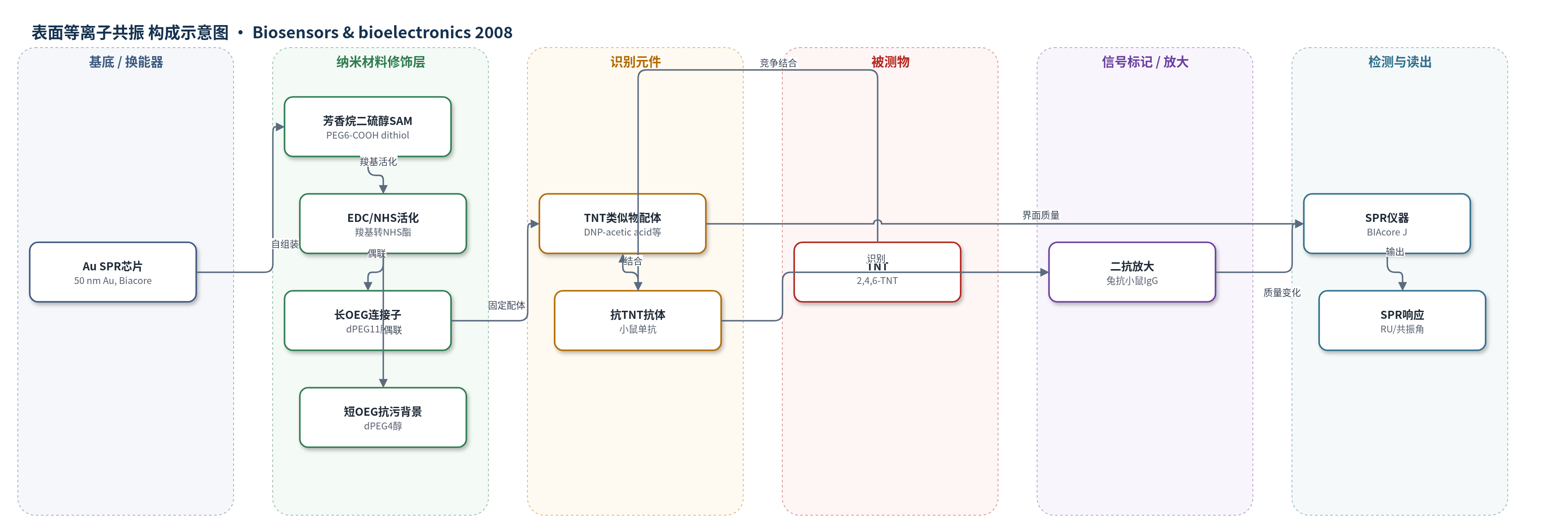
点击图片查看大图 · 依据论文自动绘制
传感器类型
表面等离子共振(SPR)生物传感器
检测对象
2,4,6-三硝基甲苯(TNT, 2,4,6-trinitrotoluene);样品基质:水样/缓冲液(Milli-Q水、PBST)
检测原理
该传感器采用间接竞争免疫分析。Au SPR芯片表面经芳香烷二硫醇SAMs、EDC/NHS活化和OEG连接子修饰后,共价固定TNT类似物半抗原。样品中的TNT先与抗TNT抗体预混,TNT占据抗体结合位点,使自由抗体减少;混合液流过传感器表面时,未结合抗体与固定半抗原结合。TNT浓度越高,表面结合抗体越少,SPR共振角/RU响应越低,结合百分比下降。OEG链抑制蛋白非特异吸附,提高信噪比。在低抗体浓度下,兔抗小鼠IgG二抗结合已结合的一抗,放大界面质量变化,从而降低检出限。
检测灵敏度
LOD: ca. 80 ppt (pg ml−1);LOD: ca. 220 ppt;LOD: ca. 100 ppt;LOD: ca. 50 ppt
效应效果
该表面显著抑制蛋白非特异吸附:1000 µg ml−1 BSA、100 µg ml−1人IgG和100 µg ml−1兔抗小鼠IgG流过EG17系列表面时几乎无响应,其中8:2比例最优。OEG链长影响响应,20 µg ml−1抗体在EG17(8:2)表面响应约2250 RU,高于EG0的1200 RU和EG3的1635 RU。实验数据RSD小于4%,250 ng ml−1抗体参考RSD小于3%,25 ng ml−1参考RSD约5%。DNP-acetic acid表面LOD约80 ppt,二抗放大后约50 ppt。表面可重复使用100次以上,温和再生条件为3.13 mM NaOH、30% acetonitrile和0.05% Tween 20,适合现场爆炸物检测并降低维护成本。
传感器的构成
- 基底/换能器:Au SPR芯片(Biacore SIA Kit Au,50 nm Au),提供表面等离子共振换能表面
- 自组装单分子层:PEG6-COOH芳香烷二硫醇(aromatic alkanedithiol)在Au上形成稳健SAMs,提供羧基反应位点
- OEG连接子层:mono-N-t-boc-amido-dPEG11 amine(H2N(C2H4O)11C2H4NHCOOC(CH3)3)经EDC/NHS偶联到SAMs羧基,4N-HCl去保护后提供氨基固定TNT类似物
- 抗蛋白污染背景:amino-dPEG4 alcohol(H2N(C2H4O)3C2H4OH)经EDC/NHS以8:2比例与长OEG连接子偶联,形成羟基末端OEG抗污背景
- 固定识别配体:TNP-glycine、DNP-glycine或DNP-acetic acid经EDC/NHS活化羧基后与表面氨基偶联,作为TNT半抗原
- 识别/信号标记:小鼠抗TNT单克隆抗体(TNT antibody)与TNT竞争结合;兔抗小鼠IgG二抗用于信号放大
- 再生条件:3.13 mM NaOH、30% (v/v) acetonitrile、0.05% (v/v) Tween 20温和再生表面
中文摘要
本文报道了一种基于芳香烷二硫醇和聚乙二醇(OEG)连接子自组装单分子层(SAMs)的新型表面等离子共振(SPR)免疫传感器表面,用于高灵敏检测2,4,6-三硝基甲苯(TNT)。首先在Au传感器表面形成芳香烷二硫醇SAMs,再通过OEG链共价固定TNT类似物。两种含氨基OEG化合物以一定比例偶联到SAMs羧基末端:H2N(C2H4O)11C2H4NHCOOC(CH3)3作为连接子与TNT类似物羧基反应,H2N(C2H4O)3C2H4OH作为抗蛋白污染背景,并考察最佳比例。采用TNP-glycine、DNP-glycine和DNP-acetic acid三种TNT类似物作为固定配体,通过间接竞争法检测TNT,并比较其结构差异对灵敏度的影响。结果显示,对TNT抗体亲和力最低的DNP-acetic acid固定表面具有最佳检出限(约80 ppt,pg ml−1),而亲和力最高的TNP-glycine表面检出限最差(约220 ppt);在DNP-acetic acid表面使用二抗后,检出限进一步降至约50 ppt。该传感器表面化学稳定性好,再生条件温和,可重复使用100次以上且无明显性能下降。
英文摘要
This paper describes the development of novel biosensor surfaces supported by robust self-assembled monolayers (SAMs) of aromatic alkanedithiol and oligo(ethylene glycol) (OEG) linker for highly sensitive surface plasmon resonance (SPR) detection of 2,4,6-trinitrotoluene (TNT). Aromatic alkanedithiol SAMs were firstly formed on Au sensor surface and TNT analogues were immobilized on it through OEG chain. Two kinds of OEG containing amine compounds, where H(2)N(C(2)H(4)O)(11)C(2)H(4)NHCOOC(CH(3))(3) served as a linker to react with carboxyl groups of TNT analogues while H(2)N(C(2)H(4)O)(3)C(2)H(4)OH served as a protein non-fouling background, were covalently bound to carboxyl terminal groups of SAMs with a certain ratio. Optimal ratio of them was also examined. Three kinds of TNT analogues, namely TNP-glycine, DNP-glycine, and DNP-acetic acid were used as immobilized ligands. Highly sensitive TNT detection by indirect competitive assay was conducted on the fabricated sensor surfaces; we examined how structural variations of them affect sensitivity in order to choose optimal hapten as well to improve sensitivity. The DNP-acetic acid immobilized surface, which had the lowest affinity to the TNT antibody among the three, showed the best limit of detection (LOD) value (ca. 80 ppt (pg ml(-1))). On the other hand, the TNP-glycine immobilized surface, which had the highest affinity, showed the worst LOD value (ca. 220 ppt). The LOD got lower to ca. 50 ppt by the use of the secondary antibody on the DNP-acetic acid immobilized surface. The sensor surfaces are durable for more than 100 times repeated use without any noticeable deterioration by their chemical stability and rather mild regeneration condition.