组成图示
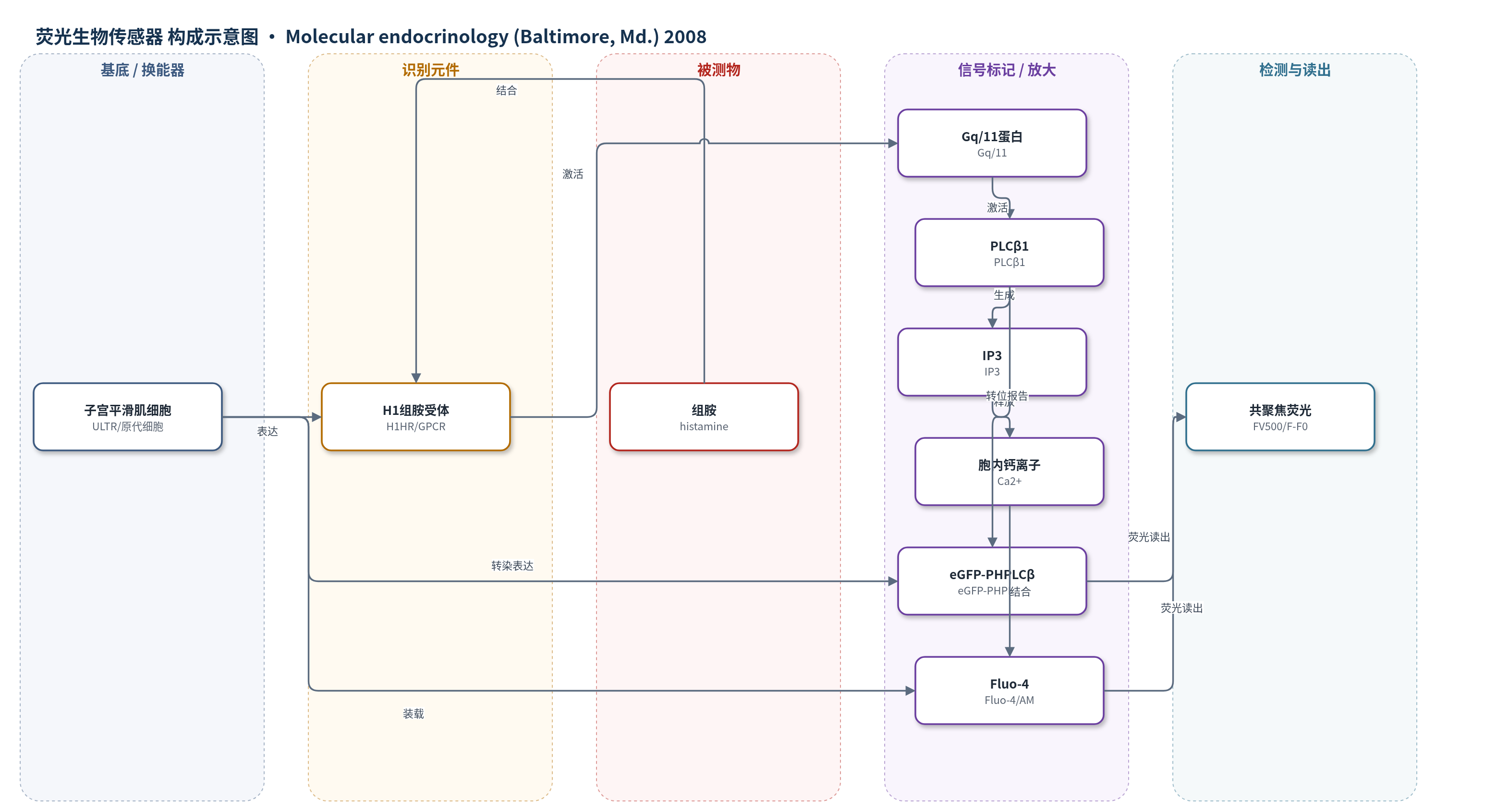
点击图片查看大图 · 依据论文自动绘制
传感器类型
荧光生物传感器
检测对象
肌醇1,4,5-三磷酸(IP3)、胞内钙离子([Ca2+]i);样品基质:人子宫平滑肌细胞(ULTR 细胞系、原代人子宫平滑肌细胞)
检测原理
组胺与细胞膜上的 H1 组胺受体结合后,激活 Gq/11 蛋白并进一步激活磷脂酶 Cβ1(PLCβ1)。PLCβ1 水解膜磷脂酰肌醇 4,5-二磷酸(PIP2),生成肌醇 1,4,5-三磷酸(IP3)和二酰甘油(DAG);IP3 作用于内质网受体,促使胞内 Ca2+ 释放。eGFP-PHPLCβ 的 PH 域在静息时结合膜 PIP2,PLC 激活后 PIP2 消耗使探针从膜转位至胞质,共聚焦荧光变化反映 IP3/PLC 活性;Fluo-4 与 Ca2+ 结合后荧光增强,反映 [Ca2+]i。组胺浓度升高时,IP3 和 Ca2+ 信号增强,呈现浓度依赖性。
检测灵敏度
EC50: 977 ± 50 nM([Ca2+]i);EC50: 6.1 ± 1.2 μM(eGFP-PHPLCβ IP3 转位)
效应效果
该荧光检测具有良好受体亚型选择性:H1 拮抗剂苯海拉明完全抑制组胺诱导的 IP3 和 Ca2+ 信号,H2 拮抗剂西咪替丁无影响。在 ULTR 细胞中,最大组胺脉冲后 R2/R1 反应降低约 54%(Fluo-4)和 60%(eGFP-PHPLCβ);原代子宫平滑肌细胞中分别降低 58% 和 46%。脱敏可在 10–15 min 内恢复。显性负性 GRK2 和 anti-GRK2 siRNA 均阻止脱敏,GRK3/5/6 无作用;原代细胞中 anti-GRK2 siRNA 处理后 R2 反应为 R1 的 113±7%。作者认为 GRK2 是 H1 受体急性脱敏的关键调控因子,可能有助于理解早产机制。
传感器的构成
- 细胞基质:ULTR 人子宫平滑肌细胞或原代人子宫平滑肌细胞,承载 H1 受体并作为检测平台
- 识别元件:H1 组胺受体(H1HR,GPCR),特异性结合组胺(histamine)
- 信号转导元件:Gq/11 蛋白与磷脂酶 Cβ1(PLCβ1),将受体激活转化为 IP3 生成
- 荧光换能探针:eGFP-PHPLCβ(PH 域融合增强绿色荧光蛋白),结合膜 PIP2,PLC 激活后转位至胞质以报告 IP3/PLC 活性
- 钙指示剂:Fluo-4/Fluo-4-AM,结合胞内 Ca2+ 后荧光增强,报告 [Ca2+]i
- 读出系统:Olympus FV500 扫描激光共聚焦显微镜,488 nm 激发并采集 F/F0 荧光变化
中文摘要
组胺可刺激子宫收缩,但子宫组胺受体信号调控机制尚不清楚。本研究在人子宫平滑肌 ULTR 细胞系和原代人子宫平滑肌细胞中,利用肌醇 1,4,5-三磷酸(IP3)荧光生物传感器 eGFP-PHPLCβ 和钙敏感染料 Fluo-4,检测组胺刺激的 Gq/11 偶联 H1 组胺受体信号。结果显示,组胺引起浓度依赖性的 IP3 生成和胞内钙升高,H1 受体拮抗剂苯海拉明完全抑制这些反应,H2 受体拮抗剂西咪替丁无影响。通过表达显性负性 G 蛋白偶联受体激酶(GRK)或转染特异性 siRNA 发现,抑制 GRK2 可阻止 H1 受体脱敏,而 GRK3、GRK5 或 GRK6 无此作用。数据表明,组胺通过 H1 受体激活磷脂酶 C 信号,GRK2 招募是人子宫平滑肌中 H1 受体信号调控的关键机制,可为早产等子宫平滑肌失调疾病提供机制依据。
英文摘要
Histamine stimulates uterine contraction; however, little is known regarding the mechanism or regulation of uterine histamine receptor signaling. Here we investigated the regulation of Galpha(q/11)-coupled histamine receptor signaling in human myometrial smooth muscle cells using the inositol 1,4,5-trisphosphate biosensor pleckstrin homology domain of phospholipase-delta1 tagged to enhanced green fluorescent protein and the Ca(2+)-sensitive dye Fluo-4. Histamine addition caused concentration-dependent increases in inositol 1,4,5-trisphosphate and [Ca(2+)](i) in the ULTR human uterine smooth muscle cell line and primary human myometrial cells. These effects were completely inhibited by the H(1) histamine receptor antagonist, diphenhydramine, and were unaffected by the H(2) histamine receptor antagonist, cimetidine. ULTR and primary myometrial cells were transfected with either dominant-negative G protein-coupled receptor kinases (GRKs) or small interfering RNAs targeting specific GRKs to assess the roles of this protein kinase family in H(1) histamine receptor desensitization. Dominant-negative GRK2, but not GRK5 or GRK6, prevented H(1) histamine receptor desensitization. Similarly, transfection with short interfering RNAs (that each caused >70% depletion of the targeted GRK) for GRK2, but not GRK3 or GRK6, also prevented H(1) histamine receptor desensitization. Our data suggest that histamine stimulates phospholipase C-signaling in myometrial smooth muscle cells through H(1) histamine receptors and that GRK2 recruitment is a key mechanism in the regulation of H(1) histamine receptor signaling in human uterine smooth muscle. These data provide insights into the in situ regulation of this receptor subtype and may inform pathophysiological functioning in preterm labor and other conditions involving uterine smooth muscle dysregulation.