组成图示
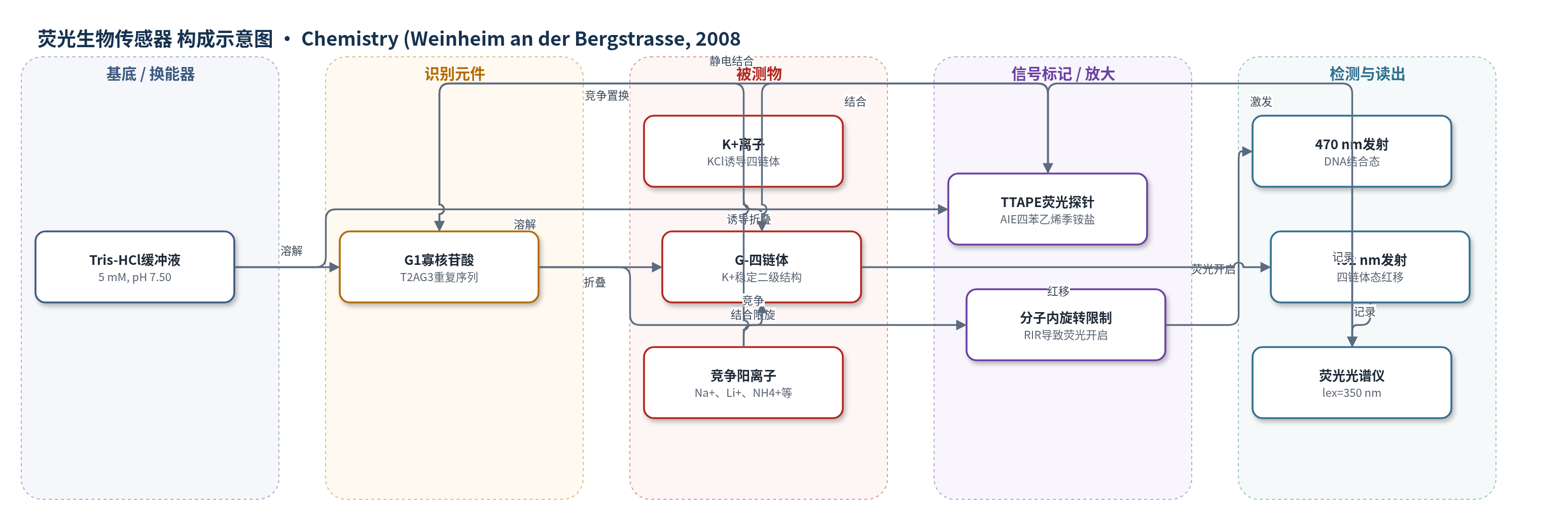
点击图片查看大图 · 依据论文自动绘制
传感器类型
荧光生物传感器
检测对象
G-四链体(G-quadruplex)、钾离子(K+)、DNA折叠过程(G1 folding);样品基质:5 mM Tris-HCl 缓冲液(pH 7.50)水溶液
检测原理
TTAPE 为水溶性 AIE 四苯乙烯季铵盐,在稀水溶液中因苯环绕中心双键自由旋转而几乎不发光。当带正电的 TTAPE 通过静电作用结合带负电的 G1 寡核苷酸时,分子内旋转受限(RIR),非辐射衰减被阻断,470 nm 荧光开启。加入 K+ 后,K+ 进入 G-四联体中心并诱导 G1 折叠为 K+-稳定 G-四链体;TTAPE 的 TPE 核心与端部 G-四联体几何匹配并堆叠,铵基团与沟槽相互作用,使发射峰红移至 492 nm。竞争阳离子(Na+、Li+、NH4+、Mg2+、Ca2+)可置换 TTAPE 或改变四链体构象,使 492 nm 信号减弱或关闭。因此荧光强度与红移可反映 G-四链体形成及 K+ 存在,无需 DNA 预标记。
检测灵敏度
LOD: approximately 0.5 mm of G1 (PAGE)
效应效果
TTAPE 对 K+-稳定 G-四链体亲和力高,ITC 得 Kb=2.4×10^5 M^-1、ΔG°=-7.3 kcal mol^-1;Na+、Li+、NH4+、Mg2+、Ca2+ 均使 492 nm 发射减弱。K+ 存在下加入 12 倍过量 Na+,492 nm 光谱轮廓与 CD 不变,说明 K+ 四链体更稳定。C1 杂交解开四链体并淬灭 492 nm,C2 保留 492 nm 并增强约 400 nm。PAGE 染色 5 min 可显示 G1,检测约 0.5 mm G1,优于 EB 30 min 且背景低。时间分辨荧光得折叠平均时间常数 116 s,约 5 min 完成,可用于高通量四链体靶向药物筛选。
传感器的构成
- 检测介质:5 mM Tris-HCl 缓冲液(pH 7.50),提供水相反应与荧光读出环境
- 荧光探针/信号标记物:TTAPE(1,1,2,2-tetrakis[4-(2-triethylammonioethoxy)phenyl]ethene tetrabromide),AIE 四苯乙烯季铵盐,结合 DNA 后限制分子内旋转并产生荧光
- 识别元件:G1 寡核苷酸(5'-GGGTTAGGGTTAGGGTTAGGG-3'),模拟人端粒 T2AG3 重复序列,可折叠为 G-四链体
- 结构诱导剂:K+(KCl),诱导并稳定 G1 形成 K+-稳定 G-四链体,使 TTAPE 发射红移至 492 nm
- 竞争/干扰离子:Na+、Li+、NH4+、Mg2+、Ca2+,用于验证选择性,竞争结合 DNA 或改变四链体构象
- 荧光读出:350 nm 激发,470 nm(DNA 结合态)与 492 nm(G-四链体态)发射监测
中文摘要
分子信标等生物传感过程常需对生物分子进行共价标记,操作繁琐。本文报道一种无标记 DNA 检测体系,采用具有聚集诱导发光(AIE)特性的简单染料作为荧光生物探针。1,1,2,2-四[4-(2-溴乙氧基)苯基]乙烯在水中不发光,但聚集后强发光;其季铵盐 TTAPE(1,1,2,2-四[4-(2-三乙基铵乙氧基)苯基]乙烯四溴化物)在水溶液中因分子内旋转受阻而呈现 AIE 效应。TTAPE 通过静电吸引结合富鸟嘌呤 DNA 链 G1 后,分子内旋转受限,荧光开启;加入竞争性阳离子后染料脱离,荧光关闭。TTAPE 可作为聚丙烯酰胺凝胶电泳(PAGE)后染色剂快速显示 G1 条带,并对 G1 的 G-四链体二级结构具有高亲和力。G1 折叠过程中发射峰发生红移,使 G-四链体可与其他 DNA 结构光谱区分。TTAPE 的 AIE 特性使其无需在 DNA 上预接荧光基团即可实时监测 G1 折叠过程,并可作为 K+ 离子生物传感器,因其对 K+ 诱导和稳定的四链体结构具有特异性。
英文摘要
Biosensing processes such as molecular beacons require non-trivial effort to covalently label or mark biomolecules. We report here a label-free DNA assay system with a simple dye with aggregation-induced emission (AIE) characteristics as the fluorescent bioprobe. 1,1,2,2-Tetrakis[4-(2-bromoethoxy)phenyl]ethene is nonemissive in solution but becomes highly emissive when aggregated. This AIE effect is caused by restriction of intramolecular rotation, as verified by a large increase in the emission intensity by increasing viscosity and decreasing temperature of the aqueous buffer solution of 1,1,2,2-tetrakis[4-(2-triethylammonioethoxy)phenyl]ethene tetrabromide (TTAPE). When TTAPE is bound to a guanine-rich DNA strand (G1) via electrostatic attraction, its intramolecular rotation is restricted and its emission is turned on. When a competitive cation is added to the G1 solution, TTAPE is detached and its emission is turned off. TTAPE works as a sensitive poststaining agent for poly(acrylamide) gel electrophoresis (PAGE) visualization of G1. The dye is highly affinitive to a secondary structure of G1 called the G-quadruplex. The bathochromic shift involved in the G1 folding process allows spectral discrimination of the G-quadruplex from other DNA structures. The strong affinity of TTAPE dye to the G-quadruplex structure is associated with a geometric fit aided by the electrostatic attraction. The distinct AIE feature of TTAPE enables real-time monitoring of folding process of G1 in the absence of any pre-attached fluorogenic labels on the DNA strand. TTAPE can be used as a K+ ion biosensor because of its specificity to K+-induced and -stabilized quadruplex structure.