组成图示
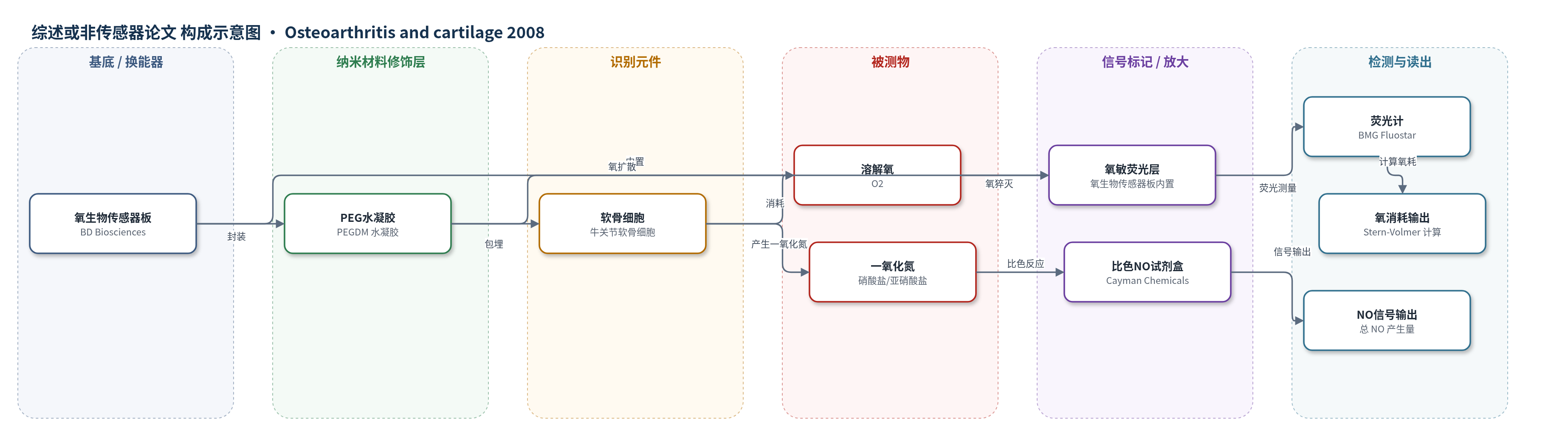
点击图片查看大图 · 依据论文自动绘制
传感器类型
综述或非传感器论文
检测对象
氧(O2,PEG水凝胶培养体系/凝胶中心)、一氧化氮(NO,以硝酸盐/亚硝酸盐形式,培养上清)
检测原理
本文并非报道新型传感器,而是使用氧生物传感器板和比色 NO 试剂盒评估软骨细胞代谢。氧生物传感器板中,氧敏感荧光材料的荧光受溶解氧猝灭:氧浓度越高,荧光强度越低;软骨细胞在 PEG 水凝胶中消耗 O2,使局部氧浓度下降,荧光信号随之变化。通过 0 h 与 48 h 荧光测量,按 Stern-Volmer 方程换算氧浓度,得到氧消耗量,从而反映细胞代谢活性。NO 检测采用比色法:细胞产生的 NO 在培养上清中转化为硝酸盐/亚硝酸盐,与试剂盒试剂发生显色反应,吸光度随总 NO 量增加而增加。机械加载通过改变 PEG 水凝胶交联密度和细胞变形,影响 NO 产生、蛋白聚糖合成和细胞增殖。
检测灵敏度
原文未报告 LOD、线性范围、灵敏度斜率或检测相关系数。
效应效果
文中未报告传感器选择性、抗干扰、稳定性、重现性、加标回收率或与 ELISA/HPLC/qPCR 的对比。实验显示,三种交联密度 PEG 水凝胶中软骨细胞活力均高于 70%,不同加载条件下无显著差异。氧生物传感器检测显示,48 h 培养后凝胶中心氧浓度由 164±7 mM 降至 20±10、20±8 和 23±9 mM,下降约 88%,P<0.001,不同交联密度间无显著差异。统计分析显示,静态加载下总 NO 与细胞增殖正相关(R=0.5,P<0.05),与 PG 合成无显著相关(R=0.1,P=0.67);0.3 Hz 动态加载下 NO 与 CP 正相关(R=0.54,P<0.01),NO 与 PG 合成正相关(R=0.73,P<0.01);1 Hz 下无显著相关。作者认为高细胞密度造成低氧环境,使 NO 在特定加载条件下对软骨细胞生物活性呈促进作用。
传感器的构成
- 基底/换能器:96-well oxygen biosensor plate(BD Biosciences),承载 PEG 水凝胶并作为氧浓度检测基底
- 信号层:氧生物传感器板内置氧敏荧光体系(原文未列具体材料),用于将溶解氧浓度转换为荧光信号
- 读出设备:BMG Labtech Fluostar Optima 荧光计,测量 0 h 与 48 h 荧光并按 Stern-Volmer 方程计算氧浓度
- 辅助检测:Colorimetric Total Nitric Oxide Assay Kit(Cayman Chemicals),比色检测培养上清中硝酸盐/亚硝酸盐以反映总 NO 产生
中文摘要
机械加载是调控软骨细胞的重要因素,但软骨细胞力学转导机制仍不清楚。本研究以聚乙二醇(PEG)水凝胶为模型,通过改变凝胶交联密度(rx)控制细胞变形,研究软骨细胞响应。将牛关节软骨细胞(50×10^6 个/mL)包埋于三种交联密度 PEG 水凝胶中,施加静态 15% 应变或动态 0.3 Hz、1 Hz(15% 幅值)加载 48 h。用共聚焦显微镜观察细胞变形,并检测总一氧化氮(NO)产生、蛋白聚糖(PG)合成(35SO4^2- 掺入)和细胞增殖(CP,[3H] 胸苷掺入),同时用氧生物传感器检测氧消耗。结果显示,交联密度升高使含水量降低、压缩模量升高、细胞变形增大。细胞响应受加载方式和交联密度共同影响:静态应变下 NO 不变,低交联密度下 CP 和 PG 合成受抑制,高交联密度下受促进;动态加载对 NO、CP 和 PG 合成无影响或抑制。静态和 0.3 Hz 动态加载下,NO 与 CP 和/或 PG 合成相关,作者归因于高细胞密度造成的低氧环境。研究证明凝胶交联密度和加载条件影响 NO、CP 和 PG 合成;低氧和特定加载条件下,NO 可能促进软骨细胞生物活性。
英文摘要
OBJECTIVE: Mechanical loading is an important regulator of chondrocytes; however, many of the mechanisms involved in chondrocyte mechanotransduction still remain unclear. Here, poly(ethylene glycol) (PEG) hydrogels are proposed as a model system to elucidate chondrocyte response due to cell deformation, which is controlled by gel crosslinking (rho(x)).
METHODS: Bovine articular chondrocytes (50 x 10(6)cells/mL) were encapsulated in gels with three rho(x)s and subjected to static (15% strain) or dynamic (0.3 Hz or 1 Hz, 15% amplitude strain) loading for 48 h. Cell deformation was examined by confocal microscopy. Cell response was assessed by total nitric oxide (NO) production, proteoglycan (PG) synthesis ((35)SO(4)(2-)-incorporation) and cell proliferation (CP) ([(3)H]-thymidine incorporation). Oxygen consumption was assessed using an oxygen biosensor.
RESULTS: An increase in rho(x) led to lower water contents, higher compressive moduli, and higher cell deformations. Chondrocyte response was dependent on both loading regime and rho(x). For example, under a static strain, NO was not affected, while CP and PG synthesis were inhibited in low rho(x) and stimulated in high rho(x). Dynamic loading resulted in either no effect or an inhibitory effect on NO, CP, and PG synthesis. Overall, our results showed correlations between NO and CP and/or PG synthesis under static and dynamic (0.3 Hz) loading. This finding was attributed to the hypoxic environment that resulted from the high cell-seeding density.
CONCLUSION: This study demonstrates gel rho(x) and loading condition influence NO, CP, and PG synthesis. Under a hypoxic environment and certain loading conditions, NO appears to have a positive effect on chondrocyte bioactivity.