组成图示
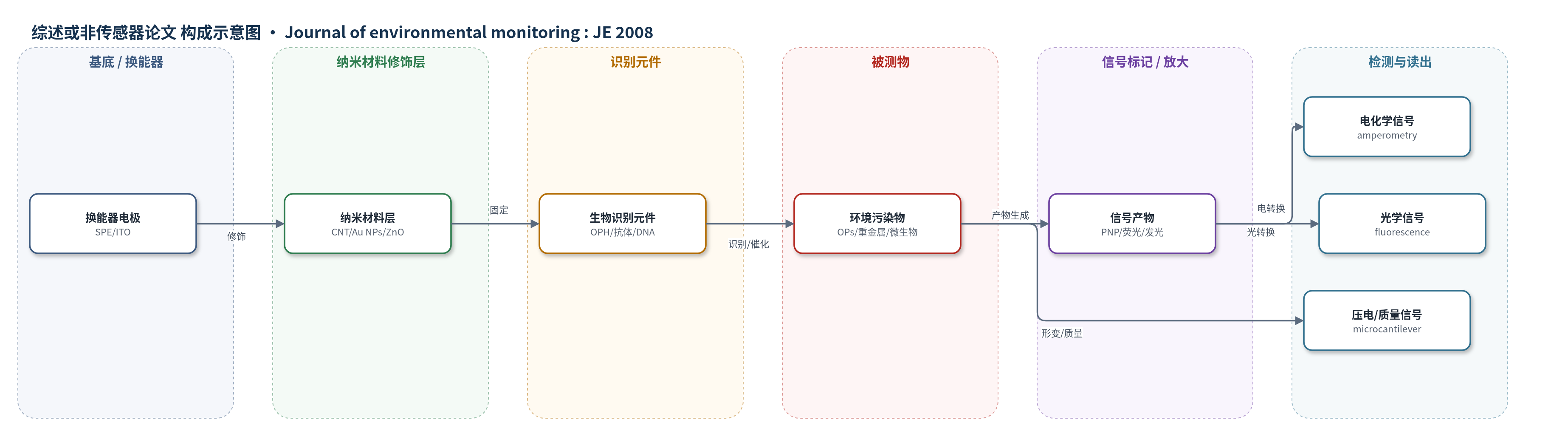
点击图片查看大图 · 依据论文自动绘制
传感器类型
综述或非传感器论文
检测对象
有机磷神经毒剂(organophosphate nerve agents, OPs)、重金属离子(heavy metal ions)、有机污染物(organic contaminants,如PCBs、PAHs、PNP、EDCs)、病原微生物及其毒素(pathogenic microorganisms and toxins);样品基质包括环境水样、土壤、空气、油漆、血清等。
检测原理
综述涵盖多种换能机制:酶、抗体、DNA探针或全细胞作为识别元件,与目标物结合或催化后,引起电活性产物、pH、质量、荧光、发光或阻抗变化,再由电化学、光学或压电换能器转换为可测信号。以OPH有机磷传感器为例,OPH催化有机磷水解生成对硝基酚(PNP)或硫醇,产物在电极上发生安培氧化,电流随有机磷浓度升高;同时水解释放质子,可用电位法监测pH变化。AChE抑制型则通过底物水解产物减少或pH变化反映酶活性抑制。DNAzyme可催化切割底物并调控金纳米颗粒聚集,产生颜色变化;全细胞传感器通过报告基因表达产生荧光或发光信号。
检测灵敏度
LOD: 10^-7 M(OPH微悬臂梁);LOD: 0.02 ppb(Zn2+,apo-AP);LOD: 90 pM(Microcystis基因);LOD: 15 ng/L(microcystin);LOD: 10^5 cfu/mL、10^7 pfu/mL、10 ng/mL(多分析物荧光免疫阵列);LOD: 100 cells/mL(竞争性PCR)
效应效果
综述认为生物传感器相比传统色谱和光谱方法更便携、快速、实时,并可提供选择性响应,适合环境安全监测。具体性能方面,Ebola病毒免疫传感器灵敏度比ELISA高24倍;微囊藻毒素传感器检出限15 ng/L,低于WHO限值1 mg/L;Zn2+检测达0.02 ppb,可与GF-AAS和ICP-MS竞争;全细胞重金属传感器可达纳摩尔至飞摩尔水平,与GF-AAS、ICP-MS和ASV相当或更低。双安培-电位传感器可提高信息量并减少假阳性/假阴性;DNAzyme-金纳米颗粒传感器可用于油漆中铅的比色检测;ZnO纳米平台增强荧光,有助于区分炭疽杆菌。作者指出复杂基质干扰、寿命和现场适用性仍是挑战。
传感器的构成
- 基底/换能器电极:丝网印刷电极(SPE)、ITO光纤、碳糊电极等,提供导电或光学换能界面
- 纳米材料修饰层:碳纳米管(CNT)、金纳米颗粒(Au NPs)、ZnO纳米结构等,增强电子转移或荧光
- 识别元件:OPH、AChE、抗体、DNA探针、DNAzyme、全细胞等,实现特异性识别
- 信号标记物:PNP、硫醇、荧光类似物、报告基因产物等,产生电活性或光学信号
中文摘要
环境安全是人类福祉的基本要求,但仍是全球重大挑战。除减少或消除有毒排放外,还需发展灵敏、选择性强的技术以检测和监测环境污染物,从而有效修复。生物传感器因具有集成化特点,可便携、实时、快速、灵敏且选择性地响应,非常适合环境监测与检测。本综述讨论与环境监测和检测最相关的生物传感器开发主要概念,并回顾和记录近年来生物传感器研发的趋势与挑战,重点涉及有机磷神经毒剂、重金属、有机污染物、病原微生物及其毒素等环境意义物种的检测。文章特别关注在环境安全领域最具应用前景的趋势,最后指出未来环境安全生物传感器研究可能的发展方向。
英文摘要
Environmental security is one of the fundamental requirements of our well being. However, it still remains a major global challenge. Therefore, in addition to reducing and/or eliminating the amounts of toxic discharges into the environment, there is need to develop techniques that can detect and monitor these environmental pollutants in a sensitive and selective manner to enable effective remediation. Because of their integrated nature, biosensors are ideal for environmental monitoring and detection as they can be portable and provide selective and sensitive rapid responses in real time. In this review we discuss the main concepts behind the development of biosensors that have most relevant applications in the field of environmental monitoring and detection. We also review and document recent trends and challenges in biosensor research and development particularly in the detection of species of environmental significance such as organophosphate nerve agents, heavy metals, organic contaminants, pathogenic microorganisms and their toxins. Special focus will be given to the trends that have the most promising applications in environmental security. We conclude by highlighting the directions towards which future biosensors research in environmental security sector might proceed.