组成图示
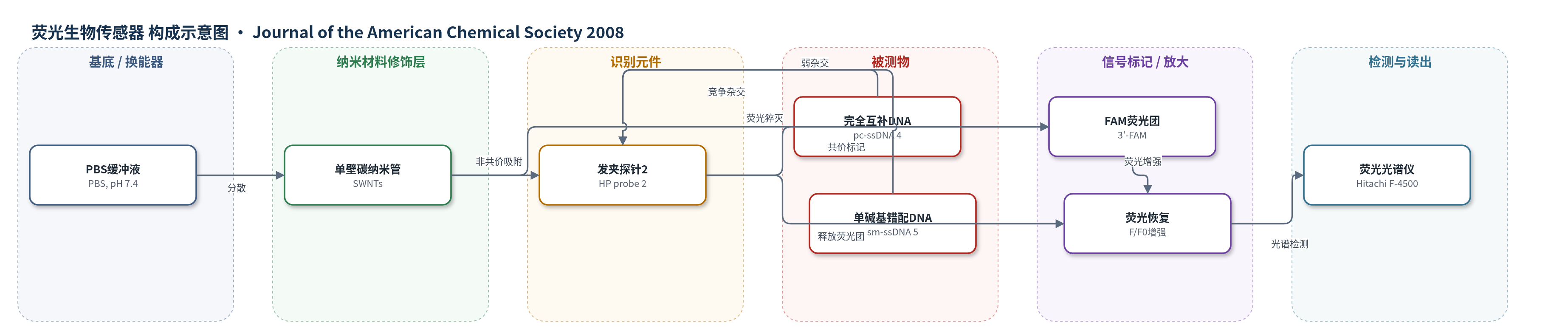
点击图片查看大图 · 依据论文自动绘制
传感器类型
荧光生物传感器
检测对象
完全互补单链DNA(pc-ssDNA, target 4)、单碱基错配单链DNA(sm-ssDNA, target 5);样品基质为PBS缓冲液及含DNA、BSA、氨基酸的混合液
检测原理
发夹结构寡核苷酸探针2的3′端标记FAM。在无目标时,单链寡核苷酸通过碱基与SWNT侧壁之间的π-π堆积非共价缠绕在SWNT表面,SWNT作为纳米支架和纳米淬灭剂,使FAM荧光被猝灭(50–200 nM探针下猝灭率>98%)。加入完全互补目标DNA后,目标与探针发生竞争杂交,使探针从SWNT表面解离或构象改变,FAM远离SWNT,荧光恢复。荧光增强幅度随目标浓度增加而增大,在15.0–750 nM范围内响应。荧光各向异性与透析实验表明杂交主要发生在溶液中,而非纳米管表面。
检测灵敏度
LOD: 4.0 nM;响应浓度范围: 15.0–750 nM
效应效果
在6倍过量完全互补目标下,SWNT存在时探针1–3的信背比分别为13.7、15.4和16.2,无SWNT时分别为5.6、1.4和1.1。对单碱基错配目标5,MB 1的荧光增强为完全互补的82%,2-SWNT为64%;选择性系数R由MB的0.764降至2-SWNT的0.472,表明错配区分能力提高。加入100 nM DNA、1.0 µg/mL BSA和10 µM氨基酸后响应曲线几乎重合,仅背景略增。2-SWNT在60 °C以上荧光变化小,75 °C下S/B为7.8,而MB 1为1.2。作者认为其可替代传统MB,用于核酸研究、分子传感和实时PCR。
传感器的构成
- 纳米淬灭/支架层:单壁碳纳米管(SWNTs),非共价吸附寡核苷酸并作为纳米淬灭剂猝灭FAM荧光
- 识别元件:发夹结构寡核苷酸探针2(HP probe 2),含19碱基环和6碱基茎,用于识别互补DNA
- 信号标记物:荧光素(FAM),标记于探针3′端,杂交后荧光恢复
- 反应介质:磷酸盐缓冲液(PBS,137 mM NaCl、2.5 mM Mg2+、10 mM Na2HPO4、2.0 mM KH2PO4,pH 7.4),维持杂交与荧光测量
- 对照探针:分子信标1(MB 1,Dabcyl/FAM双标记)和线性探针3(LN probe 3,FAM),用于比较信背比与选择性
中文摘要
本文报道了一种由单壁碳纳米管(SWNT)与寡核苷酸自组装形成的新型荧光猝灭复合物,并证明其可在均相溶液中一步识别和检测特定DNA序列。该复合物的关键组分是发夹结构荧光寡核苷酸,使SWNT同时充当寡核苷酸的“纳米支架”和荧光团的“纳米淬灭剂”。因此,该碳纳米管复合物代表一类与有机淬灭剂显著不同的通用荧光淬灭剂,有望在分子工程和生物传感器开发中应用。目标DNA与SWNT竞争结合寡核苷酸,使荧光信号相对于无目标时增强,同时产生明显荧光猝灭。与传统分子信标的环-茎构型不同,该新型荧光寡核苷酸只需标记一个荧光团,且发射测量背景干扰很小,从而显著提高信背比,同时保持DNA结合特异性。作者采用热力学分析和荧光各向异性测量研究相互作用机制,结果表明MB/SWNT探针可作为核酸研究和分子传感的优良平台。
英文摘要
We report an effective, novel self-assembled single-wall carbon nanotube (SWNT) complex with an oligonucleotide and demonstrate its feasibility in recognizing and detecting specific DNA sequences in a single step in a homogeneous solution. The key component of this complex is the hairpin-structured fluorescent oligonucleotide that allows the SWNT to function as both a "nanoscaffold" for the oligonucleotide and a "nanoquencher" of the fluorophore. Given this functionality, this carbon nanotube complex represents a new class of universal fluorescence quenchers that are substantially different from organic quenchers and should therefore have many applications in molecular engineering and biosensor development. Competitive binding of a DNA target and SWNTs with the oligonucleotide results in fluorescence signal increments relative to the fluorescence without a target as well as in marked fluorescence quenching. In contrast to the common loop-and-stem configuration of molecular beacons (MBs), this novel fluorescent oligonucleotide needs only one labeled fluorophore, yet the emission can be measured with little or no background interference. This property greatly improves the signal-to-background ratio compared with those for conventional MBs, while the DNA-binding specificity is still maintained by the MB. To test the interaction mechanisms of the fluorescent oligonucleotide with SWNTs and target DNA, thermodynamic analysis and fluorescence anisotropy measurements, respectively, were applied. Our results show that MB/SWNT probes can be an excellent platform for nucleic acid studies and molecular sensing.