组成图示
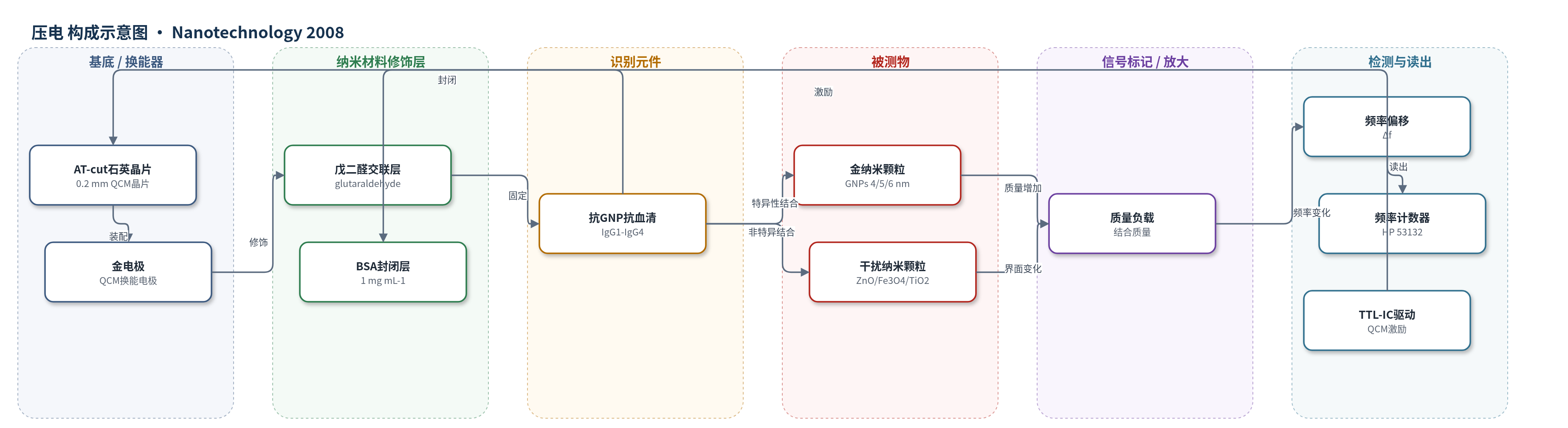
点击图片查看大图 · 依据论文自动绘制
传感器类型
压电(QCM)生物传感器
检测对象
金纳米颗粒(gold nanoparticles, GNPs,4/5/6 nm)、氧化锌纳米颗粒(ZnO)、四氧化三铁纳米颗粒(Fe3O4)、二氧化钛纳米颗粒(TiO2);样品基质:PBS溶液/流动池样品
检测原理
该传感器以抗体-抗原识别为基础。抗金纳米颗粒抗血清经戊二醛交联固定在QCM金电极表面,BSA封闭非特异性位点。当样品中的GNPs流过时,抗血清按粒径特异性结合4、5或6 nm GNPs,结合质量使石英晶片表面质量增加。根据压电QCM的Sauerbrey关系,表面质量增加导致共振频率下降,频率偏移量与结合GNPs质量近似成正比,因此可随GNPs浓度变化而改变。该方法无酶或荧光放大,灵敏度受压电换能器本底限制;ZnO、Fe3O4等纳米颗粒可能通过非特异性相互作用引起额外频率偏移。
检测灵敏度
LOD: 5.5 ng;灵敏度: 10.3 ± 0.9 ng Hz−1
效应效果
抗血清对GNPs粒径选择性明显:ELISA峰位为4、5、5、6 nm,峰宽2.7、1.6、3.1、2.0 nm;QCM峰位为4.4、5.2、5.4、5.9 nm,峰宽2.1、1.8、3.7、2.8 nm。0.1 mM 5 nm GNPs引起21.6 Hz偏移,3.5 nm为5.3 Hz,8 nm为0.8 Hz,12和37 nm无响应。BSA与1 mM ZnO单独注入无频率变化,但ZnO/Fe3O4与GNPs混合时出现额外下移,提示非特异结合。电极可用0.1 N HCl再生约5次,重复再生会降低结合能力并造成频率响应差异。作者认为该平台首次实现便捷、经济的纳米颗粒现场检测。
传感器的构成
- 基底/换能器:AT-cut石英晶片(0.2 mm)与金电极,提供压电振荡和质量敏感界面
- 交联修饰层:2.5%戊二醛(glutaraldehyde),用于固定抗血清
- 识别元件:抗金纳米颗粒抗血清(anti-GNP antiserum,IgG1/IgG2/IgG3/IgG4),特异性结合4/5/6 nm GNPs
- 封闭层:牛血清白蛋白(BSA,1 mg mL−1),封闭非特异性结合位点
- 样品流路:流动池(flow cell)与PBS流动,实现流注入分析
- 读出系统:TTL-IC驱动与频率计数器(Agilent HP 53132),监测QCM频率变化
中文摘要
随着纳米颗粒在环境中的存在及其对生物系统的潜在毒性影响受到广泛关注,现场检测纳米颗粒已成为一项迫切需求。本文构建了一种电极表面修饰抗体的压电生物传感器。抗血清能够以高选择性和高灵敏度结合金纳米颗粒(GNPs)。根据所包被抗血清的不同,该生物传感器可分别检测4、5或6 nm的GNPs。对5 nm GNPs的检测灵敏度为10.3±0.9 ng Hz−1,低检出限为5.5 ng。石英晶体微天平(QCM)传感器还可检测GNPs及其他类型纳米颗粒,如ZnO或Fe3O4。本研究首次提供了一种便捷、经济的纳米颗粒检测平台,为环境样品中纳米颗粒的直接监测提供了新策略。
英文摘要
Since the existence of nanoparticles in our environment has already attracted considerable attention due to their possible toxic impact on biological systems, the field detection of nanoparticles is becoming a technology that will be much in need. We have constructed a piezoelectric sensor with an antibody-coated electrode. The antiserum can bind gold nanoparticles with a high degree of selectivity and sensitivity. The biosensor thus constructed can detect 4, 5, or 6 nm gold nanoparticles (GNPs) depending on the coated antiserum. The sensitivity for the detection of 5 nm GNPs was 10.3 ± 0.9 ng Hz(-1), with the low limit of detection at 5.5 ng. A quartz crystal microbalance (QCM) sensor was capable of detecting GNPs and other types of nanoparticle, such as ZnO, or Fe(3)O(4). The current study provides, for the first time, a platform for detecting nanoparticles in a convenient, economical manner.