组成图示
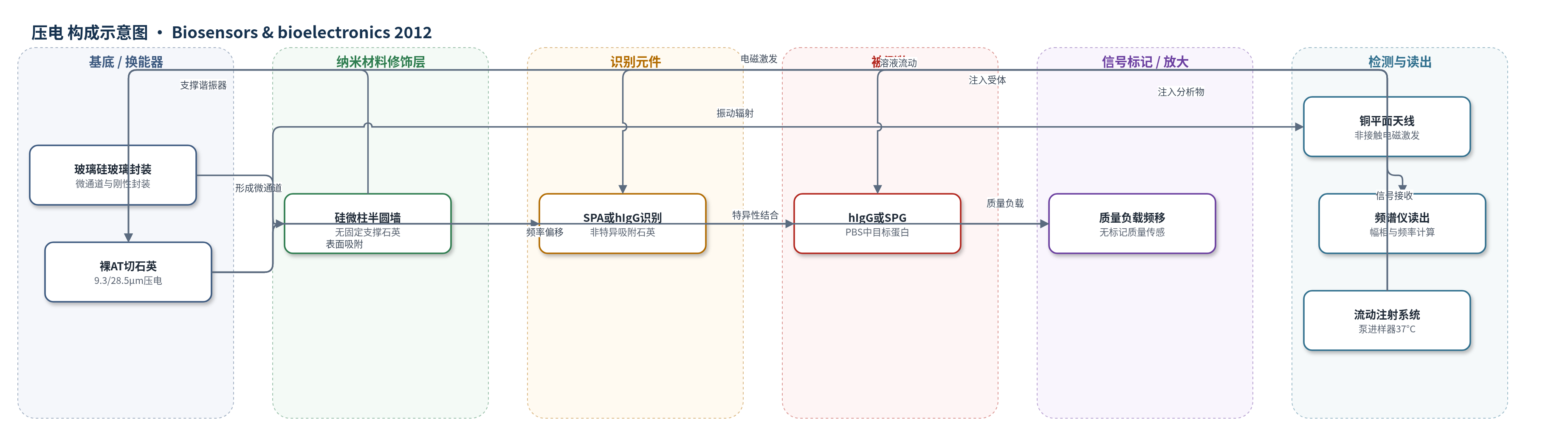
点击图片查看大图 · 依据论文自动绘制
传感器类型
压电(QCM)生物传感器
检测对象
人免疫球蛋白 G(human immunoglobulin G, hIgG)、链球菌蛋白 G(streptococcal protein G, SPG);样品基质为磷酸盐缓冲液(PBS)
检测原理
RAMNE-Q 基于压电石英晶体微天平的质量传感机制。铜平面天线在芯片上下两侧产生面内电磁场,通过逆压电效应非接触激发裸 AT 切石英的厚度剪切振动;石英振动又通过压电效应辐射电磁场,由接收天线检测。识别蛋白(SPA 或 hIgG)非特异性吸附于石英表面,目标蛋白(hIgG 或 SPG)与识别蛋白特异性结合后,界面吸附质量增加,使有效谐振质量增大,共振频率按 Sauerbrey 关系下降。器件采用 9.3 μm 薄石英、高频(约 178 MHz 基频或 58 MHz 三次泛音)、无电极和低结构阻尼支撑,提高质量灵敏度,基线波动小于 2 ppm,对应 0.01 ng/mm2。结合过程呈指数趋近,指数系数 α=kaCt+kd 与目标浓度相关,因此可通过频率变化或 α 值进行定量和亲和力分析,无需标记或蛋白修饰。
检测灵敏度
可检测浓度: 1 ng/mL hIgG;hIgG 浓度测试范围: 0.001–10 μg/mL;基线质量灵敏度: 0.01 ng/mm2;Q 值: 约 1500
效应效果
RAMNE-Q 在 PBS 流动中基线波动小于 2 ppm,质量灵敏度 0.01 ng/mm2,Q 值约 1500,信噪比高。NaCl 浓度升高会降低共振幅值,但低于 300 mM 时影响不显著。检测 hIgG 时,10 ng/mL 特异性结合频率变化约 20 kHz,非特异性结合仅 0.05 kHz,选择性良好;1 ng/mL hIgG 可检测。芯片经 piranha 溶液和超纯水清洗后可重复使用,多次结果一致。与常规 QCM/SPR 相比,无需电极和复杂表面修饰,总检测时间约 2 h,短于传统方法制备芯片需 2–3 h。由频率响应估算 SPG 分子量 22.6 kDa,接近理论值 21.6 kDa;ka=1.52×10^4 M^-1 s^-1、kd=5.84×10^-4 s^-1、KA=2.59×10^7 M^-1,与文献一致,适用于无标记实时定量亲和力分析。
传感器的构成
- 基底/封装层:玻璃-硅-玻璃三层结构(glass-silicon-glass),硅层刻蚀微通道,玻璃层阳极键合形成刚性封装,保护薄石英并构成流路。
- 换能器层:裸 AT 切石英谐振器(AT-cut quartz resonator,9.3 或 28.5 μm 厚),作为压电剪切振动换能器,表面吸附质量引起共振频率变化。
- 支撑结构层:硅微柱和半圆形硅墙(silicon micropillars and semicircular walls),无固定支撑石英,降低结构阻尼并允许双面传感。
- 识别元件层:金黄色葡萄球菌蛋白 A(SPA)或人免疫球蛋白 G(hIgG),非特异性吸附于裸石英表面,用于捕获 SPG 或 hIgG。
- 信号标记层:无标记(label-free),不添加荧光、酶或纳米标记物,直接通过质量吸附改变频率。
- 激发/检测天线层:铜薄膜平面天线(copper film flat antennas),位于芯片上下两侧,非接触产生和接收电磁场,激发和检测石英剪切振动。
- 流路与再生层:微通道、特氟龙流池(microchannel and Teflon flow cell)及 O 形圈密封,引入/排出 PBS;piranha 溶液(30% H2O2、70% H2SO4)和超纯水用于清洗再生。
中文摘要
通过微加工方法实现了裸嵌石英谐振声学微天平(RAMNE-Q),旨在拓展石英晶体微天平(QCM)生物传感器的应用。RAMNE-Q 生物传感器由三层构成:刻蚀有微通道的硅层及上下夹持的玻璃层。厚度为 9.3 或 28.5 μm 的裸 AT 切石英谐振器置于微通道中,由硅微柱和半圆形壁支撑而不固定,并被刚性封装体包覆。铜天线用于产生和接收电磁场,在溶液流动过程中激发和检测石英振荡器的剪切振动,从而实现共振频率的非接触测量。由于谐振器隔离,即使在流动溶液中 Q 值也足够高(约 1500,170–180 MHz)。作者通过非特异性固定在石英表面的金黄色葡萄球菌蛋白 A 成功检测了磷酸盐缓冲液中 1 ng/mL 的人免疫球蛋白 G,证明了 RAMNE-Q 生物传感器的高灵敏度和高信噪比。该器件无需电极,属于免更换生物传感器,并确认了其可重复使用性。
英文摘要
A resonance acoustic microbalance with a naked-embedded quartz (RAMNE-Q) is realized by a microfabrication method, aiming at broader applications of quartz-crystal microbalance (QCM) biosensors. The RAMNE-Q biosensor consists of three layers; a silicon layer with an engraved microchannel and sandwiching glass layers. The naked AT-cut quartz resonator of 9.3 or 28.5 μm thick is located in the microchannel and supported by the silicon micropillars and semicircular walls without fixing, and it is encapsulated by the rigid body. Cupper antennas are used for generating and receiving electromagnetic fields to excite and detect the shear vibration of the quartz oscillator during the solution flow, thereby achieving the noncontact measurement of the resonance frequency. Because of the isolated resonator, the Q factor is high enough (about 1500 at 170-180 MHz) even in the flowing solution. We succeeded in detecting 1 ng/ml human immunoglobulin G in phosphate-buffered-saline solution via Staphylococcus aureus protein A immobilized nonspecifically on the quartz surfaces, demonstrating the high sensitivity and high signal-to-noise ratio of the RAMNE-Q biosensor. It does not require electrodes and is a replacement-free biosensor, and its reusability is confirmed.