组成图示
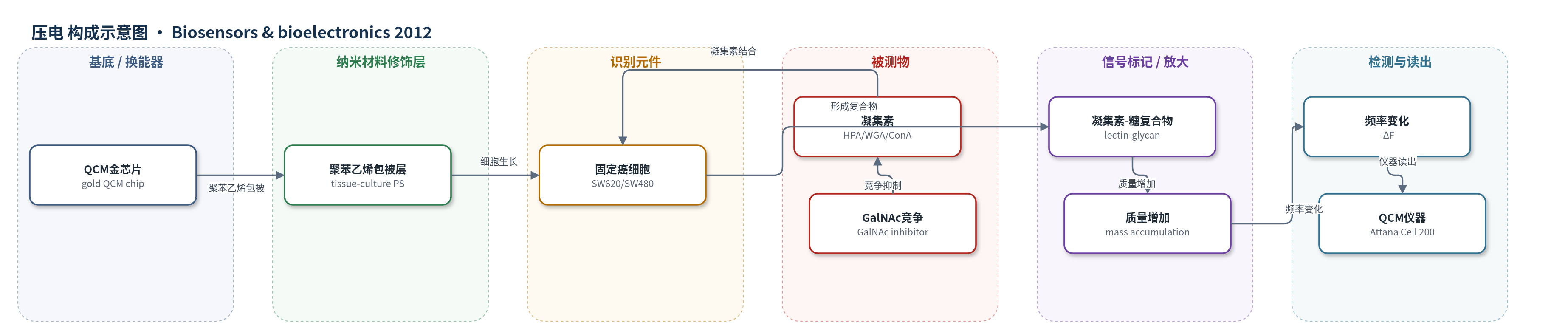
点击图片查看大图 · 依据论文自动绘制
传感器类型
压电(QCM)生物传感器
检测对象
凝集素(lectins,包括 HPA、WGA、ConA、PHA-E、RCA、UEA-1、SJA);样品基质:PBS 运行缓冲液(细胞芯片含 0.025% Tween-20,蛋白芯片另含 0.05% BSA)
检测原理
该传感器基于石英晶体微天平(QCM)的 Sauerbrey 效应:贴壁癌细胞生长在聚苯乙烯包被的金 QCM 芯片上并经甲醛固定,形成完整细胞表面识别界面。当 PBS 中注入凝集素(如 HPA、WGA、ConA)时,凝集素与细胞膜表面糖链/糖蛋白特异性结合,结合质量使晶体共振频率下降,产生 -ΔF 信号。结合相与解离相实时监测,采用考虑质量传输限制的 1:1 动力学模型拟合 kon、koff 并计算 KD。信号大小随凝集素浓度和结合量增加而增大,无酶促或核酸放大;GalNAc 可竞争抑制 HPA 结合,验证糖结合特异性。
检测灵敏度
原文未报告 LOD、线性范围、灵敏度斜率或相关系数。
效应效果
固定细胞芯片可用 10 mM glycine(pH 1.0,0.5 M NaCl)再生,约重复 20–30 次,再生后响应回到初始水平。QCM 数据以均值±SD 报告(n=6)。HPA 对 SW620 的 KD 为 118±40 nM,对 SW480 为 9.80×10^5±4300 nM;重组 HPA-His/HPA-RFP 对 SW620 的 KD 为 8.84/7.18 nM,强于天然 HPA。与固定糖蛋白芯片相比,HPA 对 SW620 细胞 KD 118 nM,对固定糖蛋白 859 nM。GalNAc 剂量依赖抑制 HPA 结合,共聚焦荧光与 QCM 趋势一致。作者认为该细胞生物传感器比平面 QCM/SPR 更接近体内环境,适用于凝集素、抗体及受体-配体研究。
传感器的构成
- 基底/换能器:金 QCM 传感器芯片(gold QCM sensor chip),提供压电换能并监测质量变化
- 修饰层:组织培养兼容聚苯乙烯(polystyrene, PS)包被层,支持贴壁细胞生长
- 识别元件:人结直肠癌细胞 SW620(转移性)或 SW480(非转移性),经 3.7% 甲醛固定,提供完整细胞表面糖蛋白/糖链位点
- 分析物结合层:植物凝集素(WGA、ConA、PHA-E、RCA、UEA-1、SJA、HPA)及重组 HPA-His/HPA-RFP,结合细胞表面碳水化合物
- 信号标记物:无外源信号标记(label-free QCM);His/RFP 为重组蛋白标签,不用于 QCM 信号读出
- 运行/再生缓冲液:PBS + 0.025% Tween-20(细胞芯片)或 PBS + 0.05% BSA + 0.025% Tween-20(蛋白芯片),用于维持环境、降低非特异结合与再生
- 读出系统:Attana Cell 100/200 QCM 仪器与 Attester/Evaluation 软件,监测频率变化(-ΔF)
中文摘要
针对实体瘤生物治疗中糖基化改变靶向策略,作者开发了一种新型细胞生物传感器,用于在更接近体内环境的全细胞表面评估凝集素与癌细胞相互作用。将转移性结直肠癌细胞 SW620 和非转移性 SW480 培养于组织培养兼容聚苯乙烯包被的生物传感器芯片表面,并置于石英晶体微天平(QCM)装置中,实时监测多种凝集素的结合动力学。罗马蜗牛凝集素(HPA)可结合侵袭性转移癌,作者制备了 His 标签和 RFP 标签重组 HPA。结果显示,HPA 对转移性 SW620 细胞的亲和力处于纳摩尔级,而对非转移性 SW480 细胞仅为微摩尔级。总体而言,该细胞生物传感器中测得的凝集素解离常数(KD)比传统 QCM/SPR 平面固定系统低约一个数量级,多处于纳摩尔范围。该细胞生物传感器可在更相关的细胞环境中研究分子相互作用,为开发靶向细胞表面的新型生物治疗策略提供工具,适用于癌症等多种疾病研究。
英文摘要
The development of biological agents for the treatment of solid tumours is an area of considerable activity. We are pursuing carbohydrate-binding proteins (lectins) in a strategy aimed at targeting cancer-associated changes in glycosylation. To evaluate lectin-cancer cell interactions we developed a novel cell biosensor in which binding events take place at the cell surface, more closely mimicking an in vivo system. Metastatic, SW620, and non-metastatic, SW480, colorectal cancer cells were grown on the surface of a tissue-culture compatible polystyrene coated biosensor chip and housed in a quartz crystal microbalance (QCM) apparatus, the kinetics of binding of a diverse range of lectins was evaluated. The lectin Helix pomatia agglutinin (HPA) has been shown to bind aggressive metastatic cancer and was produced in recombinant form (His- and RFP-tagged). The affinity of HPA was in the nanomolar range to the metastatic SW620 cells but was only in the micromolar range to the non-metastatic SW480. Overall, the dissociation constant (K(D)) of the lectins tested in the new cell biosensor system was an order of magnitude lower (nanomolar range) than has generally been reported with systems such as QCM/SPR. This new cell-biosensor enables molecular interactions to be studied in a more relevant environment. An intrinsic problem with developing new biological therapies is the difficulty in determining the affinity with which proteins will interact with intact cell surfaces. This methodology will be of interest to researchers developing new biological approaches for targeting cell surfaces in a wide range of diseases, including cancer.