组成图示
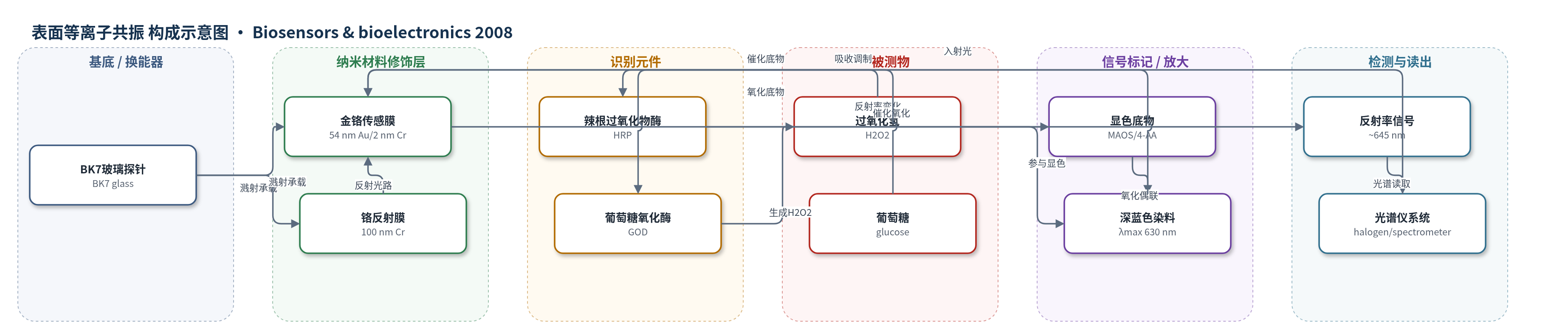
点击图片查看大图 · 依据论文自动绘制
传感器类型
表面等离子共振(SPR)生物传感器
检测对象
过氧化氢(hydrogen peroxide, H2O2,10 mM PB缓冲液标准溶液)、葡萄糖(glucose,10 mM PB缓冲液标准溶液;作者面向血液/尿液临床样品)
检测原理
该传感器以酶促显色作为识别与信号产生事件。测量液中,H2O2在HRP催化下氧化MAOS和4-AA,发生氧化偶联生成最大吸收630 nm的深蓝色染料;H2O2浓度越高,染料生成量越多,溶液吸光度越大。对于葡萄糖检测,GOD先氧化葡萄糖生成H2O2,再进入HRP/Trinder显色体系。生成的染料位于探针表面附近的测量液中,对约645 nm处p偏振光产生吸收,从而调制金膜表面等离子共振反射率谱的局部最小值反射率。系统读取该反射率变化,而非依赖SPR波长位移,因此受测量液折射率变化影响较小。该方法没有使用HCR、RCA或CRISPR-Cas等核酸放大策略,其信号放大主要来自酶催化显色反应。
检测灵敏度
LOD: 0.5 mM;线性范围: 1.0–50 mM;r = 0.991
效应效果
方法重现性良好:0和20 mM H2O2反射率RSD为0.117%和0.295%,校准平均RSD为0.152%(n=3)。0与20 mM H2O2间波长位移<0.5 nm,折射率影响小。pH 5.0–9.0下反射率随pH变化,pH 7.0附近HRP活性较高,适合生物流体。20 mM葡萄糖检测中,0和20 mM反射率RSD为0.151%和0.189%,与20 mM H2O2相比波长位移+0.36 nm,GOD加入引起0.72 nm位移。该探针可直读吸光度46.7 cm−1的深蓝色样品,无需稀释,较分光光度法简便。作者认为可用于临床血糖/尿糖、家庭诊断、现场监测及连续监测。
传感器的构成
- 基底/换能器:BK7玻璃探针,承载金属膜并传导激发光
- 传感金属膜:54 nm Au/2 nm Cr溅射层,激发表面等离子体并产生反射率信号
- 反射金属膜:100 nm Cr溅射层,作为反射镜增强光路
- 识别/催化元件:HRP(辣根过氧化物酶),催化H2O2参与显色反应;葡萄糖检测时GOD(葡萄糖氧化酶)催化葡萄糖生成H2O2
- 显色底物/信号标记:MAOS与4-AA,在HRP/H2O2作用下氧化偶联生成λmax 630 nm深蓝色染料
- 反应介质:10 mM PB(磷酸盐缓冲液,pH 7.0),提供反应环境并作为测量液溶剂
中文摘要
本研究开发了一种基于吸收型表面等离子共振(SPRAbs)的生物传感器探针,用于简单、可重复地测定过氧化氢。该探针采用改良Trinder显色试剂:在辣根过氧化物酶(HRP)存在下,过氧化氢催化N-乙基-N-(2-羟基-3-磺丙基)-3,5-二甲基苯胺钠盐一水合物(MAOS)与4-氨基安替比林(4-AA)发生氧化偶联,生成最大吸收波长为630 nm的深蓝色染料。研究省略了原试剂中的尿素加合物,含5 mM过氧化氢的测量液呈深蓝色,计算吸光度达46.7 cm−1,无需稀释即可直接滴加到SPR探针表面进行测定。SPRAbs响应以SPR光谱中约645 nm处反射率局部最小值的变化获得。经pH条件考察后,在1.0–50 mM过氧化氢范围内获得线性校准曲线(r=0.991,六点,平均相对标准偏差0.152%,n=3),检出限为0.5 mM。此外,利用葡萄糖氧化酶(GOD)成功检测20 mM葡萄糖,且测量液折射率变化对结果无明显影响,表明该SPRAbs探针可拓展至其他分析物的生物传感。
英文摘要
An absorption-based surface plasmon resonance (SPR(Abs)) biosensor probe has been developed for simple and reproducible measurements of hydrogen peroxide using a modified Trinder's reagent (a chromogenic reagent). The reagent enabled the determination of the hydrogen peroxide concentration by the development of deep color dyes (lambda(max)=630 nm) through the oxidative coupling reaction with N-ethyl-N-(2-hydroxy-3-sulfopropyl)-3,5-dimethylaniline sodium salt monohydrate (MAOS; C(13)H(20)NNaO(4)S.H(2)O) and 4-aminoantipyrine (4-AA) in the presence of hydrogen peroxide and horseradish peroxidase (HRP). In the present study, urea as an adduct of hydrogen peroxide for color development could be omitted from the measurement solution. The measurement solution containing 5mM hydrogen peroxide was deeply colored at a high absorbance value calculated as 46.7cm(-1) and was directly applied to the SPR(Abs) biosensing without dilution. The measurement was simply performed by dropping the measurement solution onto the surface of the SPR sensor probe, and the SPR(Abs) biosensor response to hydrogen peroxide was obtained as a reflectivity change in the SPR spectrum. After investigation of the pH profiles in the SPR(Abs) biosensor probe, a linear calibration curve was obtained between 1.0 and 50mM hydrogen peroxide (r=0.991, six points, average of relative standard deviation; 0.152%, n=3) with a detection limit of 0.5mM. To examine the applicability of this SPR(Abs) biosensor probe, 20mM glucose detection using glucose oxidase was also confirmed without influence of the refractive index in the measurement solution. Thus, the SPR(Abs) biosensor probe employing the modified Trinder's reagent demonstrated applicability to other analyte biosensing tools.