组成图示
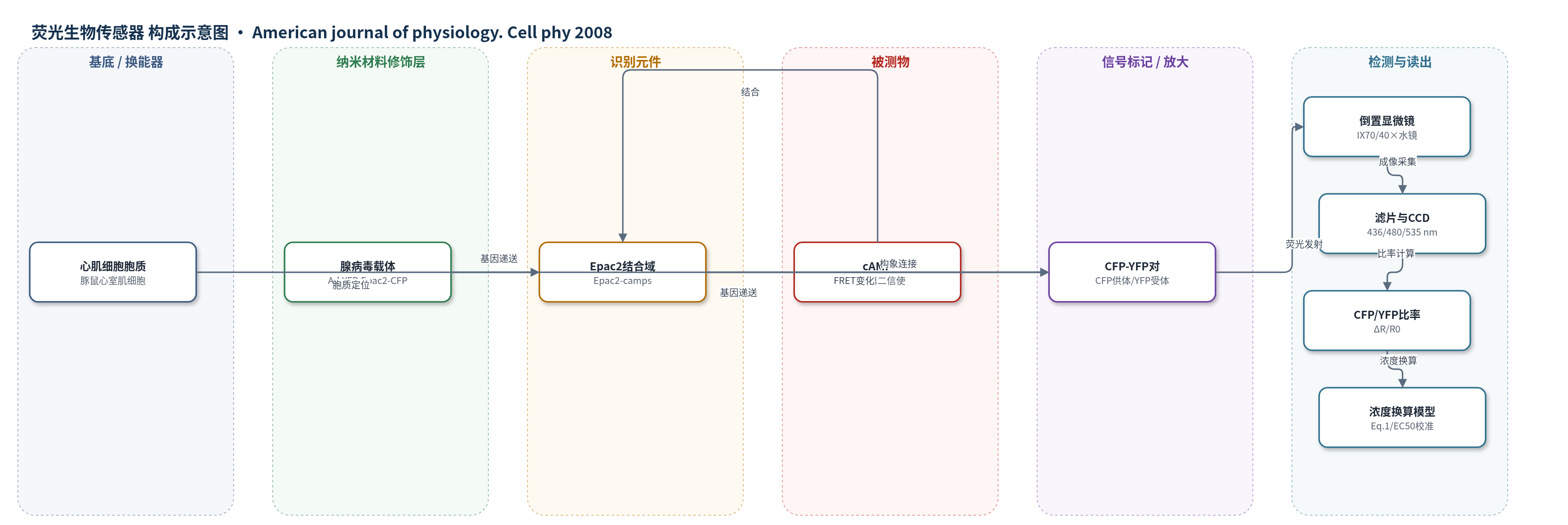
点击图片查看大图 · 依据论文自动绘制
传感器类型
荧光生物传感器
检测对象
环磷酸腺苷(cAMP);样品基质:完整成年豚鼠心室肌细胞胞质(intact adult guinea pig ventricular myocytes, cytosol)
检测原理
Epac2-camps由Epac2的cAMP结合结构域与CFP和YFP融合构成。cAMP结合后引起结合域构象变化,改变CFP与YFP之间的荧光共振能量转移效率。用436 nm激发CFP,同时检测480 nm CFP发射和535 nm YFP/FRET发射,计算CFP/YFP比率变化ΔR/R0。体外用Sf9细胞表达或纯化探针测定cAMP EC50为1.1 μM、Hill系数1和绝对最大FRET响应Fabs约43%。完整细胞中用Iso加IBMX获得最大FRET响应Fmax,再按公式将FRET响应换算为cAMP浓度。β1AR激动剂Iso通过Gs-AC增加cAMP,M2R激动剂ACh通过Gi调节AC,PDE抑制剂IBMX减少cAMP降解,从而改变FRET信号。无酶促放大,信号直接来自cAMP结合与FRET比率变化。
检测灵敏度
探针cAMP EC50: 1.1 μM;Hill系数: 1;Iso EC50: 4.7 nM;未报告LOD、线性范围、灵敏度斜率或R^2。
效应效果
该FRET探针可检测完整心肌细胞中β1肾上腺素能和M2毒蕈碱受体介导的cAMP变化。Iso响应EC50为4.7 nM,最大FRET约13.9±1.6%;加100 μM IBMX后FRET再增27±1.5%,说明未饱和。探针cAMP EC50为1.1 μM,Hill系数1,绝对最大FRET 42.9±1.6%。ACh使Iso诱导cAMP由12.4 μM降至3.1 μM,抑制约75%;单独ACh使基础FRET下降1.7±0.13%,洗脱回弹峰值3.4±0.73%。对AMP、cGMP选择性较好,MgATP下EC50仍1.1 μM。作者认为可定量胞质cAMP并支持区室化模型。
传感器的构成
- 表达载体:腺病毒Ad-YFP-Epac2-CFP,用于将传感器基因导入豚鼠心室肌细胞
- 识别元件:Epac2的cAMP结合结构域(Epac2-camps),特异性结合cAMP并发生构象变化
- 荧光换能层:CFP-YFP荧光蛋白对,CFP为供体、YFP为受体,通过FRET比率报告cAMP结合
- 细胞基质:成年豚鼠心室肌细胞胞质,传感器自由扩散并反映整体胞质cAMP
- 光学读出:倒置显微镜、CFP激发滤片(D436/20)、CFP/YFP发射滤片(D480/30、D535/30)与CCD相机
- 比率成像:Dual View Micro Imager分光器,同步采集CFP与YFP荧光并计算CFP/YFP比率
- 体外校准:Sf9细胞表达或纯化Epac2-camps,用于测定cAMP EC50、Hill系数和绝对最大FRET响应
中文摘要
心肌细胞中部分受体激活可通过刺激cAMP产生调节蛋白激酶A(PKA)依赖反应,且cAMP产生可能局限于离散胞内区室。作者此前建立区室化cAMP信号计算模型,可重现β1肾上腺素能和M2毒蕈碱受体介导的cAMP变化发生在与PKA信号相关的微区室,但模型提示细胞大部分胞质cAMP浓度可能高于PKA信号区室。本研究使用由Epac2-camps构建的自由扩散荧光共振能量转移(FRET)生物传感器检验该假设。在成年心室肌细胞中,探针检测到的基础cAMP浓度约为1.2 μM,足以最大程度激活PKA;探针还可检测β1和M2受体激活产生的反应。模型分析表明Epac2-camps主要反映整体胞质区室变化,PKA信号微区室贡献很小。结果支持尽管受体激活可引起全局cAMP变化,区室化仍通过维持cAMP水平显著低于大部分胞质的微区室,使受体刺激能在适合调节高亲和力(如PKA)和低亲和力(如Epac)效应物的浓度范围内调控cAMP活性。
英文摘要
In cardiac myocytes there is evidence that activation of some receptors can regulate protein kinase A (PKA)-dependent responses by stimulating cAMP production that is limited to discrete intracellular domains. We previously developed a computational model of compartmentalized cAMP signaling to investigate the feasibility of this idea. The model was able to reproduce experimental results demonstrating that both beta(1)-adrenergic and M(2) muscarinic receptor-mediated cAMP changes occur in microdomains associated with PKA signaling. However, the model also suggested that the cAMP concentration throughout most of the cell could be significantly higher than that found in PKA-signaling domains. In the present study we tested this counterintuitive hypothesis using a freely diffusible fluorescence resonance energy transfer-based biosensor constructed from the type 2 exchange protein activated by cAMP (Epac2-camps). It was determined that in adult ventricular myocytes the basal cAMP concentration detected by the probe is approximately 1.2 muM, which is high enough to maximally activate PKA. Furthermore, the probe detected responses produced by both beta(1) and M(2) receptor activation. Modeling suggests that responses detected by Epac2-camps mainly reflect what is happening in a bulk cytosolic compartment with little contribution from microdomains where PKA signaling occurs. These results support the conclusion that even though beta(1) and M(2) receptor activation can produce global changes in cAMP, compartmentation plays an important role by maintaining microdomains where cAMP levels are significantly below that found throughout most of the cell. This allows receptor stimulation to regulate cAMP activity over concentration ranges appropriate for modulating both higher (e.g., PKA) and lower affinity (e.g., Epac) effectors.