组成图示
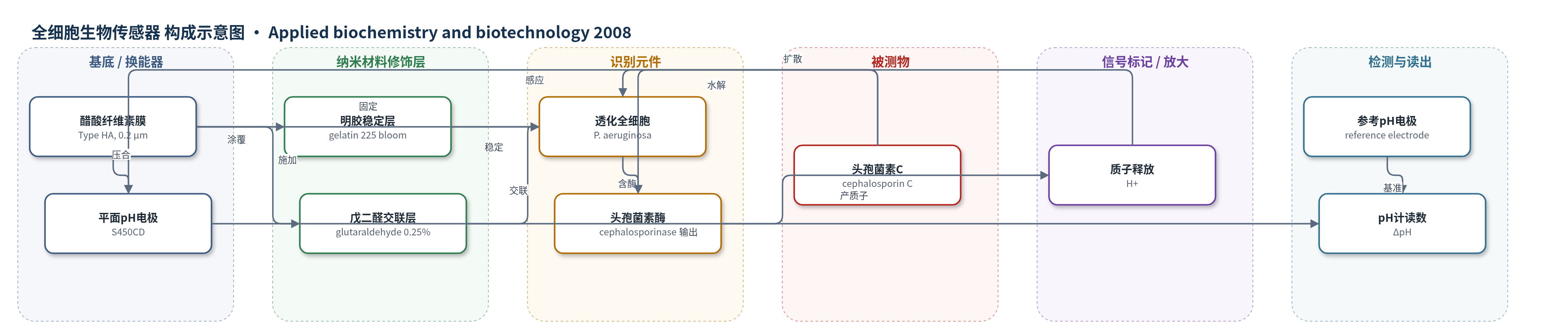
点击图片查看大图 · 依据论文自动绘制
传感器类型
全细胞生物传感器
检测对象
头孢菌素类抗生素(cephalosporins):头孢菌素C(cephalosporin C)、头孢噻肟(cephalotaxime)、头孢氨苄(cephalexin)、头孢力定(cephaloridine);样品基质:磷酸盐缓冲液(pH 7.0,25 mM),作者亦主张可用于纯品与药物制剂。
检测原理
头孢菌素从样品中扩散穿过醋酸纤维素膜进入固定化透化铜绿假单胞菌层。溶菌酶与Na2EDTA预处理破坏外膜,提高头孢菌素酶(cephalosporinase)对底物的可及性,使酶活性较正常细胞提高约6.5倍。头孢菌素酶水解头孢菌素的β-内酰胺环,生成头孢菌素酸并释放H+。H+扩散至平面pH电极表面,使工作电极局部pH下降;参考电极pH基本不变。pH计读取两电极间的ΔpH,ΔpH随头孢菌素浓度升高而增大,在0.1–11 mM内呈线性。该过程以酶促水解产质子为信号放大机制,无需外加标记物。
检测灵敏度
线性范围: 0.1–11 mM;R^2 = 0.99;灵敏度: 76.3 (pH difference/mM of cephalosporin C×10^3);正常细胞灵敏度: 30.3 (pH difference/mM of cephalosporin C×10^3)
效应效果
该传感器对头孢菌素类选择性良好:5 mM下头孢菌素C响应为100%,头孢噻肟82%、头孢氨苄69%、头孢力定77%;青霉素G仅12%、阿莫西林7%。头孢菌素C与青霉素G或阿莫西林混合时响应为101%和100%,非头孢菌素干扰小。响应时间3.5–11 min,5 mM时约3 min稳定。储存稳定性:7 d内稳定,8 d后响应时间增加,14 d后活性损失40%。准确度:3、5、8、10 mM头孢菌素C测定的CV为1.54%–1.92%,SD为±0.0732–0.0985 mM,与羟胺法一致。作者认为可替代现有方法用于纯品和药物制剂常规检测。
传感器的构成
- 换能器电极:平面 pH 电极(S450CD,Sensorex),感应头孢菌素水解产生的 H+ 并输出电位/pH 信号。
- 参考电极:另一 pH 敏感电极,连接 pH 计另一端口,提供基准电位。
- 支撑膜:醋酸纤维素膜(Type HA,0.2 μm 孔径,Sartorius),承载生物活性层并允许底物扩散。
- 识别/催化元件:溶菌酶和 Na2EDTA 透化的铜绿假单胞菌(P. aeruginosa)全细胞,含头孢菌素酶(cephalosporinase),水解头孢菌素 β-内酰胺环。
- 固定剂:戊二醛(glutaraldehyde,0.25% v/v),交联固定细胞于膜上。
- 稳定剂:明胶(gelatin,225 bloom),稳定细胞表面蛋白并维持生物活性层。
- 机械夹持:塑料膜夹持器与 Parafilm,将膜与 pH 电极压合组装。
- 检测仪器:pH 计,读取工作电极与参考电极的 pH 差值。
中文摘要
本研究开发了一种基于铜绿假单胞菌的电位型微生物生物传感器,用于检测头孢菌素类抗生素。初步结果表明,与正常细胞相比,经溶菌酶处理的铜绿假单胞菌细胞在 0.1–11 mM 宽浓度范围内检测头孢菌素 C 的效率更高、灵敏度更好。通过优化三个关键传感器设计参数——透化细胞含量、明胶用量和戊二醛浓度,获得了较高性能;优化值分别为细胞含量 2.5 mg/cm²、明胶 8.5 mg/cm² 和 0.25% 戊二醛。同时优化了磷酸盐缓冲液 pH、离子强度和温度等检测条件,以获得最佳性能。对不同 β-内酰胺类抗生素的特异性测试显示,该传感器仅对头孢菌素类产生良好响应。在检测头孢菌素 C 时的操作稳定性和储存稳定性表明,该传感器在准确检测头孢菌素类方面具有良好应用潜力。
英文摘要
A new potentiometric microbial biosensor based on Pseudomonas aeruginosa was developed in this study for detecting the cephalosporin group of antibiotics. Preliminary results with the biosensor indicated that P. aeruginosa cells, when treated with lysozyme, showed more efficiency in detecting cephalosporin C in a wide concentration range of 0.1-11 mM with high sensitivity compared to the normal cells. Optimization of the three important biosensor design parameters permeabilized cell contents, quantities of gelatin, and glutaraldehyde resulted in high performance of the biosensor. The optimized values of the above parameters were cell contents 2.5 mg/cm(2), gelatin 8.5 mg/cm(2), and 0.25% glutaraldehyde. The assay conditions, namely phosphate buffer pH, ionic strength, and temperature, were optimized for best performance of the biosensor. The specificity test of the biosensor towards detecting different beta-lactam antibiotics showed good response only for the cephalosporins. The operational and storage stability in detecting cephalosporin C indicated very good potential of the biosensor in detecting cephalosporins with high accuracy.