组成图示
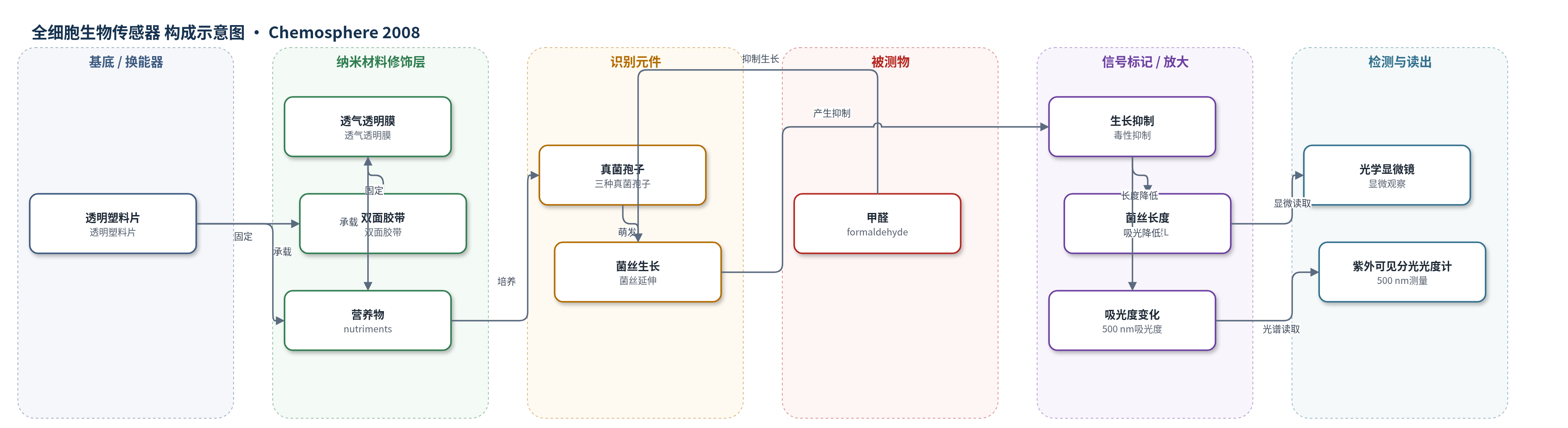
点击图片查看大图 · 依据论文自动绘制
传感器类型
全细胞生物传感器
检测对象
甲醛(formaldehyde, HCHO);样品基质:室内空气质量/气相空气(indoor air, gas phase)
检测原理
该传感器以活真菌作为识别与响应元件。室内空气中的甲醛扩散进入传感器板,与真菌细胞及菌丝接触,抑制其代谢和菌丝延伸,形成生长抑制事件。随着甲醛浓度升高,菌丝长度增加受抑,同时菌丝厚度、孢子色素和光散射等变化减弱,使传感器板在500 nm处的吸光度增加降低。生物生长状态被转换为光学信号:显微镜测量最长五条菌丝的平均长度L,并以IL=(L0-L)/L0表示抑制比;紫外可见分光光度计测量吸光度增加A,并以IA=(A0-A)/A0表示抑制比。培养数天使微小毒性效应被生物生长过程放大,最终通过长度或吸光度下降反映甲醛浓度。
检测灵敏度
动态范围: 700–4000 μg m^-3 或更宽
效应效果
在28 ℃、90%相对湿度下,三种真菌对甲醛均表现出浓度依赖性生长抑制,700 μg m^-3以上抑制明显,4000 μg m^-3时至少4天内生长完全受抑。基于菌丝长度,Eurotium herbariorum生长快且敏感性适中,最适宜;Aspergillus penicillioides在吸光度法中比Alternaria alternata更敏感。吸光度法动态范围至少700–4000 μg m^-3,标准偏差范围2–8%。80%相对湿度下生长缓慢,需控制湿度。与HPLC/GC-MS相比,该方法设备简单、适合快速筛查危害性,但难以识别具体VOC,且低于WHO指南值100 μg m^-3时灵敏度不足,需吸附富集或原位监测。作者认为其可用于新VOC或联合毒性风险评价,并可通过真菌阵列预测毒性类型。
传感器的构成
- 基底/支撑层:透明塑料片(transparent plastic sheet),提供光学透明支撑并承载传感器板。
- 气体接触层:透气透明膜(air-permeable transparent film),允许甲醛气体扩散进入并维持光学透明。
- 固定层:双面胶带(two-sided adhesive tape),固定透明膜与塑料片并形成样品腔。
- 营养层:营养物(nutriments),为真菌生长提供营养基质。
- 识别/响应元件:三种真菌孢子及菌丝(Alternaria alternata、Eurotium herbariorum、Aspergillus penicillioides),通过生长抑制响应甲醛。
- 信号读出层:光学显微镜与紫外可见分光光度计(UV–visible spectrophotometer, 500 nm),读取菌丝长度和吸光度变化。
中文摘要
本研究将真菌生物传感器板应用于室内空气中甲醛危害性的评估。选用 Alternaria alternata、Eurotium herbariorum 和 Aspergillus penicillioides 三种真菌,将干燥孢子与营养物置于透明塑料片和透气透明膜之间,制成可暴露于气相样品的传感器板。含甲醛空气通入测试腔后,甲醛通过抑制真菌生长产生响应,研究以菌丝长度和传感器板光学透明度/吸光度作为生长指标。结果表明,甲醛浓度升高时菌丝生长和吸光度增加均受抑制,测量动态范围为700–4000 μg m^-3或更宽。基于菌丝长度检测时,Eurotium herbariorum 最适宜;基于吸光度检测时,Aspergillus penicillioides 最适宜。该方法可用于气相挥发性有机物的快速筛查与风险评价,但对低于WHO指南值100 μg m^-3的甲醛仍需富集或原位监测。
英文摘要
A fungal biosensor plate was applied to assessment of the harmfulness of air polluted by formaldehyde. Alternariaalternata, Eurotiumherbariorum and Aspergilluspenicillioides were used as fungal species. Fungal mycelium length and optical transparency of the biosensor plate were employed as indices of the fungal growth. Formaldehyde in air was detected on the basis of growth inhibition, reflected by suppression of the growth indices. Dynamic range of the measurement was 700-4000 microg m(-3) or broader. Eurotiumherbariorum and Aspergilluspenicillioides were the most suitable fungal species to formaldehyde sensing based on the mycelium length and that based on the transparency, respectively.