组成图示
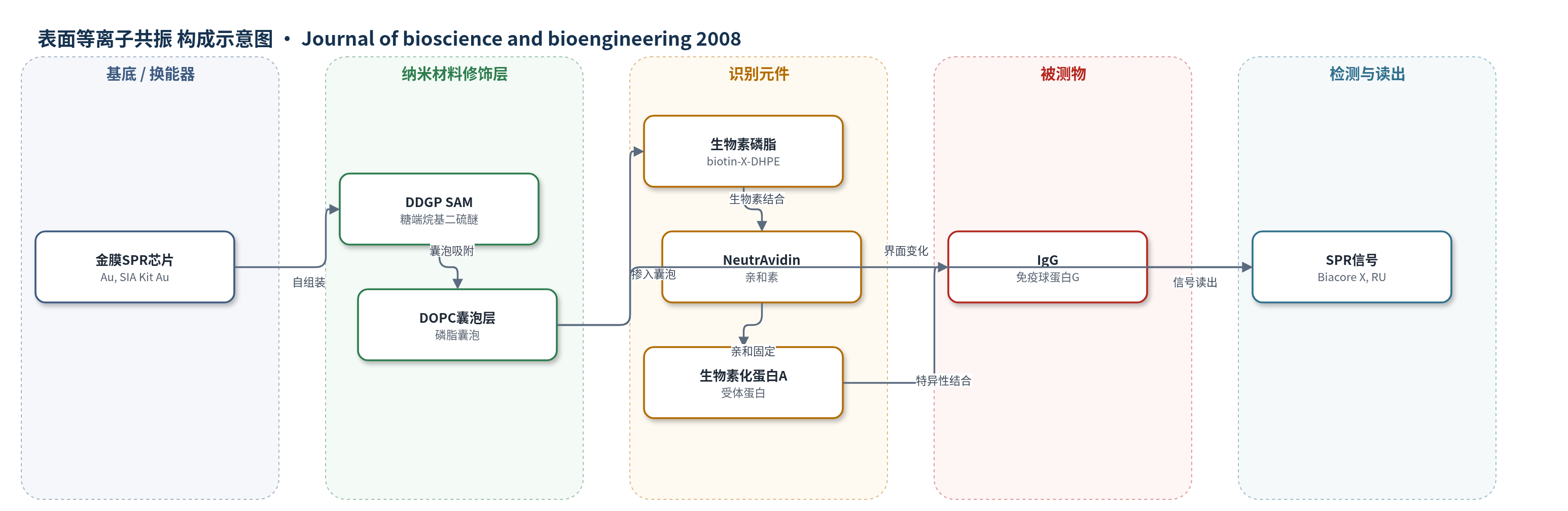
点击图片查看大图 · 依据论文自动绘制
传感器类型
表面等离子共振(SPR)生物传感器
检测对象
IgG(immunoglobulin G,免疫球蛋白G);样品基质为缓冲液(0.15 M NaCl、10 mM Tris-HCl pH 7.4、2 mM CaCl2)
检测原理
该传感器以金膜为SPR换能基底,DDGP糖端烷基二硫醚SAM提供亲水、抗非特异吸附界面,并促进DOPC磷脂囊泡物理吸附形成囊泡层。囊泡中掺入约3 mol% biotin-X-DHPE,使生物素暴露于囊泡外表面。NeutrAvidin通过生物素-亲和素高亲和作用结合到囊泡层,并进一步固定生物素化蛋白A。当样品中的IgG与蛋白A特异性结合时,传感表面质量与局部折射率增加,导致SPR共振信号(RU)上升。SPR可实时监测结合/解离过程,信号变化与结合蛋白量近似相关(文中采用0.1 ng/cm2/RU换算)。该体系主要依靠生物素-亲和素固定和磷脂囊泡抗非特异吸附,而非酶促或核酸放大。
检测灵敏度
原文未报告LOD、线性范围、灵敏度斜率或相关系数。
效应效果
DDGP SAM上DOPC囊泡层覆盖高且稳定,高流速冲洗后SPR信号基本不变,1000 s内标准差1.63 RU,约为饱和信号11000 RU的0.015%。biotin-X-DHPE使NeutrAvidin结合最快且总量最高,双指数参数k1=3.7 min^-1、A1=4150 RU、k2=0.22 min^-1、A2=2040 RU;biotin-DHPE和biotin-DOPE以慢结合为主且总信号较低。3 mol% biotin-X-DHPE时NeutrAvidin、生物素化蛋白A和IgG信号为6600、1800、4900 RU,约对应660、180、490 ng/cm2;无生物素DOPC对照仅230、93、430 RU,非特异吸附低。作者认为可用于抗体SPR芯片及SPR增强荧光联用。
传感器的构成
- 基底/换能器:金膜SPR传感芯片(SIA Kit Au, Biacore),提供SPR换能表面
- 自组装单分子层:DDGP(dithiobis(1-deoxy-D-glucitol-1-carbamoyl pentane))糖端烷基二硫醚SAM,亲水抗非特异吸附并促进囊泡吸附
- 磷脂囊泡层:DOPC(1,2-dioleoyl-sn-glycero-3-phosphocholine)单层囊泡物理吸附,形成类膜界面
- 生物素磷脂:biotin-X-DHPE(N-((6-(biotinoyl)amino)hexanoyl)-1,2-dihexadecanoyl-sn-glycero-3-phosphoethanolamine)掺入DOPC囊泡,提供生物素位点
- 亲和固定元件:NeutrAvidin(中性亲和素),高亲和结合生物素并固定受体蛋白
- 识别元件:biotinylated protein A(生物素化蛋白A),作为受体结合IgG
- 读出层:Biacore X SPR仪器,监测结合引起的SPR信号变化(RU)
中文摘要
本文报道了一种在金表面自组装单分子层上构建含生物素磷脂囊泡层,用于表面等离子共振(SPR)生物传感器固定生物素化受体蛋白的技术。作者以糖端烷基二硫醚二硫双(1-脱氧-D-山梨醇-1-氨基甲酰戊烷)(DDGP)形成亲水自组装单分子层,并比较了DOPC囊泡在DDGP、11-巯基十一烷酸、11-巯基十一烷醇、11-氨基-1-十一烷硫醇和12-巯基十二烷SAM上的吸附。SPR显示DOPC囊泡在DDGP SAM上快速吸附并达到最高表面覆盖;QCM-D表明其为完整囊泡物理吸附形成的囊泡层。将三种生物素化磷脂之一与DOPC混合形成含生物素囊泡层后,比较NeutrAvidin结合发现biotin-X-DHPE可实现最快、最高表面密度的NeutrAvidin固定。进一步通过NeutrAvidin固定生物素化蛋白A,并成功用SPR观察其与免疫球蛋白G(IgG)的结合。结果表明该含生物素囊泡层可作为SPR生物传感器表面的有用组件。
英文摘要
We describe a technique to form a biotin-containing phospholipid vesicle layer on a self-assembled monolayer (SAM) deposited on a gold surface to immobilize biotinylated receptor proteins for a surface plasmon resonance (SPR) biosensor. The adsorption of vesicle of 1,2-dioleoyl-sn-glycero-3-phosphocholine (DOPC) was examined by SPR on the SAMs of dithiobis(1-deoxy-glucitol-1-carbamoyl pentane) (DDGP), 11-mercaptoundecanoic acid, 11-mercaptoundecanol, 11-amino-1-undecanethiol, and 12-mercaptododecane, and it was found that the DOPC vesicle rapidly adsorbed on the DDGP SAM to achieve the highest coverage of the surface. By quartz crystal microbalance with dissipation monitoring (QCM-D), the DOPC layer formed on the DDGP SAM was shown to be a vesicle layer, in which intact DOPC vesicles physisorbed on the SAM surface. To immobilize a biotinylated receptor protein, one of three biotinylated phospholipids, 1,2-dioleoyl-sn-glycero-3-phosphoethanolamine-N-(biotinyl) (biotin-DOPE), N-((6-(biotinoyl)amino)hexanoyl)-1,2-dihexadecanoyl-sn-glycero-3-phosphoethanolamine (biotin-X-DHPE) and N-(biotinoyl)-1,2-dihexadecanoyl-sn-glycero-3-phosphoethanolamine (biotin-DHPE), was mixed with DOPC to form a biotin-containing vesicle layer on the DDGP SAM. A comparative binding study of NeutrAvidin and the biotin-containing vesicle layers showed that the use of biotin-X-DHPE achieved the most rapid immobilization of NeutrAvidin on the vesicle layer at the highest surface density. Furthermore, biotinylated protein A, as a receptor protein, could be immobilized through NeutrAvidin on the vesicle layer containing DOPC and biotin-X-DHPE, and its reaction with immunoglobulin G, as an analyte, was successfully observed by SPR. The results demonstrate that the biotin-containing vesicle layer on the DDGP SAM must be a useful component for SPR biosensor surfaces.