组成图示
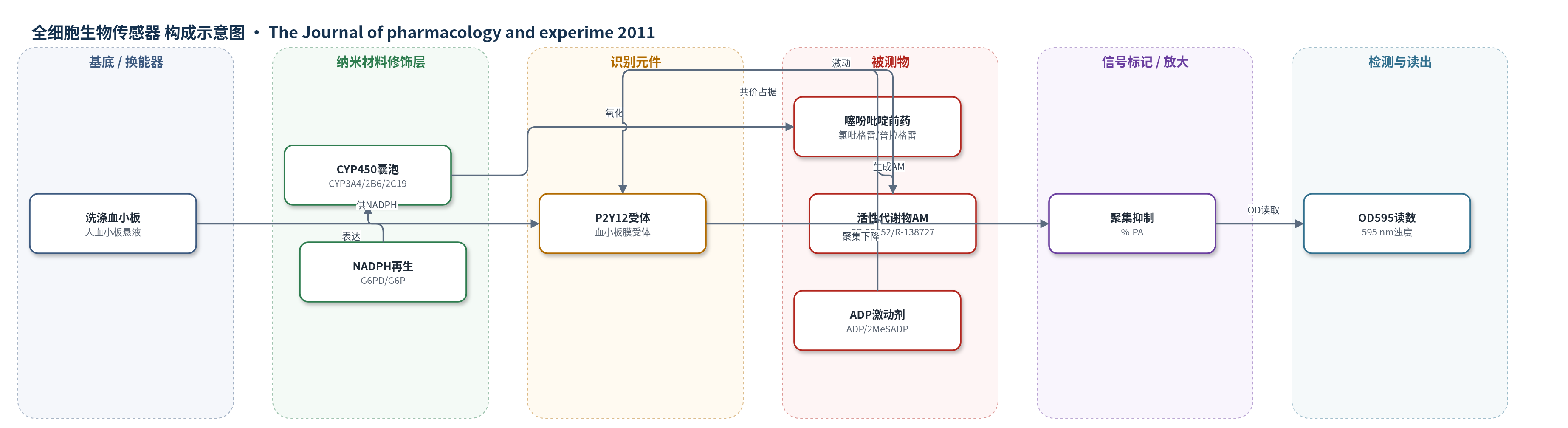
点击图片查看大图 · 依据论文自动绘制
传感器类型
全细胞生物传感器
检测对象
氯吡格雷活性代谢物(Clopidogrel active metabolite, AM/SR-25552)、普拉格雷活性代谢物(Prasugrel active metabolite, R-138727);样品基质:体外洗涤血小板悬液与CYP450 Baculosomes反应体系
检测原理
将洗涤人血小板与噻吩吡啶前药(氯吡格雷/普拉格雷)及纯化CYP450 Baculosomes、NADPH再生系统共同孵育。CYP450原位催化前药氧化和开环,生成不稳定的活性代谢物(AM)。AM立即与血小板膜上的P2Y12受体发生共价修饰/占据,使受体功能失活。随后加入ADP或2MeSADP激动剂,若P2Y12被AM占据,则ADP诱导的血小板聚集速率下降。通过595 nm光学浊度动力学测定聚集斜率,并以对照斜率计算%IPA;%IPA随AM生成量、酶浓度、底物浓度和孵育时间增加而升高,从而间接定量AM对P2Y12的占用程度。
检测灵敏度
未报告LOD、线性范围、灵敏度斜率;相关系数示例:R^2 = 0.96、0.87、0.83、0.8、0.95、0.86、0.6、0.75、0.85、0.63。
效应效果
数据为≥3次重复均值±SD。该法具特异性:酮康唑或抗CYP3A4抗体消除CYP3A4反应,抗CYP2B6抗体无影响;无效代谢物SR-26334至160 μM无抑制;血栓素路径不受影响。CYP3A4、3A5、2B6可使氯吡格雷达近100% IPA,CYP2C19低于约80%;CYP2C9/2D6不能转化母药,但可转化2-氧代氯吡格雷,最大%IPA约54%/53%。结果与LC-MS大体一致,唯CYP3A4有差异。作者认为可用于筛选噻吩吡啶活化CYP及评估药物相互作用。
传感器的构成
- 细胞基底/换能器:洗涤人血小板(washed human platelets),提供P2Y12受体并介导ADP诱导聚集,作为全细胞换能器
- 识别元件:血小板膜P2Y12受体(P2Y12 receptor),被活性代谢物共价修饰/占据,决定信号特异性
- 反应修饰模块:纯化CYP450 Baculosomes(CYP3A4、3A5、2B6、2C19、2C9、2D6、1A2),原位氧化噻吩吡啶生成AM
- 辅因子模块:NADPH再生系统(NADP+、葡萄糖-6-磷酸、葡萄糖-6-磷酸脱氢酶G6PD),维持CYP450催化活性
- 刺激读出剂:ADP或2MeSADP(2-methylthio-ADP),激发P2Y12介导聚集,提供可读动力学信号
- 信号读出:光学浊度法(595 nm OD)监测聚集斜率变化,计算血小板聚集抑制率%IPA
中文摘要
噻吩吡啶类抗血小板药物(如噻氯匹定、氯吡格雷和普拉格雷)需经细胞色素P450在体内激活,才能有效阻断ADP驱动的血小板聚集。由于开环活性代谢物不稳定、反应性强且可形成多种代谢物,其代谢激活研究受到限制。作者开发了一种新方法:将血小板与细胞色素P450及目标噻吩吡啶孵育不同时间,直接检测ADP诱导血小板聚集的变化,从而把血小板用作检测活性代谢物的生物传感器。利用该方法,鉴定出能够将氯吡格雷、普拉格雷和2-氧代氯吡格雷转化为抑制ADP诱导聚集代谢物的细胞色素P450,以及能够催化部分反应的亚型。结果表明,体外CYP3A4/5、2C19和2B6均可单独将氯吡格雷和普拉格雷转化为活性代谢物,且这两种噻吩吡啶对细胞色素P450的偏好性非常相似。
英文摘要
The thienopyridine antiplatelet drugs, such as ticlopidine, clopidogrel, and prasugrel, require activation by cytochromes P450 in vivo to effectively block platelet aggregation. The study of the metabolic activation of these compounds has been hampered by the lability and reactivity of the ring-opened active metabolite (AM) and by the numerous metabolites that can be formed in such a transformation. We have developed a novel method whereby platelets are incubated with the cytochrome P450 and the thienopyridine of interest for various amounts of time, and the effects on ADP-driven platelet aggregation are directly examined. In this way, the platelet is used as a biosensor for detection of the AM. Using this method, cytochromes P450 capable of converting clopidogrel, prasugrel, and 2-oxo-clopidogrel to metabolites that inhibit ADP-induced platelet aggregation were identified as well as which cytochromes P450 were capable of catalyzing partial reactions (e.g., conversion of 2-oxo-clopidogrel to the AM). These studies show that, in vitro, CYP3A4/5, 2C19, and 2B6 are individually capable of converting clopidogrel and prasugrel to the AM and that the cytochrome P450 preference for these two thienopyridines is very similar.