组成图示
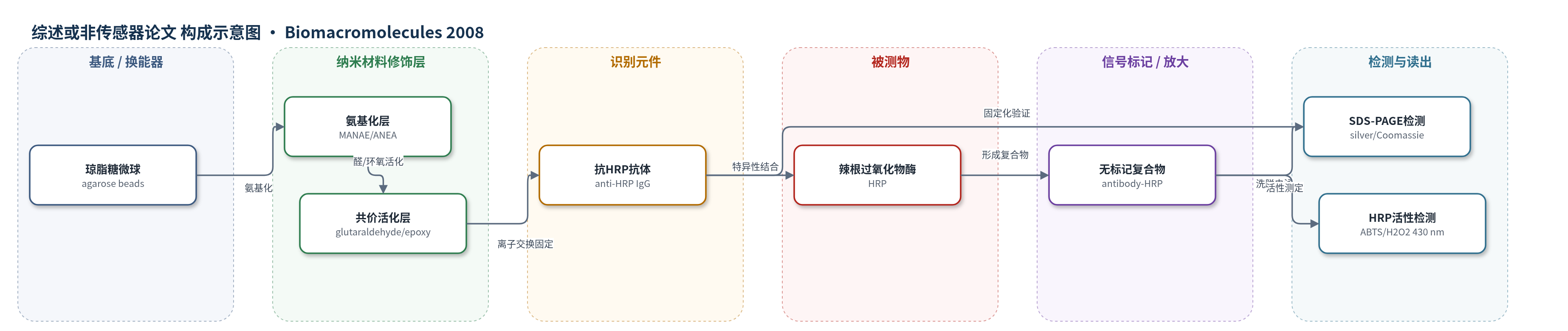
点击图片查看大图 · 依据论文自动绘制
传感器类型
综述或非传感器论文
检测对象
辣根过氧化物酶(HRP, horseradish peroxidase),样品基质为大肠杆菌(E. coli)蛋白粗提取物
检测原理
本文未构建完整电/光换能读出,而是建立抗体固定化与捕获机制。未修饰IgG表面存在高密度羧基区域,在低离子强度下与带正电的氨基化琼脂糖载体发生多点阴离子交换,使抗体四个亚基贴近载体、Fab区靠近表面;随后戊二醛或环氧基与抗体邻近残基共价结合,形成稳定定向固定。剩余戊二醛用NaBH4还原,剩余环氧基用天冬氨酸封闭,使载体表面电荷中和,降低非特异蛋白吸附。当含HRP的大肠杆菌粗提物接触固定化抗HRP抗体时,抗原-抗体特异性结合形成复合物;通过高盐洗脱、SDS-PAGE、Bradford或HRP催化ABTS氧化(430 nm)验证捕获量。该过程无信号放大,信号强度取决于固定化抗体保留功能与HRP捕获量。
检测灵敏度
原文未报告LOD、线性范围、灵敏度斜率或相关系数。
效应效果
固定化抗HRP IgG保留约65±5%(戊二醛体系)和75±5%(ANEA-epoxy体系)的可溶性抗体功能;SDS-PAGE显示超过90%抗体亚基参与固定化,ANEA-epoxy体系超过95%。在100 mM磷酸钠、pH 7下,低活化载体不吸附大肠杆菌粗提物蛋白,而高活化MANAE载体吸附约60%蛋白,说明惰性化有效。固定化抗体能从含HRP粗提物中特异性捕获HRP,洗脱后SDS-PAGE仅见HRP和抗体条带。高离子强度洗脱后共价固定抗体释放可忽略,24 h后几乎无脱落。实验至少三次重复,误差低于5%。作者认为该定向固定适合免疫传感器和免疫层析,尤其适用于碳纳米管FET等需要抗原靠近载体表面且无第二抗体读出的体系。
传感器的构成
- 基底/载体:琼脂糖微球(agarose beads,4%交联或CM-agarose 4BCL),提供多孔固相支撑。
- 氨基功能化层:MANAE-agarose 或 ANEA-agarose,引入伯/仲氨基,用于抗体阴离子交换和后续共价反应。
- 共价活化层:戊二醛(glutaraldehyde)或1,4-丁二醇二缩水甘油醚(BDDGE)环氧基,与抗体邻近残基形成共价键。
- 识别元件:未修饰抗HRP IgG(anti-HRP IgG),通过表面羧基富集区多点吸附并定向固定。
- 封闭/惰性化层:NaBH4还原剩余戊二醛,或天冬氨酸(aspartic acid)封闭剩余环氧基,形成电中性表面并降低非特异吸附。
中文摘要
抗体正确固定化是制备免疫传感器和免疫层析基质的关键步骤。最终载体必须化学和物理惰性,以避免非特异性蛋白吸附降低传感器灵敏度或色谱纯化效果。本文提出两种简单新颖策略,使未修饰抗体先通过阴离子交换吸附到载体上,再共价固定,使超过90%的抗体以四个亚基结合于载体,保留高识别功能并形成最终惰性表面。第一种采用低表面氨基密度的琼脂糖载体并用戊二醛活化;极低氨基密度使其在100 mM磷酸钠中不吸附蛋白,而抗体在低离子强度下先离子吸附,再与戊二醛共价结合。第二种设计氨基-环氧载体,抗体同样先离子交换再与环氧基反应;剩余环氧基可用天冬氨酸封闭以抵消电荷,因此初始氨基-环氧密度可较高。两种体系均实现IgG正确定向固定,固定化抗体保留65–75%功能,并能从大肠杆菌蛋白粗提物中完全特异性捕获辣根过氧化物酶(HRP)。
英文摘要
The correct immobilization of antibodies is one of the most critical steps in the preparation of immunosensors and immunochromatography matrices. In addition, the final support has to be chemical and physically inert to avoid the unspecific adsorption of proteins that can reduce the sensitivity of the biosensor or the purification achieved by the chromatography. The solution to both problems is one of the major challenges in the field. Here, we have presented two different novel and simple alternatives to have the unmodified antibody anionically exchanged to a support, further covalently immobilized with more than 90% of the antibodies bonded to the support by the four subunits, retaining a high functionality and giving a final "inert" surface. The first solution was the use of supports having a low superficial density of amino groups activated with glutaraldehyde. Here, the inertness was achieved by the use of a very low density of amino groups, unable to adsorb proteins at 100 mM sodium phosphate, while immobilization proceeds mainly via a first adsorption of the antibody and a further reaction with the glutaraldehyde groups. The second solution implies the design of a novel support (amino-epoxy). This support again produces a first ionic exchange of the antibody on the support and a further reaction with the epoxy groups, but because the epoxy groups can be finally blocked with aspartic groups (annulling the charge), the initial density of amino-epoxy groups can be as high as possible. Both systems permitted the correct and oriented immobilization of IgG. The immobilized antibody showed high-functionality (65-75%) and a final inert support surface. This immobilized antibody (antiperoxidase) was able to capture fully specifically HRP contaminating a protein crude extract from E. coli.