组成图示
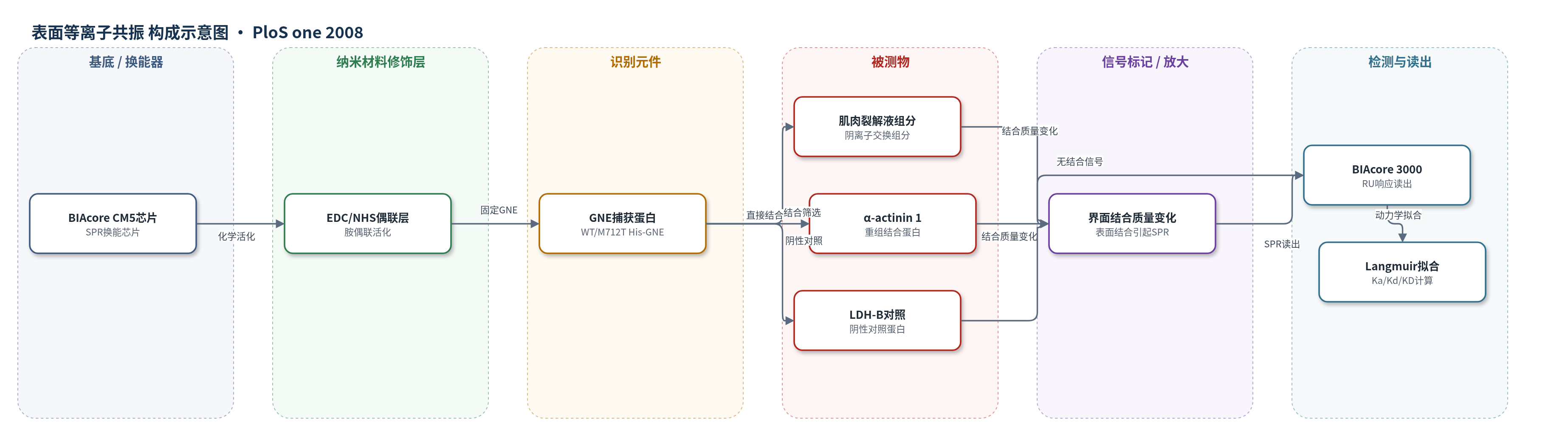
点击图片查看大图 · 依据论文自动绘制
传感器类型
表面等离子共振(SPR)生物传感器
检测对象
GNE 结合蛋白:α-actinin 1(alpha-actinin 1)、LDH-B(lactate dehydrogenase B);样品基质:人骨骼肌原代培养细胞裂解液阴离子交换组分、重组蛋白缓冲液。
检测原理
该 SPR 生物传感器以 CM5 芯片为换能基底,经 EDC/NHS 胺偶联将 His 标签 GNE 固定于芯片表面。当人骨骼肌裂解液组分或重组蛋白流过芯片时,能与 GNE 特异性结合的蛋白(如 α-actinin 1)在界面形成复合物,使表面质量/折射率增加,导致表面等离子共振条件改变,BIAcore 以响应单位(RU)记录结合与解离曲线。对 α-actinin 1 进行多浓度注入,用 1:1 Langmuir 模型拟合得到结合速率常数 Ka、解离速率常数 Kd 和平衡解离常数 KD。实验还比较钙离子存在与否,发现 Ca2+ 可增强 GNE 与 α-actinin 1 的结合亲和力。该方法未使用酶或核酸放大,信号直接来自蛋白-蛋白结合引起的界面质量变化。
检测灵敏度
未报告LOD、线性范围、灵敏度斜率或R^2。SPR动力学(1:1 Langmuir):WT-GNE Ka=1.82×10^4 1/Ms, Kd=1.24×10^-3 1/s, KD=6.8×10^-8 M, Chi2=0.619;Mutant-GNE Ka=1.23×10^4 1/Ms, Kd=1.01×10^-3 1/s, KD=8.2×10^-8 M, Chi2=1.58。钙离子效应:WT KD 6.8×10^-8 M(含CaCl2)vs 2.5×10^-7 M(无CaCl2);Mutant KD 4.5×10^-8 M vs 3.9×10^-7 M。
效应效果
SPR 筛选在阴离子交换组分 #12–16(340–620 mM NaCl)获得结合信号;体外结合与质谱鉴定出 α-actinin 1 和 LDH-B。选择性方面,1–10 μM BSA 无结合,1–27 μM LDH-B 无结合,2 μM LDH-B 不影响 0.5 μM α-actinin 1 与 GNE 的结合。钙离子存在时 WT 与突变型 GNE 对 α-actinin 1 的 KD 分别为 6.8×10^-8 M 和 8.2×10^-8 M;去除 CaCl2 后分别降至 2.5×10^-7 M 和 3.9×10^-7 M,约降低十倍。四次独立动力学实验未显示 WT 与 M712T 突变型结合差异。共免疫沉淀和免疫组化进一步支持细胞内互作及 Z 线附近共定位,提示该 SPR 方法可用于蛋白互作筛选并揭示 HIBM 相关新通路。
传感器的构成
- 基底/换能器:BIAcore 3000 系统配 CM5 传感器芯片,以表面等离子共振响应单位(RU)读出结合信号。
- 化学活化层:EDC/NHS 胺偶联试剂,活化芯片表面羧基并共价固定 GNE。
- 识别元件:His 标签野生型(WT)和 M712T 突变型 GNE 蛋白,固定于芯片表面作为捕获/识别分子。
- 样品/分析物:人骨骼肌原代培养细胞裂解液经 Resource 30Q 阴离子交换色谱分离的组分,以及重组 α-actinin 1 或 LDH-B 蛋白。
- 运行缓冲液:10 mM NaPi pH 7.5、100 mM NaCl、0.1 mM EDTA、0.1 mM DTT 用于筛选;20 mM Tris pH 7.5、100–300 mM NaCl、0.1 mM DTT、2 mM CaCl2 用于动力学。
- 再生/清洗:3 M NaCl in 100 mM NaOH 用于芯片再生。
- 数据读出:BIAevaluation 4.1 软件,1:1 Langmuir 模型拟合结合动力学常数。
中文摘要
遗传性包涵体肌病(HIBM)是一种由唾液酸生物合成关键酶 UDP-N-乙酰氨基葡萄糖 2-差向异构酶/N-乙酰甘露糖胺激酶(GNE)突变引起的罕见神经肌肉疾病。为探索 GNE 在骨骼肌中可能的新功能,作者采用基于表面等离子共振(SPR)的生物传感器方法,对人骨骼肌原代培养细胞裂解液的阴离子交换组分进行 GNE 相互作用蛋白筛选。体外结合实验显示 α-肌动蛋白 1(α-actinin 1)为潜在结合蛋白。随后通过 SPR 动力学分析在体外评估 GNE 与 α-actinin 1 的直接相互作用,并在过表达 GNE 的 293T 细胞中用共免疫沉淀验证细胞内互作。小鼠伸展肌肉免疫组化显示 GNE 与 α-actinin 1 均定位于以 Z 线为中心、重叠但不完全相同的肌原纤维区域。研究首次提示非肌肉型 α-actinin 1 在成熟骨骼肌中表达,并可能参与 α-actinin 介导的肌细胞过程;但 SPR 分析未显示野生型与突变型 GNE 结合动力学显著差异,仍需进一步研究其与 HIBM 肌病相关性的机制。
英文摘要
BACKGROUND: Hereditary inclusion body myopathy (HIBM) is a rare neuromuscular disorder caused by mutations in GNE, the key enzyme in the biosynthetic pathway of sialic acid. While the mechanism leading from GNE mutations to the HIBM phenotype is not yet understood, we searched for proteins potentially interacting with GNE, which could give some insights about novel putative biological functions of GNE in muscle.
METHODOLOGY/PRINCIPAL FINDINGS: We used a Surface Plasmon Resonance (SPR)-Biosensor based assay to search for potential GNE interactors in anion exchanged fractions of human skeletal muscle primary culture cell lysate. Analysis of the positive fractions by in vitro binding assay revealed alpha-actinin 1 as a potential interactor of GNE. The direct interaction of the two proteins was assessed in vitro by SPR-Biosensor based kinetics analysis and in a cellular environment by a co-immunoprecipitation assay in GNE overexpressing 293T cells. Furthermore, immunohistochemistry on stretched mouse muscle suggest that both GNE and alpha-actinin 1 localize to an overlapping but not identical region of the myofibrillar apparatus centered on the Z line.
CONCLUSIONS/SIGNIFICANCE: The interaction of GNE with alpha-actinin 1 might point to its involvement in alpha-actinin mediated processes. In addition these studies illustrate for the first time the expression of the non-muscle form of alpha-actinin, alpha-actinin 1, in mature skeletal muscle tissue, opening novel avenues for its specific function in the sarcomere. Although no significant difference could be detected in the binding kinetics of alpha-actinin 1 with either wild type or mutant GNE in our SPR biosensor based analysis, further investigation is needed to determine whether and how the interaction of GNE with alpha-actinin 1 in skeletal muscle is relevant to the putative muscle-specific function of alpha-actinin 1, and to the muscle-restricted pathology of HIBM.