组成图示
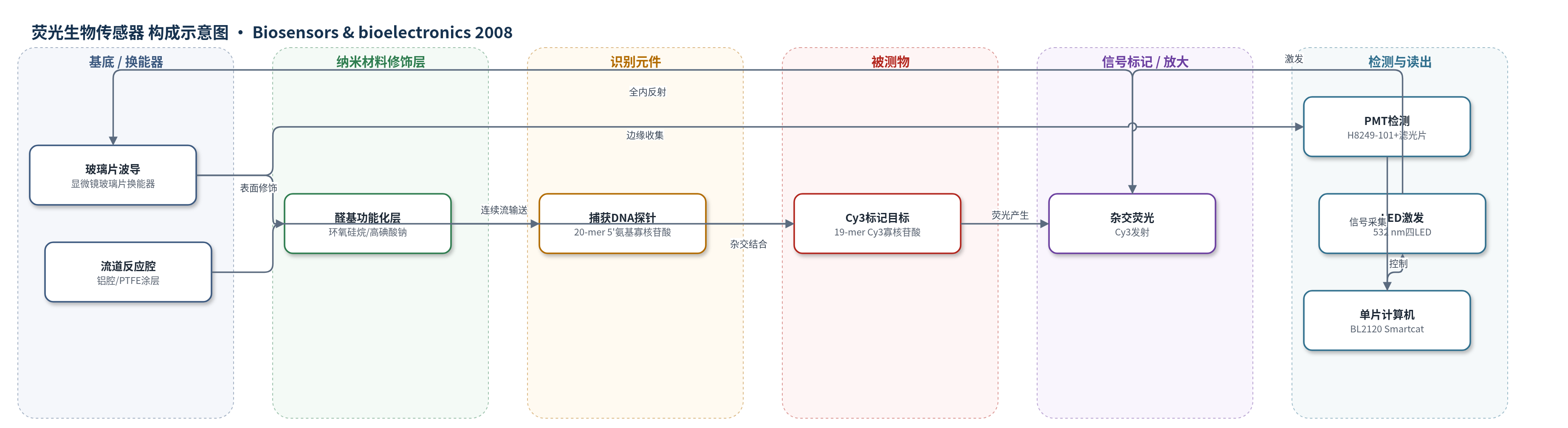
点击图片查看大图 · 依据论文自动绘制
传感器类型
荧光生物传感器
检测对象
DNA杂交目标(Cy3标记互补寡核苷酸,Cy3-labelled complementary oligonucleotide);样品基质:杂交缓冲液(hybridization buffer,10X SSC、2x Denhardt)连续流样品
检测原理
玻璃片表面经硅烷化和高碘酸钠氧化形成醛基,与5′氨基捕获寡核苷酸共价结合,形成DNA探针阵列。当含Cy3标记互补目标DNA的杂交缓冲液连续流过传感区时,目标与捕获探针杂交,使界面Cy3荧光分子密度随目标浓度增加。532 nm LED正交激发传感区,Cy3发射的荧光中满足全内反射条件的模式被耦合进玻璃片波导,并沿玻璃片导引至边缘PMT。PMT经带通和高通滤光片读出荧光强度,软件进行暗电流、背景、时间重标和参考区强度校正。信号随杂交进程实时上升,可用Langmuir模型拟合得到结合动力学;检出限由背景3σ和Langmuir模型换算为表面分子密度。
检测灵敏度
LOD: 16 mol/μm2
效应效果
系统连续运行36 h无气泡,背景120次测量CV为0.05–0.2%;12片间隔数天测试,区1–4类间CV为0.13%、0.06%、0.09%、0.26%。六片传感片平均信号片间CV为1.4–3.7%,低于常规生物重复性。25 h清洗后背景变化1.36–2.08%,随后杂交动力学和平台值与立即测试相当。参考区可在线校正仪器偏差,10 nM标记目标平台信背比为22。杂交曲线覆盖0.05–10 nM,kon约为8.3×10^4、7.8×10^4、7.3×10^4 M−1 s−1,与文献系统一致。作者认为其便携、自动、低成本,适合环境监控和实时表面反应监测。
传感器的构成
- 基底/换能器:普通显微镜玻璃片(Gold Seal Products, cat No3010),作为荧光波导和生物阵列载体,边缘直接连接PMT。
- 表面功能化层:氧等离子体处理后用5,6-环氧己基三乙氧基硅烷(5,6-epoxy hexyl-trietoxysilane)硅烷化,环氧开环并经高碘酸钠氧化生成醛基,用于共价结合5′氨基寡核苷酸。
- 识别元件:20-mer捕获探针寡核苷酸(5′氨基,15-mer hybridizable),以36个636 pL微点点样于每个传感区,与目标DNA互补;一个区域点非特异性探针作参考。
- 信号标记物:Cy3标记互补19-mer寡核苷酸(15-mer hybridizable),杂交后提供荧光信号。
- 流体反应腔:自制铝制连续流腔,黑色PTFE涂层,流道6 mm×0.130 mm×46 mm,流速0.03–2.5 mL/min。
- 激发模块:四个532 nm LED(Luxeon Emitter III, Lumiled),经球透镜聚焦和525AF45带通滤波,光斑1.47 mm,入射功率约1.8 mW。
- 检测模块:PMT(H8249-101, Hamamatsu)接玻璃片边缘,配595AF60带通和OG570高通滤光片,收集全内反射荧光。
- 控制/流体模块:BL2120 Smartcat单片计算机、蠕动泵(P625/900-143)、三通电磁阀(N21172)和Tygon管,实现自动连续流与数据采集。
中文摘要
本文报道了一种面向环境监控等现场应用的新型荧光阵列生物传感器,并成功用于DNA杂交检测。该传感器以普通显微镜玻璃片同时作为换能器和生物阵列载体,利用聚焦的532 nm LED对玻璃片表面的多个传感区进行正交激发,激发产生的荧光通过全内反射在玻璃片内导引至边缘直接连接的光电倍增管(PMT)检测。系统无需机械扫描或成像光学元件,即可对四个传感区依次进行光学询问并同步检测,实现实时多分析物监测。装置集成于自制连续流反应腔中,可自动运行并连续监测表面反应数十小时。评估表明其背景信号稳定,片间重现性小于3.7%,低于常规生物重复性。DNA杂交实验测得检出限为16 mol/μm2,并可拟合Langmuir模型获得反应动力学参数。该传感器结构简单、鲁棒、易于维护,适用于实时表面反应监测。
英文摘要
A novel fluorescence-based array biosensor targeted for field applications, such as environmental monitoring, has been developed, and successfully applied to DNA hybridization assays. The purpose was to meet the demand for automated, portable but easy-to-maintain systems allowing continuous flow monitoring of surface reactions. The biosensor presented here can be distinguished from the existing systems by the optical method used, which provides an enhanced simplicity and robustness, and enables a simple maintenance by potentially unskilled personnel. The system is based on a conventional microscope slide which acts both as transducer and biological array sensor. The excited fluorescence is guided by total internal reflection into the slide to the detector which is directly interfaced to the slide. Each region of the sensor array is successively optically interrogated, and the detection of the corresponding fluorescent emission synchronized. A real-time three-analyte analysis is thus feasible without any mechanical scanning movement or optical imaging systems as generally used in the existing instruments. The ability of the biosensor to operate in continuous flow for several tens of hours has been demonstrated. The biosensor has been assessed in terms of stability, and slide-to-slide reproducibility, which is found to be less than 3.7%, thus far below the standard biological reproducibility. DNA hybridization assays were performed to estimate a limit of detection, which was found to be 16 mol/microm(2), and to determine the reaction kinetics associated to the DNA model used. The developed biosensor is thus shown to be able to predict reaction kinetics, and to monitor in real time surface reactions between targets and probes.