组成图示
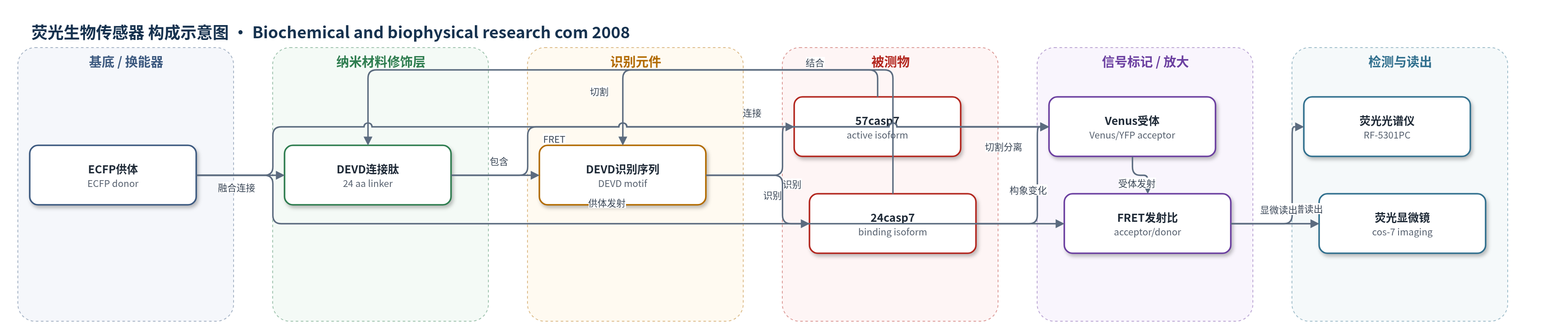
点击图片查看大图 · 依据论文自动绘制
传感器类型
荧光生物传感器
检测对象
caspase-7(CASP7)同工型 57casp7、24casp7;样品基质:重组蛋白溶液、cos-7 细胞
检测原理
vDEVDc 由 ECFP 供体、含 DEVD 序列的 24 氨基酸连接肽和 Venus 受体组成。未结合时,供体与受体距离较近,440 nm 激发 ECFP 后发生 FRET,Venus 发射较强,FRET 发射比(受体/供体)较高。57casp7 识别并切割 DEVD 位点,使连接肽断裂、供体与受体分离,FRET 效率下降,受体发射降低、供体发射升高,信号随切割比例增加而下降。24casp7 虽无水解活性,但结合 DEVD 后改变连接肽构象,使 FRET 发射比增加 15%;计算模型预测增加 31.7%。在 cos-7 细胞中,STS 诱导凋亡激活 caspase-7,438 nm 激发下监测 CFP(483 nm)与 YFP(520 nm)通道,YFP/CFP 比下降反映切割。
检测灵敏度
原文未报告 LOD、线性范围、灵敏度斜率或相关系数。
效应效果
该传感器对 DEVD 识别序列具有特异性:57casp7 切割 vDEVDc,对照 v4Gc 不被切割;24casp7 仅结合 vDEVDc,不与 v4Gc 作用。单独孵育 1 h 时 vDEVDc、v4Gc 及 24casp7+v4Gc 光谱均无变化,说明 FRET 变化来自 DEVD 特异性识别。时间序列中光漂白造成约 2.5% 的 FRET 发射比下降;57casp7 引起 67% 指数下降,24casp7 引起 8% 指数增加(1 h 实验为 15%)。cos-7 细胞中 5 μM STS 诱导凋亡约 2 h 后出现 YFP 下降、CFP 上升。计算模型预测结合使 FRET 发射比增加 31.7%,与实验一致。作者认为该传感器可区分 caspase-7 的结合与水解活性。
传感器的构成
- 供体荧光蛋白:ECFP(enhanced cyan fluorescent protein),作为 FRET 供体,激发后向受体转移能量。
- 受体荧光蛋白:Venus(YFP 变体),作为 FRET 受体,切割或结合后发射变化。
- 识别元件:DEVD 四肽序列(位于 GGASGGASGGDEVDGGASGGASGG 中),被 caspase-7 识别并切割。
- 连接肽:24 氨基酸柔性连接肽,连接 ECFP 与 Venus,决定供体-受体距离与 FRET 效率。
- 对照识别元件:v4Gc 中的四甘氨酸序列(GGGG),不含 DEVD,用于排除非特异性切割或结合。
- 表达构建体:phvDEVDctx 质粒(由 pCfptx、pVentx、pHistx、pDEVDtx 组装),编码 vDEVDc 融合蛋白。
- 细胞表达系统:cos-7 细胞,转染 phvDEVDctx 后用于 STS 诱导凋亡的活细胞 FRET 监测。
中文摘要
本研究基于荧光共振能量转移(FRET)构建了 caspase-7 生物传感器 vDEVDc,用于研究细胞凋亡执行蛋白酶 caspase-7 的蛋白水解特性。vDEVDc 由 ECFP 供体、含 DEVD 识别序列的 24 氨基酸连接肽和 Venus 受体组成。N 端缺失 56 个残基的活性同工型 57casp7 可在识别序列处切割 vDEVDc,使 FRET 效率下降 61%;而 N 端缺失 23 个残基的同工型 24casp7 虽能与 vDEVDc 结合但不切割,使 FRET 发射比增加 15%。动力学结果显示 57casp7 呈指数切割曲线,24casp7 呈指数结合曲线。在 cos-7 细胞中,STS 诱导凋亡后监测 vDEVDc 的 FRET 变化,观察到 YFP 信号下降、CFP 信号上升。计算模型预测 24casp7 结合使 FRET 发射比增加 31.7%,与实验 15% 一致。结果表明两种截短 caspase-7 同工型具有不同酶学性质:24casp7 仅结合底物,57casp7 可水解底物。
英文摘要
A caspase-7 biosensor (vDEVDc) based on FRET (fluorescence resonance energy transfer) was used to study the proteolytic properties of caspase-7, an executioner protease in cellular apoptosis. An active isoform of caspase-7 with the 56 N-terminal residues truncated (57casp7) cleaved vDEVDc at the recognition sequence, resulting in a FRET efficiency decrease of 61%. In contrast, an isoform with the 23 N-terminal residues truncated (24casp7) bound to vDEVDc but did not cleave the substrate, resulting in a FRET increase of 15%. Kinetic results showed an exponential substrate cleavage and binding curve for the 57casp7 and 24casp7 isoforms, respectively. FRET changes of the vDEVDc biosensor were also monitored in cos-7 cells upon STS-induced apoptosis. Finally, we modeled caspase-7 binding to vDEVDc and estimated a FRET emission ratio increase of 31.7%, which agrees with the 15% experimental result. We showed that two differently truncated isoforms of caspase-7 exhibit different enzymatic properties, namely binding by 24casp7 and hydrolysis by 57casp7.