组成图示
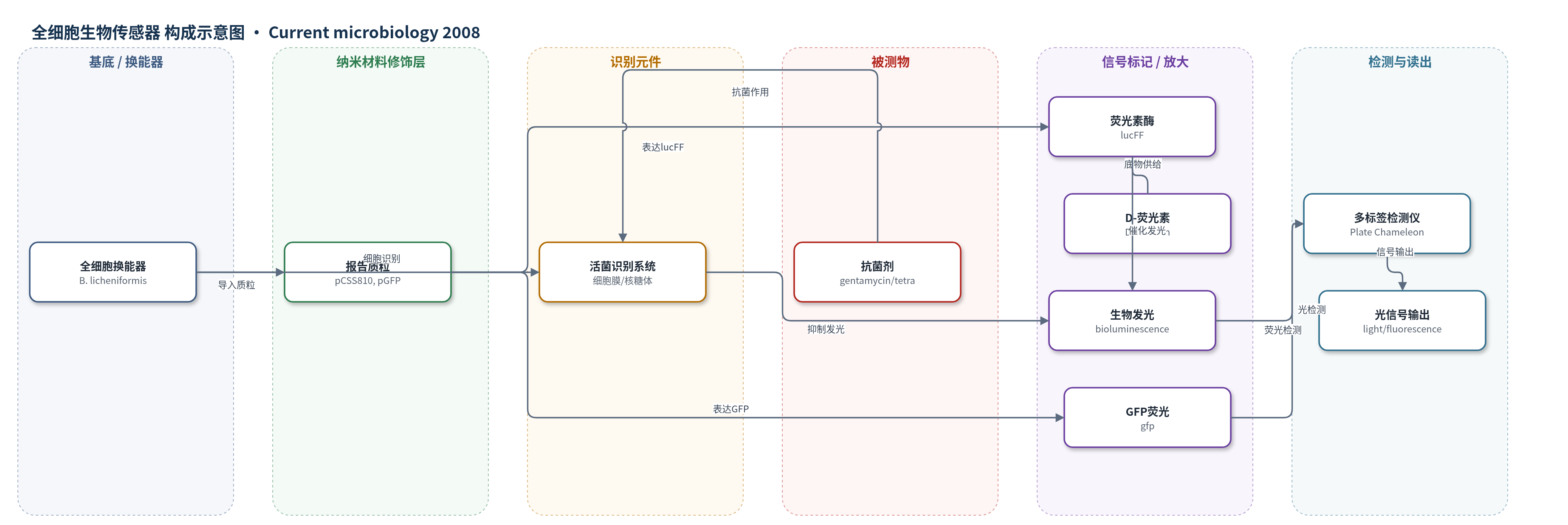
点击图片查看大图 · 依据论文自动绘制
传感器类型
全细胞生物传感器
检测对象
庆大霉素(gentamycin)、四环素(tetracycline)、羧苄西林(carbenicillin);样品基质:LB 培养基抗菌剂二倍稀释系列/细胞培养液
检测原理
该传感器以表达报告基因的全细胞为识别与换能单元。pCSS810 使地衣芽孢杆菌表达昆虫荧光素酶 lucFF,在加入 D-luciferin 后,荧光素酶催化底物氧化并产生生物发光;发光强度与细胞代谢状态、ATP 水平和活力相关。当抗菌剂如 gentamycin 或 tetracycline 作用于细胞时,分别干扰 30S 核糖体或蛋白合成,导致细胞代谢和活力下降,生物发光随抗菌剂浓度和作用时间增加而降低,从而实现对抗菌剂效应的实时检测。pGFPratiometric 表达的 GFP 不需外源底物,其荧光主要反映细胞存在与分布,不随抗菌剂处理显著变化。系统未采用 HCR、RCA 或 CRISPR-Cas 等核酸放大策略,信号放大主要来自荧光素酶催化发光和全细胞报告系统。
检测灵敏度
原文未报告 LOD、线性范围、灵敏度斜率或相关系数。
效应效果
发光株无选择压力下较稳定,20–25 代后质粒保留率 77%;GFP 质粒完全丢失且荧光株生长慢。GFP 电转化效率 7.4×10^3 CFU/μg,pCSS810 仅获 1 个发光菌落。生物发光随生长增加,23 h 后不可检测;GFP 荧光可维持至 23 h 并可显微观察。抗菌剂测试中,gentamycin 和 tetracycline 的 MIC 分别为 10 和 1 μg/mL,carbenicillin 不敏感;4 h 内发光呈时间和剂量依赖下降,tetracycline 线性剂量响应,gentamycin 仅 10 μg/mL 抑制,carbenicillin 无影响;荧光不受抗生素影响。两次独立实验变异 <10%。作者认为发光可快速实时监测细胞活力和抗菌动力学,适用于植物表面生物控制菌监测。
传感器的构成
- 全细胞换能器:Bacillus licheniformis 51.5 活菌,作为识别与代谢响应单元
- 报告质粒:pCSS810(E. coli–B. subtilis shuttle vector,含 T5 promoter–lac operator 和 lucFF 基因),赋予生物发光表型
- 报告质粒:pGFPratiometric(E. coli–L. lactis shuttle vector,含 P32 promoter 和 gfp 基因),赋予绿色荧光表型
- 识别元件:完整细菌细胞及其膜/核糖体/蛋白合成系统,响应 gentamycin、tetracycline、carbenicillin 等抗菌剂
- 信号底物:D-luciferin(1 mM,0.1 M sodium citrate buffer pH 5.0),荧光素酶催化底物,产生生物发光
- 样品基质:LB 培养基及抗菌剂二倍稀释系列,用于培养与处理细胞
- 信号读出:Plate Chameleon Multilabel Detection Platform 96-well luminometer/fluorometer,测量发光与荧光
中文摘要
本研究将环境菌地衣芽孢杆菌(Bacillus licheniformis)51.5 分别用携带昆虫荧光素酶基因 lucFF 的穿梭质粒 pCSS810 和携带绿色荧光蛋白基因 gfp 的穿梭质粒 pGFPratiometric 进行电转化,获得生物发光和绿色荧光重组株。随后用不同抗菌剂处理细胞,并测量其生物发光与荧光。结果显示,携带 gfp 的质粒在无选择压力下完全丢失,荧光株生长慢于野生型,但在落射荧光显微镜下呈亮绿色;荧光强度与细胞生长状态无关,也不受抗生素处理影响。相反,携带 lucFF 的发光株在无抗生素选择下较稳定,生长行为与不带质粒细胞相似。发光株可作为所测抗生素的生物传感器,生物发光测量能够判断重组细胞活力并跟踪抗菌作用动力学。因此,生物发光是细胞健康状况的可靠、敏感且实时指标,而荧光可用于同时观察代谢活性和非活性细胞。
英文摘要
The environmental bacterium Bacillus licheniformis was transformed with two different shuttle-vectors (pCSS810 and pGFPratiometric) containing insect luciferase and green fluorescent protein genes, respectively. The cells were treated with various antimicrobial agents and the emitted bioluminescence and fluorescence were measured. Plasmid harboring the green fluorescent protein gene was totally segregated without selective pressure, and fluorescent B. licheniformis showed a slower growth rate than the wild-type strain; those cells were bright green as visualized by epifluorescent microscopy. However, fluorescence was not correlated to the growth state of cells or affected by the antibiotic treatments. To the contrary, luminescent transformant was found to be stable without antibiotic selection and showed analogous growth behavior compared to non-plasmid-bearing cells. The luminescent strain functioned as a biosensor for the antibiotics employed. Bioluminescence measurements allowed one to determine the viability of the recombinant cells and the kinetics of the antibacterial action could be followed. Thus, the light emission was found to be a reliable, sensitive, and real-time indicator of the "well-being" of cells, whereas fluorescence allowed one to visualize both metabolically active and inactive cells.