组成图示
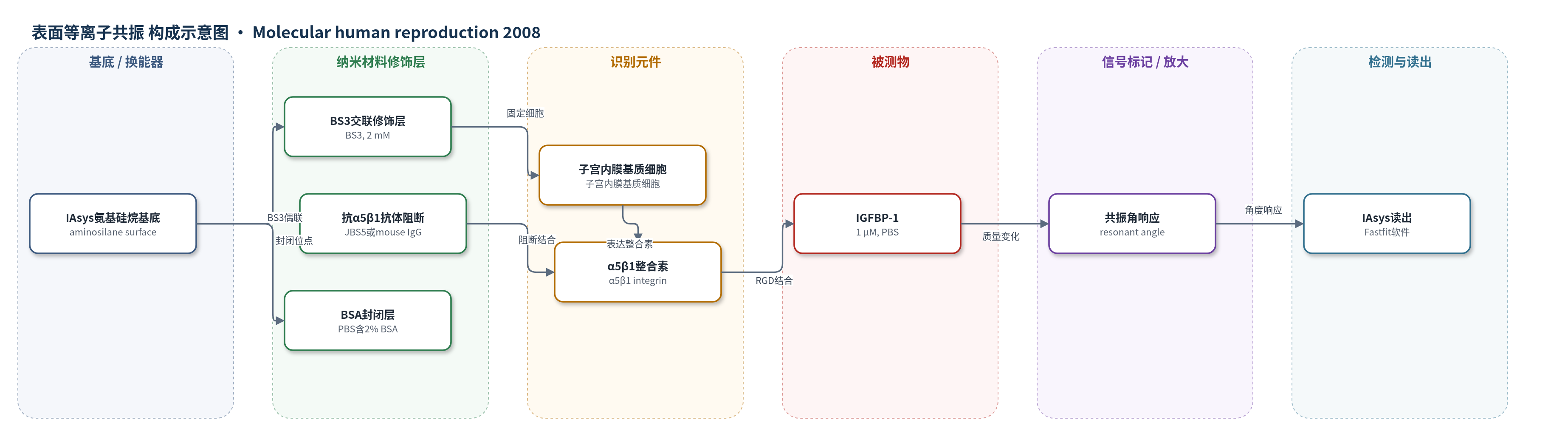
点击图片查看大图 · 依据论文自动绘制
传感器类型
表面等离子共振(SPR)生物传感器
检测对象
胰岛素样生长因子结合蛋白-1(IGFBP-1),样品基质:PBS 流动相(生物传感器结合分析);另在子宫内膜基质细胞条件培养基中检测 PRL 和 IGFBP-1(EIA/ELISA)
检测原理
该 SPR 生物传感器以 IAsys plus 双槽比色皿的平面氨基硅烷表面为换能基底,利用水溶性交联剂 BS3 将人子宫内膜基质细胞化学固定于表面,细胞表面 α5β1 整合素作为识别元件。PBS 中 1 μM IGFBP-1 流过时,其 RGD 序列与 α5β1 整合素结合,使界面质量/折射率增加,导致表面等离子共振角发生偏移;随后用 PBS 和 0.05% Tween-20 洗脱未结合物并记录解离曲线。抗 α5β1 单克隆抗体 JBS5 预孵育可阻断结合,使响应降低,而 mouse IgG 对照保留结合。信号随 IGFBP-1 结合量增加而增强,无酶促或核酸放大。
检测灵敏度
未报告生物传感器 LOD、线性范围、灵敏度斜率或相关系数。
效应效果
生物传感器结合分析显示,IGFBP-1 可结合经 mouse IgG 处理的子宫内膜基质细胞,但抗 α5β1 整合素抗体 JBS5 处理后结合被抑制,提示 α5β1 整合素是 IGFBP-1 的主要结合位点;三次独立实验结果相似。细胞培养中,E2+MPA 使 PRL 和 IGFBP-1 分泌分别升高 13.6 倍和 41.4 倍;100 nM IGFBP-1 使 PRL 升至 5.3±0.2 ng/ml,接近 E2+MPA 的 6.8±0.8 ng/ml。RGD 肽将 IGFBP-1 诱导的 PRL 降至 1.1±0.2 ng/ml,单独无作用;LR3-IGF-I 抑制 E2+MPA 诱导蜕膜化但不抑制 IGFBP-1 诱导。
传感器的构成
- 换能基底:IAsys plus 双槽搅拌比色皿与平面氨基硅烷表面(aminosilane surface),提供氨基偶联位点并产生共振角响应
- 交联修饰层:水溶性交联剂 BS3(2 mM),将子宫内膜基质细胞化学固定到氨基硅烷表面
- 识别元件:人子宫内膜基质细胞表面 α5β1 整合素(α5β1 integrin),与 IGFBP-1 的 RGD 序列结合
- 阻断/对照元件:抗 α5β1 单克隆抗体 JBS5 或 mouse IgG,用于封闭 α5β1 结合位点或设置阴性对照
- 封闭剂:PBS 含 2% BSA,封闭剩余氨基位点,降低非特异结合
- 被测物:重组人 IGFBP-1(1 μM,PBS 溶解),作为流动相分析物
- 解离/清洗液:PBS 和 0.05% Tween-20,终止结合并记录解离曲线
- 信号读出:IAsys plus 共振角响应(resonant angle response),Fastfit 软件分析
中文摘要
孕激素可诱导人子宫内膜基质细胞体外蜕膜化,蜕膜化细胞产生胰岛素样生长因子结合蛋白-1(IGFBP-1)和催乳素(PRL)。本研究检验 IGFBP-1 是否直接刺激蜕膜化。从正常月经周期、因子宫肌瘤行子宫切除术患者获取子宫内膜基质细胞,在含或不含 IGFBP-1 及 LR3-IGF-I(与 IGF-I 受体结合但对 IGFBP 亲和力降低的 IGF-I 类似物)条件下,用雌二醇(E2)和/或醋酸甲羟孕酮(MPA)培养至多 4 周。以形态改变和 PRL 释放评估蜕膜化,并用生物传感器分析 IGFBP-1 与细胞结合。结果显示,MPA 和 E2 诱导蜕膜化,LR3-IGF-I 抑制其诱导的蜕膜化及 PRL、IGFBP-1 分泌;IGFBP-1 可在无 MPA 和 E2 时诱导蜕膜化。IGFBP-1 诱导的蜕膜化不被 LR3-IGF-I 抑制,但被 RGD 肽抑制,RGD 肽单独无作用。结合分析显示 IGFBP-1 结合于子宫内膜基质细胞表面,抗 α5β1 整合素抗体可抑制其结合。结果提示子宫内膜产生的 IGFBP-1 可能通过 α5β1 整合素介导孕激素诱导的蜕膜化。
英文摘要
Progesterone is known to induce decidualization of human endometrial stromal cells in vitro. Decidualized stromal cells produce insulin-like growth factor binding protein-1 (IGFBP-1) as well as prolactin (PRL). In this study, we tested the possibility that IGFBP-1 directly stimulates endometrial stromal cell decidualization. Endometrial stromal cells were obtained from normal menstruating patients with uterine myoma at hysterectomy. Stromal cells were cultured for up to 4 weeks with estradiol (E(2)) and/or medroxy progesterone acetate (MPA) in the presence or the absence of IGFBP-1 and, LR(3)-IGF-I (an IGF-I analogue) that binds to the IGF-I receptor but has reduced affinity for IGFBPs. Decidualization of endometrial stromal cells was evaluated by morphological changes and PRL release into culture media. The binding of IGFBP-1 to endometrial cells was analysed using a biosensor. MPA and E(2) induced decidualization of stromal cells, while LR(3)-IGF-I inhibited decidualization by MPA and E(2) as well as PRL and IGFBP-1 secretion into medium. IGFBP-1 induced decidualization of stromal cells in the absence of MPA and E(2) in the medium. IGFBP-1-induced decidualization was not inhibited by the addition of LR(3)IGF-1 but was inhibited by the addition of an RGD peptide, however, the RGD peptide had no effect on decidualization when added alone. The binding analysis showed that IGFBP-1 bound to the surface of endometrial stromal cells and an anti-alpha5beta1 integrin antibody inhibited its binding. These results suggest that IGFBP-1 produced by endometrium can mediate progesterone-induced decidualization possibly by interacting with alpha5beta1 integrin on the surface of endometrial stromal cells.