组成图示
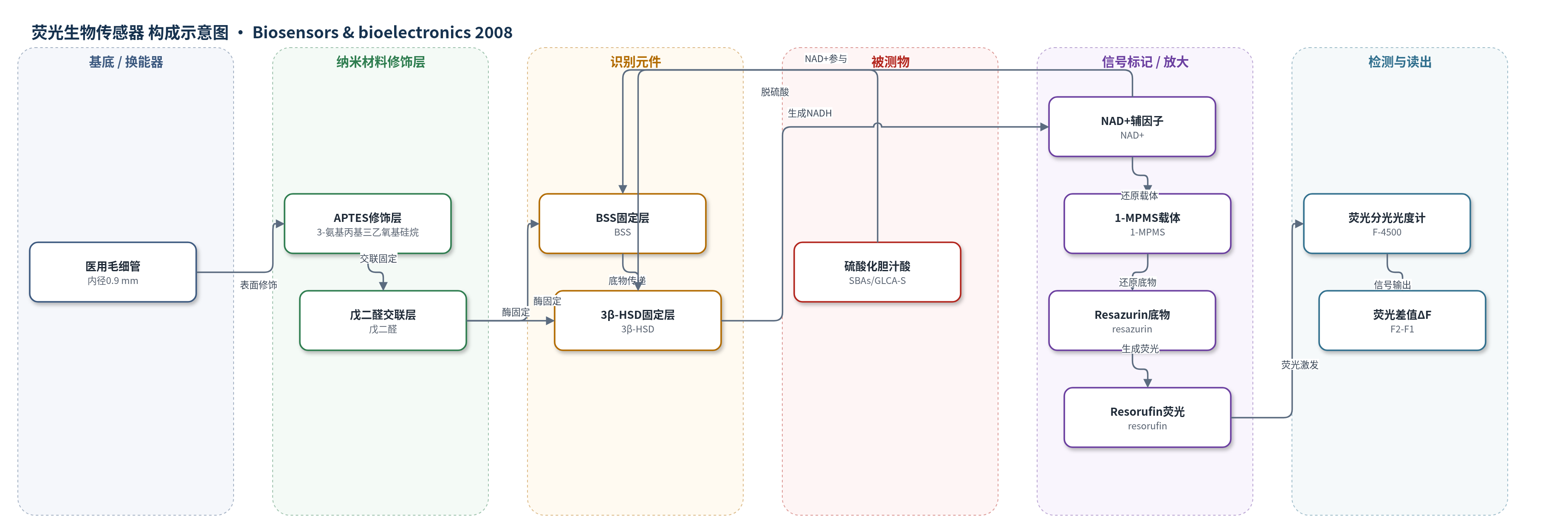
点击图片查看大图 · 依据论文自动绘制
传感器类型
荧光生物传感器
检测对象
硫酸化胆汁酸(sulfated bile acids, SBAs;以甘氨胆酸硫酸酯 GLCA-S 为代表);样品基质:尿液
检测原理
该传感器以固定化酶催化作为识别事件:SBAs在BSS催化下脱硫酸生成3β-羟基胆汁酸;3β-HSD进一步催化3β-羟基胆汁酸氧化为3-酮类固醇,同时NAD+被还原为NADH。NADH作为电子供体将1-MPMS还原为1-MPMSH2,并再生NAD+,形成循环传递;1-MPMSH2再将resazurin还原为强荧光产物resorufin。resorufin在540 nm激发、580 nm发射,荧光差值ΔF随SBAs浓度升高而增大。酶促级联与NAD+/1-MPMS循环构成信号放大,使微量SBAs产生可测荧光。固定化酶可提高灵敏度并便于重复使用。
检测灵敏度
LOD: 0.16 μmol L−1;线性范围: 0.5–5.0 μmol L−1;灵敏度斜率: 71.286;相关系数: r = 0.9991
效应效果
该传感器抗干扰能力较好,尿素(50–1000 mmol/L)、抗坏血酸(0.25–2.0 mmol/L)、尿酸(0.25–2.5 mmol/L)、葡萄糖(50–200 mg/L)和NaCl(100–500 mg/L)均不干扰;尿液预反应10 min可消除未知干扰。稳定性方面,同一传感器每周测3次、连续1个月,荧光均值165.4±2.4,RSD<1.4%(n=12),4 ℃保存至少6个月。重现性RSD为2.2%–3.3%。尿液加标回收率为95.5%–106%。与商用UBASTEC试剂盒相比结果无明显差异;固定化传感器斜率71.286高于液相酶法38.055。单次反应体积仅18 μL,试剂用量约为传统荧光法的1/400,适合临床尿液SBAs检测。
传感器的构成
- 基底/反应腔:医用毛细管(medical capillary,内径0.9 mm),作为反应容器和荧光检测窗口
- 表面修饰层:3-氨基丙基三乙氧基硅烷(APTES),共价结合于毛细管内壁羟基,提供氨基
- 交联固定层:戊二醛(glutaraldehyde),与APTES氨基反应形成醛基交联层,用于固定酶
- 催化识别元件:胆汁酸硫酸酯酶(BSS,EC 2.8.2.14)和3β-羟基类固醇脱氢酶(3β-HSD,EC 1.1.1.51),催化SBAs脱硫酸及3β-羟基胆汁酸氧化
- 封闭层:0.5 mmol/L Tris缓冲液,封闭残余醛基
- 信号放大试剂:NAD+、1-MPMS和resazurin,构成NADH/1-MPMS循环并将resazurin还原为resorufin
- 读出装置:F-4500荧光分光光度计与自制毛细管夹持器,540 nm激发、580 nm发射检测resorufin荧光
中文摘要
本文提出一种固定化酶荧光毛细管生物传感器(SBAs-IE-FCBS),用于尿液中硫酸化胆汁酸(SBAs)的测定。该传感器将胆汁酸硫酸酯酶(BSS)和3β-羟基类固醇脱氢酶(3β-HSD)固定于医用毛细管内壁。在BSS催化下,SBAs脱硫酸生成3β-羟基胆汁酸;在3β-HSD催化下,3β-羟基胆汁酸与NAD+反应生成3-酮类固醇和NADH。NADH与1-甲氧基-5-甲基吩嗪甲基硫酸盐(1-MPMS)循环反应生成NAD+和1-MPMSH2,1-MPMSH2进一步将resazurin还原为resorufin(λex/λem:540/580 nm),通过resorufin荧光强度定量SBAs。优化条件下,BSS和3β-HSD固定化浓度均为5 kU/L,1-MPMS和resazurin均为25 μmol/L,Tris-HCl缓冲液和NAD+分别为100和400 μmol/L,反应总体积18 μL,37 ℃反应15 min。SBAs浓度在0.5–5.0 μmol/L范围内与荧光强度呈线性关系,RSD小于3.4%,检出限为0.16 μmol/L,回收率为95.5%–106%。该传感器可用于尿液SBAs定量,辅助诊断肝胆疾病。
英文摘要
The authors have proposed an immobilized enzymatic fluorescence capillary biosensor (SBAs-IE-FCBS) for the determination of sulfated bile acids (SBAs). The reaction principle of the biosensor is that under the catalysis of the bile acid sulfate sulfatase (BSS) and beta-hydroxysteroid dehydrogenase (beta-HSD) immobilized on inner surface of a medical capillary, SBAs desulfates to 3beta-hydroxyl bile acids, then the latter reacts with nicotinamide adenine dinucleotide (NAD(+)), and is converted into 3-ketosteroid; meanwhile, NAD(+) is converted to reduced nicotinamide adenine dinucleotide (NADH). NADH continuously reacts with 1-methoxy-5-methylphenazinium methyl sulfate (1-MPMS) and is converted into NAD(+) circularly and 1-MPMSH(2). Finally resazurin is reduced into resorufin by 1-MPMSH(2), the formed resorufin (lambda(ex)/lambda(em): 540 nm/580 nm) is used for quantifying the concentration of SBAs. Optimized conditions being suitable with the biosensor are as follows: the concentrations of BSS and beta-HSD used for the immobilization all are 5 kUL(-1); the concentrations of 1-MPMS and resazurin all are 25 micromolL(-1); the concentrations of Tris-HCl buffer and NAD(+) are 100 and 400 micromolL(-1), respectively; total volume of the enzyme, reagent and sample is only 18 microL per time for determining; the reaction temperature is 37 degrees C; the reaction time is 15min. The concentration of SBAs is directly proportional to the fluorescence intensity of the biosensor measured from 0.5 to 5.0 micromolL(-1). The relative standard deviation is less than 3.4%, and the detection limit was 0.16 micromolL(-1). The recoveries are in the range 95.5-106%. This SBA-IE-FCBS can be used for quantifying SBAs in urine to diagnose and judge hepatobiliary diseases, etc.