组成图示
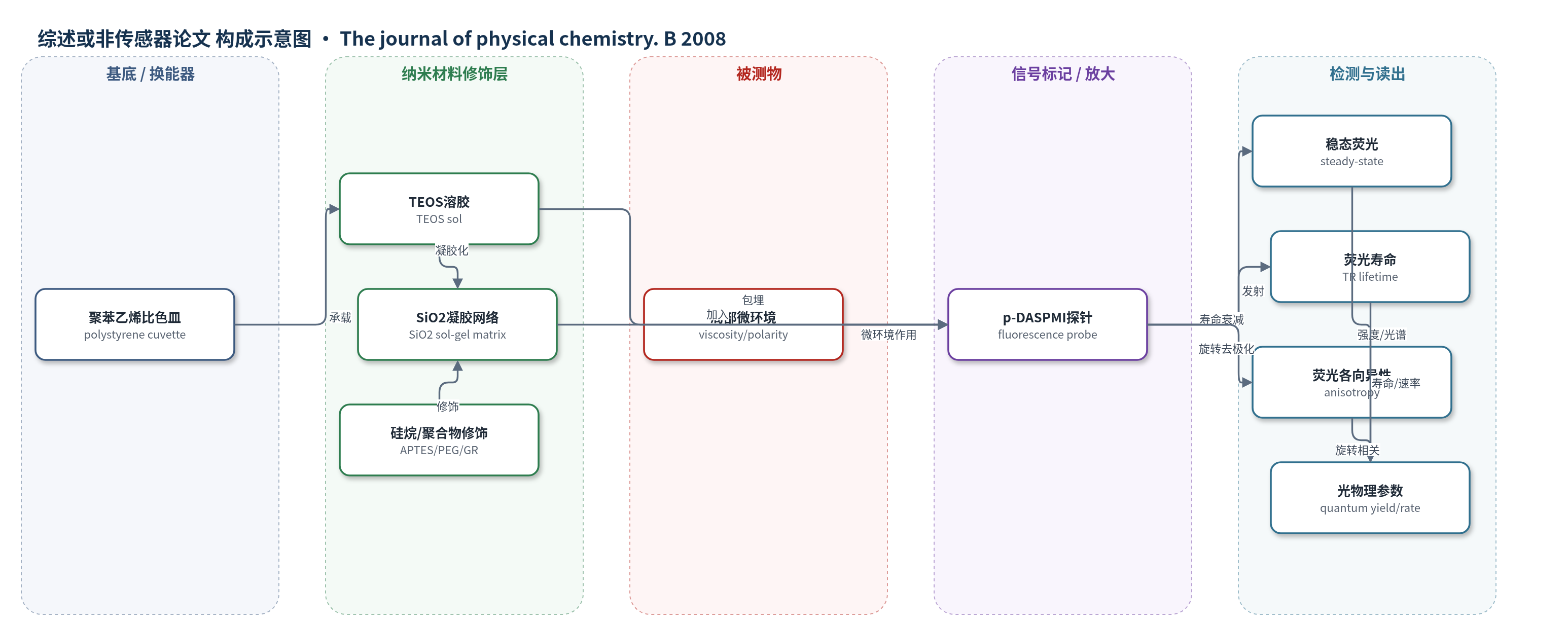
点击图片查看大图 · 依据论文自动绘制
传感器类型
综述或非传感器论文
检测对象
局部粘度与极性微环境(local viscosity/polarity microenvironment)、凝胶化与老化过程(gelation and aging process);样品基质:TEOS 溶胶-凝胶二氧化硅基质(SiO2 sol-gel matrix)
检测原理
p-DASPMI 为 stilbazolium 类荧光探针,激发后存在平面态、电荷转移态和扭曲分子内电荷转移(TICT)态。当 TEOS 溶胶发生水解缩合并形成 SiO2 网络时,局部粘度迅速升高,抑制探针的非辐射衰减通道,使荧光量子产率、发射强度和平均寿命增加;基质老化使孔内液相组成与极性变化,部分探针分子发生溶剂致变色蓝移。时间分辨荧光寿命反映不同激发态布居,时间分辨各向异性通过旋转相关时间报告溶剂笼、氢键和局部粘度。因此,稳态发射、寿命和各向异性共同将凝胶化/老化引起的微环境变化转换为可测荧光信号。
检测灵敏度
相关系数: R = 0.994;log-log 拟合斜率: -0.45 ± 0.02
效应效果
p-DASPMI 能区分 TEOS 溶胶-凝胶基质的凝胶化、初始老化和长期老化阶段。较高 pH 下基质粘度更高;加入 APTES、TMPS、GPTES、PEG 300、PEG 20k 或 Gelrite 后凝胶化总体变慢,其中 Gelrite 和 PEG 20k 显著增强 SiO2 网络聚合,PEG 300 影响较小,GPTES 因形成较大孔和溶剂池使粘度响应最低。老化约 20 天后数据趋于稳定,寿命随老化增加,TICT 态贡献上升;稳态发射出现 5%–20% 分子蓝移,反映局部极性降低。未报告 RSD、回收率或 ELISA/HPLC/qPCR 对比。作者认为该探针可用于优化溶胶-凝胶生物传感器基质。
传感器的构成
- 容器/基底:10 mm 聚苯乙烯比色皿(polystyrene cuvette),承载溶胶并作为光学测量窗口
- 基质前驱体:四乙氧基硅烷(TEOS),水解缩合形成二氧化硅(SiO2)溶胶-凝胶网络
- 硅烷修饰层:3-氨基丙基三乙氧基硅烷(APTES)、三甲基丙基硅烷(TMPS)或 3-缩水甘油氧基丙基三乙氧基硅烷(GPTES),调控孔壁亲疏水性与网络结构
- 聚合物修饰层:聚乙二醇(PEG 300、PEG 20k)或 Gelrite(GR,结冷胶),吸附或模板于孔表面,改变凝胶化与老化
- 荧光探针:p-DASPMI(4-(4-(dimethylamino)styryl)-N-methylpyridinium iodide),报告局部粘度与极性
- 缓冲介质:磷酸盐缓冲液(pH 7),维持水相并避免 p-DASPMI 质子化
- 光学读出:稳态荧光光谱与时间分辨单光子计数荧光/各向异性,检测 490 nm 激发、约 600 nm 发射
中文摘要
stilbazolium 盐因扭曲分子内电荷转移(TICT)机制而具有多种荧光行为,其荧光寿命对粘度敏感,适合作为细胞和溶胶-凝胶介质等微非均相体系的探针。溶胶-凝胶基质光学透明,可用于光谱研究,并已被用于固定蛋白质等生物分子以开发生物传感器,但需优化。本研究通过引入硅烷或聚合物对二氧化硅溶胶-凝胶基质进行改性,添加物包括(3-氨基丙基)三乙氧基硅烷(APTES)、三甲基丙基硅烷(TMPS)、(3-缩水甘油氧基丙基)三乙氧基硅烷(GPTES)、聚乙二醇(PEG 300 和 PEG 20k)以及 Gelrite(GR)。采用稳态和时间分辨荧光研究 p-DASPMI 的光物理性质,考察改性剂对凝胶化和老化过程的影响,并区分改性溶胶-凝胶基质制备各主要步骤中占主导的染料-基质相互作用。
英文摘要
Stillbazolium salts present remarkable potential for application in several scientific areas. Their versatile behavior is explained by invoking the "twisted intramolecular charge-transfer" (TICT) mechanism, a model that describes the multiple fluorescence of DASPMI (4-(4-(dimethylamino)styryl)- N-methylpyridiniumiodine). One feature of their behavior is the sensitivity of the fluorescence lifetime to viscosity, thus identifying them as suitable probes for microheterogeneous systems, such as cells and sol-gel derived media. Because of their optical transparency, sol-gel matrices are light addressable and therefore appropriate for performing spectroscopic studies. The sol-gel process has been successfully used to produce hosts to biomolecules like proteins, for biosensor applications; however, these systems have to be optimized. Therefore, in this study modification of the matrices was performed through the incorporation of either silanes or polymers. (Aminopropyl)triethoxysilane, trimethoxypropylsilane, or (glycidyloxypropyl)triethoxysilane were added. The modification was also extended to the incorporation of the polymers poly(ethylene glycol) (molecular weight 300 and 20000) and Gelrite. The effect of these modifiers upon the gelation and aging processes was examined via the study of the photophysics of p-DASPMI by using both steady-state and time-resolved fluorescence. It was possible to discriminate the dominant dye-host interactions in each of the main steps of the preparation of modified sol-gel matrices.