组成图示
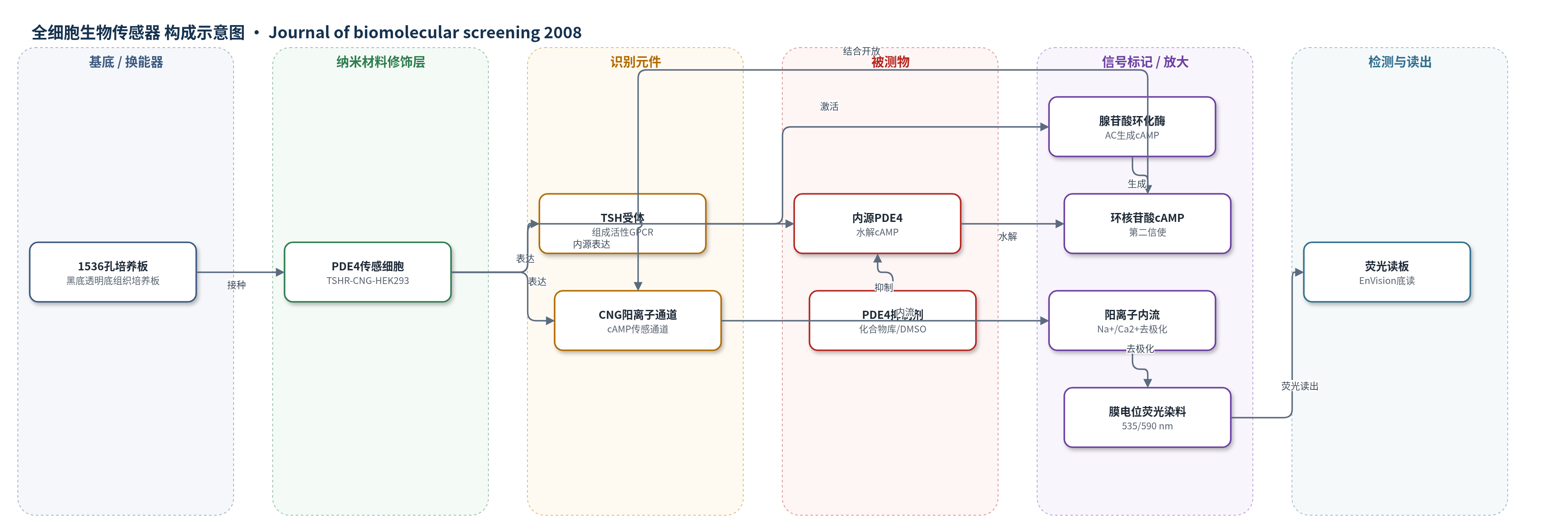
点击图片查看大图 · 依据论文自动绘制
传感器类型
全细胞生物传感器
检测对象
PDE4 抑制剂(PDE4 inhibitors);PDE4 酶活性(PDE4 activity);样品基质:DMSO 化合物库溶液(最终 DMSO <0.5%)/活细胞培养体系
检测原理
该检测以稳定共表达TSHR与CNG通道的HEK293细胞为传感平台。组成活性TSHR通过Gαs持续激活腺苷酸环化酶(AC),使细胞内维持中等水平cAMP;无抑制剂时,内源PDE4快速水解cAMP,形成基线。加入PDE4抑制剂后,PDE4活性被抑制,cAMP积累并进入CNG通道,通道开放导致Na+和Ca2+内流,细胞膜去极化。膜电位荧光染料随去极化程度增强荧光,激发535 nm、发射590 nm。因此荧光信号随PDE4抑制程度/cAMP浓度升高而升高,无需洗涤或外源激动剂,可在标准荧光读板中均相读出。
检测灵敏度
原文未报告 LOD、线性范围、灵敏度斜率或相关系数。
效应效果
1536孔板中,1000细胞/孔时S/B为5.2;DMSO板S/B 3.9、CV 10.5%、Z′ 0.50(图注0.46),DMSO至2%无明显干扰。加药后30–60 min信号稳定,60 min后下降。亲本CNG-HEK293反筛可排除荧光干扰和cAMP通路激活剂。筛选2187个化合物,得35个活性<10 μM候选物,其中17个亲本细胞也活性;11个为已知PDE抑制剂,另4个新化合物经PDE4酶法确认。已知PDE4抑制剂IC50在10倍窗口内:RO 20-1724 1.0 μM、rolipram 0.1 μM、trequinsin 3.2 μM、etazolate 9.9 μM;PDE1抑制剂vinpocetine仅20%响应。
传感器的构成
- 培养板基底:1536孔黑底透明底组织培养处理板(Kalypsys),承载细胞并适配底读荧光检测
- 细胞传感平台:TSHR-CNG-HEK293细胞(BD ACTOne),稳定共表达TSHR与CNG通道,作为活细胞换能器
- 驱动元件:甲状腺刺激激素受体(TSHR,组成活性GPCR),经Gαs激活腺苷酸环化酶(AC)持续产生cAMP
- 内源靶酶:HEK293内源PDE4,水解cAMP形成基线信号
- 传感识别元件:环核苷酸门控阳离子通道(CNG channel),结合cAMP后开放并允许Na+/Ca2+内流
- 信号标记物:膜电位荧光染料(BD ACTOne membrane potential dye),响应膜去极化,激发535 nm/发射590 nm
- 被测物/化合物:PDE4抑制剂(化合物库,DMSO溶液,最终DMSO<0.5%),抑制PDE4使cAMP积累
- 读出设备:EnVision荧光读板(PerkinElmer),底读模式检测相对荧光单位(RFU)
中文摘要
环核苷酸磷酸二酯酶(PDE)是催化cAMP和cGMP水解为5'-核苷酸单磷酸的胞内酶,通过调控环核苷酸浓度参与多种细胞信号事件,并已成为哮喘、心血管疾病、注意缺陷多动障碍、帕金森病和阿尔茨海默病等疾病的重要药物靶点。尽管纯化重组PDE酶与cAMP/cGMP底物组成的生化检测常用于化合物筛选,但基于细胞的检测能更真实地反映化合物在生理环境中的活性。作者报道并验证了一种新的基于细胞的PDE4检测方法:在1536孔板中,利用组成活性G蛋白偶联受体作为cAMP生成的驱动力,并以环核苷酸门控阳离子通道作为生物传感器,通过膜电位荧光染料均相检测PDE4抑制活性,适用于高通量筛选。
英文摘要
The cyclic nucleotide phosphodiesterases (PDEs) are intracellular enzymes that catalyze the hydrolysis of 3,'5'-cyclic nucleotides, such as cyclic adenosine monophosphate (cAMP) and cyclic guanosine monophosphate (cGMP), to their corresponding 5'nucleotide monophosphates. These enzymes play an important role in controlling cellular concentrations of cyclic nucleotides and thus regulate a variety of cellular signaling events. PDEs are emerging as drug targets for several diseases, including asthma, cardiovascular disease, attention-deficit hyperactivity disorder, Parkinson's disease, and Alzheimer's disease. Although biochemical assays with purified recombinant PDE enzymes and cAMP or cGMP substrate are commonly used for compound screening, cell-based assays would provide a better assessment of compound activity in a more physiological context. The authors report the development and validation of a new cell-based PDE4 assay using a constitutively active G-protein-coupled receptor as a driving force for cAMP production and a cyclic nucleotide-gated cation channel as a biosensor in 1536-well plates.