组成图示
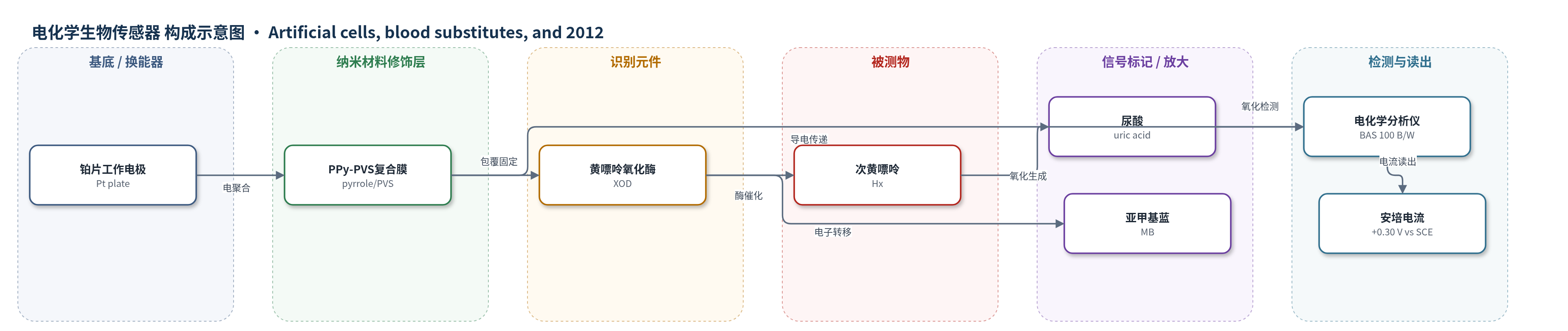
点击图片查看大图 · 依据论文自动绘制
传感器类型
电化学生物传感器
检测对象
次黄嘌呤(hypoxanthine, Hx)、黄嘌呤(xanthine, X);样品基质:鱼肉匀浆水提液(fish meat extract)
检测原理
次黄嘌呤(Hx)进入电极表面后,被固定在PPy-PVS膜中的黄嘌呤氧化酶(XOD)催化氧化,经黄嘌呤(X)进一步转化为尿酸(uric acid)。在无氧气氛下加入的亚甲基蓝(MB)作为电子媒介,从XOD获取电子并抑制过氧化氢生成,减少尿酸与H2O2同时氧化造成的干扰。尿酸在铂电极/PPy-PVS界面于+0.30 V(SCE)发生电化学氧化,产生与尿酸浓度成正比的安培电流;由于尿酸生成量随Hx浓度增加而增加,电流响应随Hx浓度升高而增大。PPy-PVS导电膜提供电子传导通道并维持酶活性,实现Hx的安培检测。
检测灵敏度
LOD: 1.0 × 10^-7 M;线性范围: 1.0 × 10^-7 – 1.0 × 10^-3 M;R^2 = 0.972(1.1 × 10^-4 – 7.0 × 10^-4 M);Imax: 1.203 μA/mM
效应效果
该传感器利用亚甲基蓝(MB)在无氧气氛中传递电子并抑制过氧化氢生成,降低尿酸与H2O2同时氧化的干扰。电极30天储存期内前6天响应无明显下降,第7–10天快速下降,第30天保留初始响应的49%,可稳定使用约1周。1.0×10^-4 M Hx下20次测量RSD为26%。鱼肉样品标准加入法测定显示Hx随储存升高:第1天3.125×10^-3 M,第2天1.053×10^-2 M,第5天1.11×10^-2 M,第7天1.54×10^-2 M,表明7天后鱼肉迅速劣变。作者认为其制备简单、成本低,适用于鱼肉新鲜度快速检测。
传感器的构成
- 基底/工作电极:铂片(Pt plate,0.5 cm²),作为导电基底与安培换能器。
- 导电聚合物修饰层:聚吡咯-聚苯乙烯磺酸盐(PPy-PVS)复合膜,由吡咯(pyrrole)与聚苯乙烯磺酸盐(PVS)电聚合形成,提供导电通道并固定酶。
- 识别元件:黄嘌呤氧化酶(XOD),通过包覆法固定在PPy-PVS膜中,催化次黄嘌呤/黄嘌呤氧化。
- 电子媒介/信号调节剂:亚甲基蓝(methylene blue, MB),在无氧工作气氛中加入,从XOD获取电子并抑制过氧化氢生成,减少尿酸与H2O2同时氧化干扰。
- 信号产物:尿酸(uric acid),XOD催化次黄嘌呤/黄嘌呤氧化生成,在+0.30 V下被电化学氧化产生安培电流。
中文摘要
本文报道了一种用于检测鱼肉中次黄嘌呤的新型安培生物传感器。将黄嘌呤氧化酶(XOD)与吡咯、聚苯乙烯磺酸盐(PVS)通过电聚合包覆法固定在铂电极表面,制备聚吡咯-聚苯乙烯磺酸盐(PPy-PVS)复合膜酶电极。在+0.30 V(SCE)下,通过酶反应释放的尿酸在电极表面氧化进行黄嘌呤-次黄嘌呤测定。研究了pH、底物浓度和温度对传感器响应的影响。该酶电极对次黄嘌呤的线性工作范围为1.0×10^-7–1.0×10^-3 mol/L,检出限为1.0×10^-7 mol/L;固定化XOD的表观米氏常数Km(app)和最大电流Imax分别为0.0154 mmol/L和1.203 μA/mmol/L。最佳pH和温度分别为7.75和25 ℃。将该传感器用于鱼肉中次黄嘌呤测定,结果表明鱼肉在储存7天后迅速劣变,次黄嘌呤含量随储存时间增加。
英文摘要
A new amperometric biosensor was developed for determining hypoxanthine in fish meat. Xanthine oxidase with pyrrole and polyvinylsulphonate was immobilized on the surface of a platinum electrode by electropolymerization. The determination of xanthine-hypoxanthine was performed by means of oxidation of uric acid liberated during the enzyme reaction on the surface of the enzyme electrode at + 0.30V (SCE). The effects of pH, substrate concentration, and temperature on the response of the xanthine-hypoxanthine biosensor were investigated. The linear working range of the enzyme electrode was 1.0 × 10(-7) -1.0 × 10(-3) M of the hypoxanthine concentration, and the detection limit was 1.0 × 10(-7)M. The apparent K(m(app)) and I(max) of the immobilized xanthine oxidase were found to be 0.0154 mM and 1.203 μA/mM, respectively. The best pH and temperature value for xanthine oxidase were selected as 7.75 and 25°C, respectively. The sensor was used for the determination of hypoxhantine in fish meat. Results show that the fish degraded very rapidly after seven days and the hypoxanthine amount was found to increase over days of storage.