组成图示
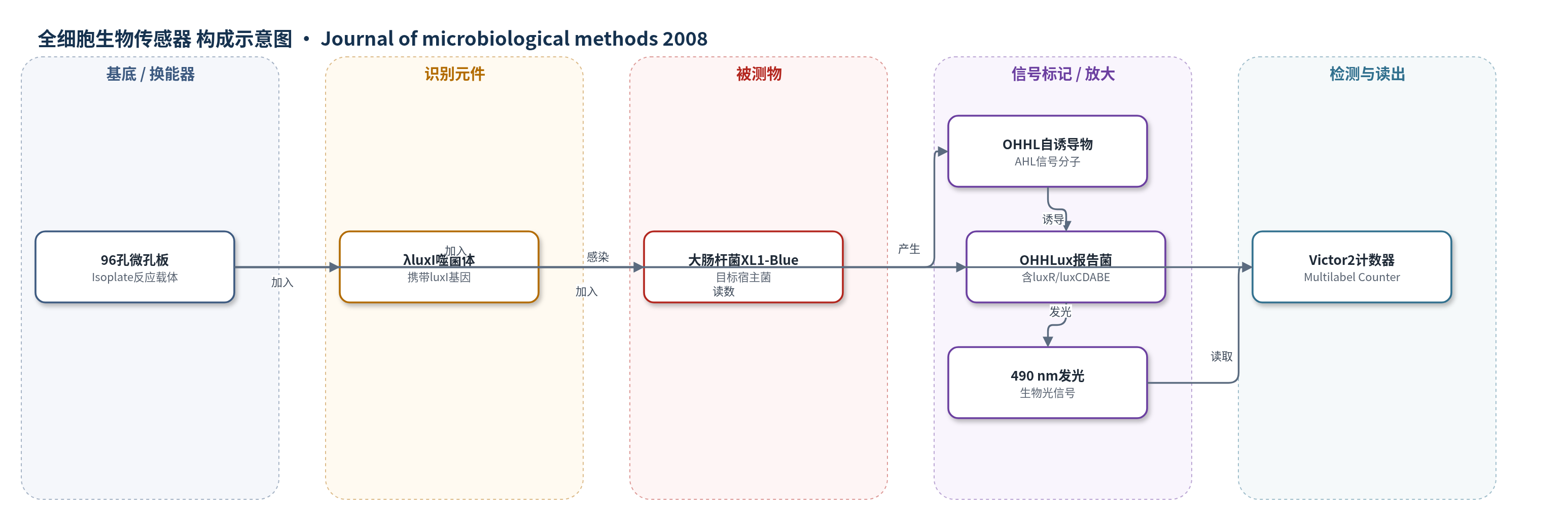
点击图片查看大图 · 依据论文自动绘制
传感器类型
全细胞生物传感器
检测对象
大肠杆菌(Escherichia coli, E. coli XL1-Blue);样品基质:环境样品、混合培养物、含碘饮用水模拟样品。
检测原理
检测基于噬菌体宿主特异性和群体感应信号放大。重组 λluxI 噬菌体特异性感染目标大肠杆菌 XL1-Blue,感染后在宿主内复制并表达 luxI,产生 N-3-(oxohexanoyl)-L-homoserine lactone(OHHL/AHL)。OHHL 扩散至 OHHLux 报告菌,与 LuxR 结合后激活 luxCDABE 表达,产生 490 nm 生物发光。目标菌浓度越高,感染事件越多,OHHL 生成量越大,报告菌发光越强,信号随目标浓度增加而增强。系统无需外加发光底物,通过 Victor2 多标签计数器读取光信号,并以高于背景 2σ 作为阳性判据。
检测灵敏度
LOD: 1 cfu/mL(14 d饥饿条件下,2σ or greater signal above background)
效应效果
系统抗干扰且保持目标特异性。Arthrobacter globiformis 背景 1×10^8–1 cfu/mL 时,1×10^8 cfu/mL XL1-Blue 均高于阴性对照 2σ。饥饿 14 d 后,1 d 峰高降低(p=0.04),3 d 达峰时间增加(p=0.01),14 d 可检测至 1 cfu/mL。碘 2、20 ppm 使报告菌 24 h 响应增加(p=2.82×10^-35、1.91×10^-39),目标菌单独暴露响应降低(p=2.52×10^-15、2.18×10^-9);同时暴露响应至少提高一个数量级。作者认为可用于病原菌远程传感。
传感器的构成
- 反应载体:96孔微孔板(Isoplate, Perkin-Elmer)与 Breathe-Easy 封条,用于容纳样品、培养与发光读数。
- 识别/感染元件:重组 lambda 噬菌体 λluxI,携带 luxI 基因,特异性感染 E. coli XL1-Blue 并复制产生自诱导物。
- 目标宿主:E. coli K12 变种 XL1-Blue,作为 λluxI 的宿主,感染后表达 luxI 并产生 OHHL。
- 信号报告细胞:E. coli OHHLux 生物报告菌,含 luxR 和 luxCDABE 基因,响应 OHHL 诱导产生 490 nm 生物发光。
- 信号分子:N-3-(oxohexanoyl)-L-homoserine lactone(OHHL/AHL),由感染后的 XL1-Blue 产生并被 OHHLux 的 LuxR 识别。
- 反应介质:Luria–Bertani broth plus supplements(LBS),用于培养 XL1-Blue、OHHLux 和噬菌体扩增;SM buffer 用于噬菌体保存。
中文摘要
本文报道了一种用于环境样品中大肠杆菌直接检测的双组分噬菌体生物发光报告系统。该系统由整合 luxI 基因的 lambda 噬菌体和基于 lux 的生物发光报告细胞组成,通过酰基高丝氨酸内酯(AHL)介导的群体感应和生物发光信号刺激响应噬菌体感染事件。研究重点考察了两个分析挑战:一是存在产生内酯酶的非目标菌可能中断 AHL 信号传导,二是亚致死损伤或生理胁迫目标细胞的检测。结果表明,该系统能在产生内酯酶的 Arthrobacter globiformis 背景浓度为 1 至 1×10^8 cfu/mL 时,自主响应目标宿主大肠杆菌 XL1-Blue 在 1×10^8 cfu/mL 下的 lambda 噬菌体感染。经碳限制饥饿 2 周或碘暴露 1 周(2 和 20 ppm)的大肠杆菌产生降低但可检测的生物传感器响应;短期碘暴露则在 24 h 内显著增加报告响应。信号响应和检出限受目标菌生理状态和环境条件影响,但系统保持目标特异性,显示其在病原菌远程传感中的应用潜力。
英文摘要
A two-component bacteriophage-based bioluminescent reporter system was developed for the detection of Escherichia coli in environmental samples. The bioreporter system consists of a luxI integrated lambda bacteriophage and a lux-based bioluminescent reporter cell that responds to the infection event through acyl-homoserine lactone (AHL) mediated quorum sensing and bioluminescent signal stimulation. This work addresses the ability of the bioreporter system to detect and quantify the target pathogen in response to two analytical challenges: (1) detection of target cells in the presence of lactonase-producing non-target organisms that could interrupt AHL signal transduction, and (2) detection of sub-lethally injured or physiologically stressed target cells. The bioreporter system was able to autonomously respond to lambda phage infection events with a target host E. coli at 1x10(8) cfu/mL against a background of lactonase-producing Arthrobacter globiformis at cell densities ranging from 1 to 1x10(8) cfu/mL. E. coli target cells stressed by carbon-limitation for 2 weeks (i.e., starvation) or exposure to iodine for 1 week at 2 and 20 ppm (i.e., disinfection) yield a reduced, but detectable, biosensor response. Conversely, short-term iodine exposure produces a significant increase in bioreporter response within the first 24 h. The signal response and limit of detection for the two-component bioreporter system were affected by the physiology and environment of the target, but the bioreporter maintained target specificity demonstrating its potential application for remote sensing of pathogens.