组成图示
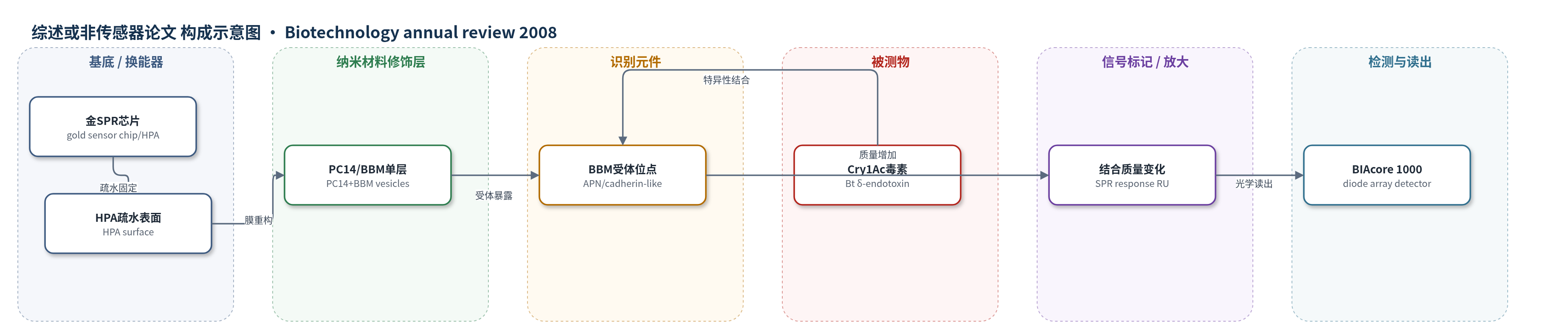
点击图片查看大图 · 依据论文自动绘制
传感器类型
综述或非传感器论文
检测对象
Cry1Ac δ-内毒素(Cry1Ac δ-endotoxin);样品基质:体外蛋白酶K激活的Bt包涵体毒素溶液(SPR流动池)
检测原理
将小菜蛾刷状缘膜囊泡(BBM)与人工磷脂PC14按蛋白/磷脂比例混合,在HPA金芯片疏水表面自发重构为单层膜,膜上保留昆虫肠上皮受体样结合位点。Cry1Ac毒素经蛋白酶K激活后流经芯片,首先与膜受体发生特异性结合,随后发生与浓度无关的膜插入/构象变化。结合质量增加改变金表面局部折射率,使偏振光共振角发生偏移,BIAcore 1000以响应单位(RU)实时读出。结合量随毒素浓度呈Michaelis-Menten饱和;两态模型给出K1=0.51 μM、K2=0.47、总Kd=0.24 μM,GalNAc可竞争性抑制(Ki=8 μM)。无化学放大。
检测灵敏度
未报告LOD、线性范围、灵敏度斜率或相关系数。
效应效果
SPR系统显示PC14/BBM单层结合响应为2620±75 RU,BSA覆盖仅112±6 RU,说明表面覆盖充分;单独BBM在再生步骤后仅约200 RU,表明PC14重构提高了稳定性。Cry1Ac结合呈饱和曲线,亲和力常数3.1 μM,最大响应170 RU;两态模型Kd=0.24 μM。GalNAc在80 μM时抑制89%结合,Ki=8 μM,证明受体介导的特异性。作者认为该无昆虫体系可用于Bt杀虫蛋白和parasporin的快速大规模筛选。文中未报告RSD、回收率或与ELISA/qPCR的定量对比。
传感器的构成
- 基底/换能器:金传感器芯片(gold sensor chip)/HPA疏水结合芯片,提供SPR光学检测界面。
- 修饰层:1,3-二正十四烷基甘油-2-磷酸胆碱(PC14)与小菜蛾刷状缘膜囊泡(BBM)混合重构单层,形成昆虫肠膜模型。
- 识别元件:BBM膜中的受体样结合位点(如氨基肽酶N/钙黏蛋白样蛋白,GalNAc相关),识别Cry1Ac毒素。
- 封闭/覆盖评估:牛血清白蛋白(BSA)注入用于评估表面覆盖程度,非主要识别层。
- 信号标记物:无外源标记,Cry1Ac毒素结合引起的界面质量变化直接产生SPR响应。
- 读出系统:BIAcore 1000 SPR检测器/二极管阵列,监测偏振光反射角变化并输出响应单位(RU)。
中文摘要
本文综述了苏云金芽孢杆菌(Bacillus thuringiensis, Bt)伴孢晶体蛋白的研究进展。Bt 可产生对昆虫高度特异毒性的δ-内毒素,包括Cry和Cyt蛋白;部分非杀虫菌株的伴孢晶体蛋白还具有选择性杀伤人癌细胞的能力,被命名为parasporin。文中首先介绍一种基于表面等离子共振(SPR)的光学生物传感器检测方法:将小菜蛾(Plutella xylostella)刷状缘膜囊泡(BBM)与人工磷脂PC14混合,在疏水结合(HPA)芯片上重构为单层,用于实时监测Bt包涵体蛋白与昆虫肠上皮膜受体的结合。随后报道从Bt A1470菌株中鉴定并克隆新型细胞毒性蛋白parasporin-4(Cry45Aa),将其在大肠杆菌中表达为包涵体,采用盐酸溶解、胃蛋白酶激活和阴离子交换层析纯化,并表征其选择性细胞毒性、稳定性和理化性质。
英文摘要
In 1901, a unique bacterium was isolated as a pathogen of the sotto disease of the silkmoth larvae, and later in 1915, the organism was described as Bacillus thuringiensis. Since the discovery, this bacterium has widely attracted attention of not only insect pathologists but many other scientists who are interested in strong and specific insecticidal activity associated with inclusion bodies of B. thuringiensis. This has led to the recent worldwide development of B. thuringiensis-based microbial insecticides and insect-resistant transgenic plants, as well as the epoch-making discovery of parasporin, a cancer cell-specific cytotoxin. In the review, we introduce a detection study of interaction between inclusion proteins of B. thuringiensis and brush border membrane of insects using surface plasmon resonance-based biosensor, and then identification and cloning of parasporin-4, a latest cancer cell-killing protein produced by B. thuringiensis A1470 strain. Inclusion bodies of the parasporin-4 produced by recombinant Escherichia coli were solubilized and activated with a new method and purified by an anion-exchange chromatography. At last the characterization of the recombinant parasporin-4 was shown.