组成图示
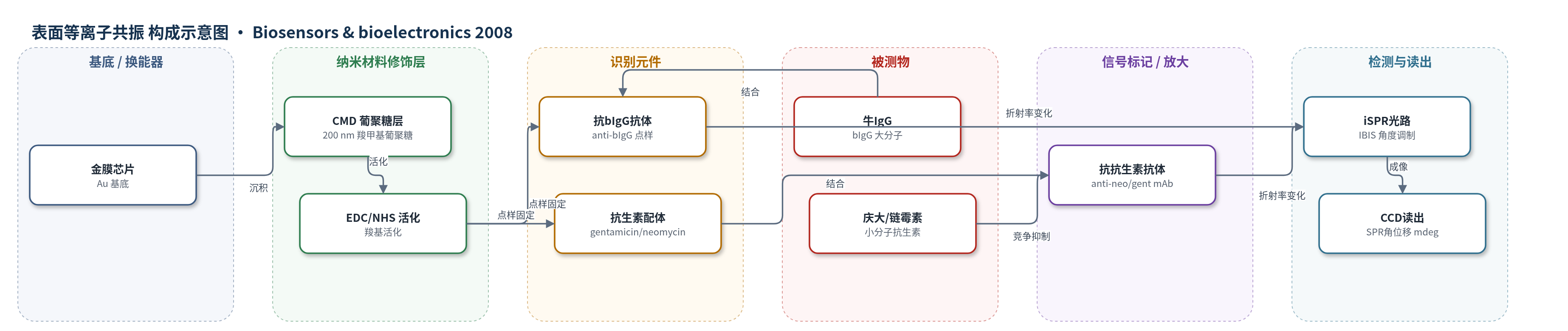
点击图片查看大图 · 依据论文自动绘制
传感器类型
表面等离子共振(SPR)生物传感器
检测对象
牛免疫球蛋白G(bovine IgG, bIgG)、庆大霉素(gentamicin)、链霉素(neomycin);样品基质:牛奶/食品样品(实验校准使用 HBS-EP 缓冲液)
检测原理
该传感器基于表面等离子共振(SPR)换能。金膜芯片上的 CMD 葡聚糖层经 EDC/NHS 活化后,共价固定识别元件:直接法固定 anti-bIgG 抗体,竞争法固定庆大霉素或链霉素小分子配体。当样品中的 bIgG 与 anti-bIgG 结合,或样品中的抗抗生素单克隆抗体与表面抗生素配体结合时,界面附近质量增加,局部折射率改变,导致 SPR 共振角发生位移。竞争法中,游离庆大霉素或链霉素与表面配体竞争结合抗体,浓度越高,抗体结合越少,SPR 响应下降。系统通过角度调制单色偏振光并用 CCD 记录反射强度,实时读出各点样 ROI 的 SPR 角位移(mdeg),实现多组分同时检测。无酶标或化学放大。
检测灵敏度
LOD: 43 pg protein mm−2;1% glycerol: 140.13 mdeg;R^2 = 0.9997;抗生素校准范围: 0.02–2000 ng mL−1;庆大霉素 IC50: 8 ± 0.3 ng mL−1;链霉素 IC50: 21 ± 1.4 ng mL−1
效应效果
光学性能:100 个 ROI 基线波动 −50 至 350 mdeg,平均约 50% 变化;甘油校准灵敏度 ROI 间差异 1.5%,实验间 1%,R^2=0.9997,LOD 43 pg mm−2。直接 bIgG 微阵列因点样固定量低,未呈剂量响应,灵敏度低于 Biacore 3000。竞争法同时检测庆大霉素和链霉素,三次重复重现性良好,IC50 为 8±0.3 和 21±1.4 ng mL−1,比 Biacore 3000 的 40 和 70 ng mL−1 高 5 倍和 3 倍;芯片稳定运行 200 循环、两个月。单循环 30 min,长于 Biacore 7 min。双配体互不干扰,灵敏度满足欧盟牛奶 MRL(庆大霉素 100、链霉素 500 ng mL−1),适合多组分食品筛查。
传感器的构成
- 基底/换能器:金膜(Au)传感器芯片与 BK7 棱镜,支撑 iSPR 光路并产生表面等离子共振。
- 修饰层:200 nm 羧甲基葡聚糖(CMD)层,提供羧基用于共价固定。
- 活化层:EDC/NHS 活化 CMD 羧基,形成可与氨基反应的位点。
- 识别元件:点样抗牛 IgG 抗体(anti-bIgG)或庆大霉素/链霉素小分子配体(gentamicin/neomycin),用于直接捕获或竞争结合。
- 溶液识别元件:抗链霉素/抗庆大霉素单克隆抗体(anti-neomycin/anti-gentamicin mAb),与表面配体结合产生质量变化。
- 封闭剂:1 M 乙醇胺(ethanolamine, pH 8.5),封闭未反应羧基。
- 读出系统:IBIS iSPR 角度调制单色偏振光与 CCD 相机,监测 SPR 角位移(mdeg)。
中文摘要
本研究考察了在 IBIS 成像表面等离子共振(iSPR)微阵列平台上实现小分子和大分子直接及竞争免疫检测的可行性。首先评估 IBIS iSPR 光学性能:在未衍生化表面用甘油校准曲线发现基线波动较大,但 100 个感兴趣区域之间灵敏度均匀且稳健。随后建立牛免疫球蛋白 G(bIgG)直接免疫检测和庆大霉素、链霉素竞争免疫检测。微阵列直接检测 bIgG 与 Biacore 3000 相比灵敏度较差,原因是点样固定效率低。微阵列竞争法同时检测庆大霉素和链霉素,灵敏度达 ng/mL 级,与 Biacore 3000 相当,并处于欧盟牛奶最大残留限量范围内。作者认为 IBIS iSPR 可用于食品分析,快速同时检测多种成分和污染物,提供详细食品谱;但从常规 SPR 向成像微阵列转移检测仍面临点样固定充分性等挑战。
英文摘要
In this study we examined the possibilities of implementing direct and competitive immunoassay formats for small and large molecule detection on a microarray, using IBIS imaging surface plasmon resonance (iSPR) system. First, IBIS iSPR optics performance was evaluated. Using a glycerol calibration curve on underivatized surface we observed high baseline variability, but uniform and robust sensitivity between hundred regions of interest. Further on, a direct immunoassay for bovine IgG detection and a competitive immunoassay for gentamicin and neomycin were developed. The direct immunoassay for bovine IgG detection in a microarray format showed poor sensitivity in comparison to the assay performed in Biacore 3000, due to low immobilization efficiency on spots. The competitive immunoassay for parallel gentamicin and neomycin detection in a microarray format displayed sensitivity in the ngmL(-1) range, comparable with the sensitivity achieved in Biacore 3000 and in the range of maximum residue limits in milk, established in the European Union. We expect that, utilization of the IBIS iSPR system for food analysis, by screening high and low molecular weight compounds, will allow rapid and simultaneous detection of various ingredients and contaminants, providing the end-user with a detailed food profile. However, assay transfer from conventional SPR biosensors to the imaging microarray platform also presents new challenges, such as sufficient immobilization on spots, that must be addressed in future studies.