组成图示
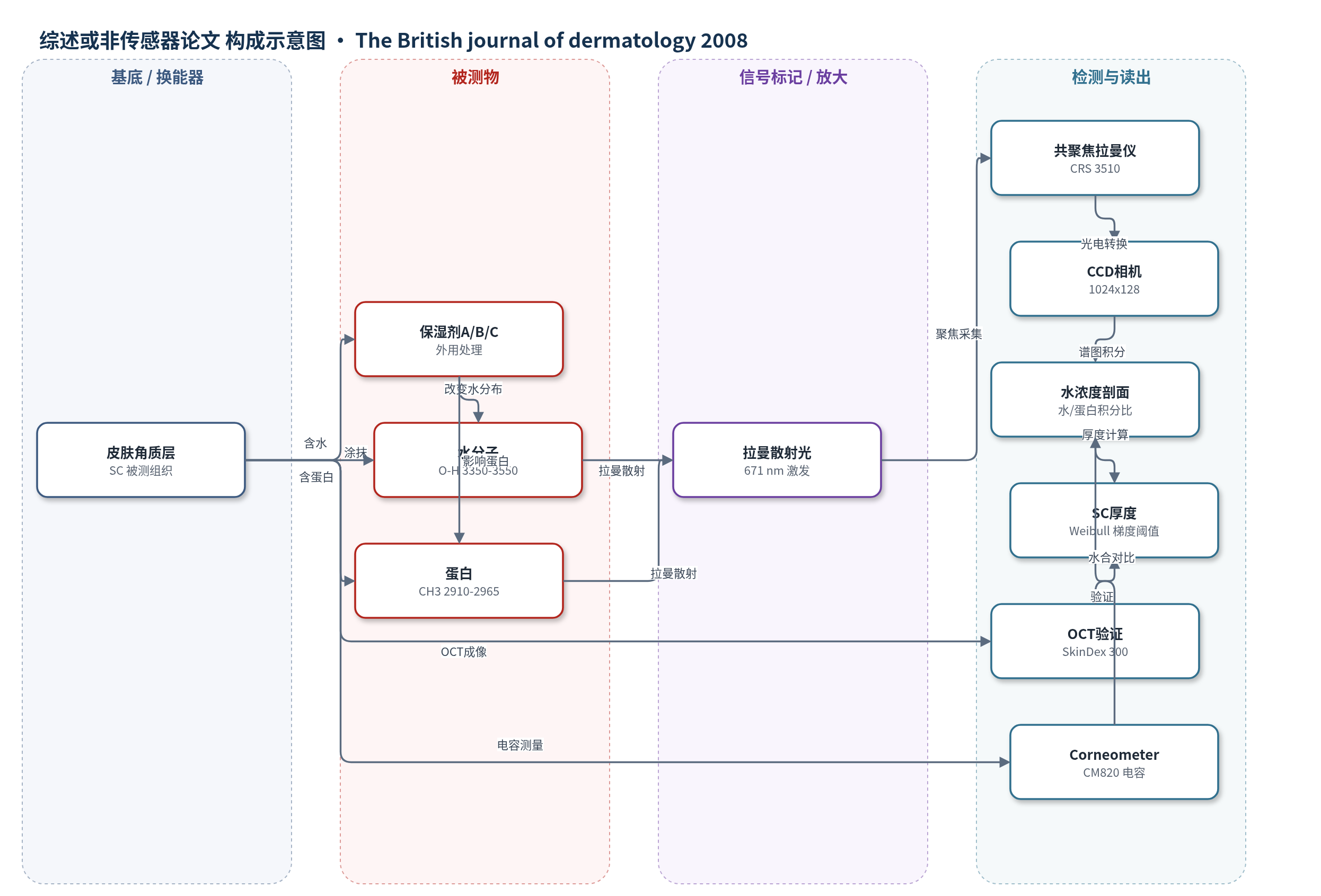
点击图片查看大图 · 依据论文自动绘制
传感器类型
综述或非传感器论文
检测对象
角质层水含量(stratum corneum water content, SCWC)、角质层厚度(stratum corneum thickness, SC thickness)、皮肤水合(skin hydration);样品基质:人体皮肤(in vivo human skin)
检测原理
共聚焦拉曼光谱(CRS)以 671 nm 激光经油浸物镜聚焦至皮肤,形成约 1 μm 光斑;组织中的水分子 O–H 伸缩振动(3350–3550 cm−1)和蛋白 –CH3 伸缩振动(2910–2965 cm−1)产生拉曼散射。25 μm 光纤作为共聚焦针孔排除离焦信号,CCD 相机记录光谱。水含量按水峰与蛋白峰积分比计算,并沿深度 0–40 μm 扫描生成水浓度剖面。保湿剂改变角质层(SC)水分布、肿胀和厚度,使剖面形状、边界深度和曲线下面积(AUC)变化。Weibull 拟合与梯度阈值法确定 SC 边界,从而得到 SC 厚度和总水含量。OCT 以 1300 nm 激光干涉成像独立验证厚度,Corneometer 以电容法提供表面电学水合对照。
检测灵敏度
相关系数: r2 = 0.9339;回归斜率: 0.9603;P < 0.0001
效应效果
CRS 与 OCT 测得的 SC 厚度呈强正相关(OCT 厚度=0.9603×CRS 厚度,r2=0.9339,P<0.0001)。在较薄非掌跖部位,OCT 厚度被压缩在 9–15 μm,而 CRS 可分辨 12–30 μm;CRS 测得面颊 12.8±0.9 μm、前臂内侧 18.0±3.9 μm、腿部 22.0±6.9 μm。3 周保湿剂研究中,仅配方 A 在 2 周后显著增加 SC 厚度(P=0.0121),停用 1 周仍显著(P=0.0162);其总 SC 水含量在 2 周(P=0.0275)和回归 1 周(P=0.0435)均显著升高。Corneometer 电容值在所有处理组均升高,但与 CRS 水合值不直接相关。作者认为 CRS 可快速、准确、深度分辨地评估 SC 水含量与厚度,优于传统电学水合测量。
传感器的构成
- 基底/被测组织:人体皮肤角质层(stratum corneum, SC),提供水与蛋白拉曼信号。
- 光学换能器:共聚焦拉曼显微光谱仪(RiverDiagnostics 3510 Skin Analyzer),实现深度分辨光谱采集。
- 激发光源:二极管泵浦激光器(671 nm 与 785 nm),671 nm 用于高波数区水/蛋白信号。
- 聚焦与空间滤波:油浸物镜(NA 0.86)和 25 μm 光纤共聚焦针孔,限定焦体积并排除离焦信号。
- 信号检测:背照式深耗尽 CCD 相机(1024×128 像素),检测拉曼散射光。
- 辅助验证换能器:光学相干断层扫描仪(SkinDex 300,1300 nm 激光),用于 SC 厚度验证。
- 辅助电学检测:Corneometer CM820,电容法测量皮肤表面水合。
中文摘要
保湿剂是最常用于治疗干燥皮肤的外用产品,可影响角质层(SC)多项性质,但部分产品可能损害屏障功能。SC 屏障功能与其整体结构和厚度相关,然而长期保湿剂对非掌跖部位 SC 厚度的体内研究较少。共聚焦拉曼光谱(CRS)可非侵入、实时、体内测量 SC 水浓度剖面。本研究首先通过与光学相干断层扫描(OCT)比较验证 CRS 测量 SC 厚度,随后在 14 名健康志愿者前臂开展 3 周盲法随机研究,比较三种市售保湿剂(A、B、C)及未处理对照对 SC 厚度、水梯度和总水合的影响,并将 CRS 水合值与 Corneometer 电容水合值比较。结果显示 CRS 与 OCT 测得的 SC 厚度呈强正相关(OCT 厚度=0.96×CRS 厚度,r2=0.93;P<0.0001),且 CRS 对较薄非掌跖部位分辨率更高。3 周研究中,仅含烟酰胺的配方 A 显著改变 SC 水梯度、厚度和水合,且停用一个星期后仍保持;电容水合值与 CRS 水合值不直接相关。结论:CRS 可用于体内测量掌跖和非掌跖皮肤 SC 厚度,并能同时评估保湿剂对 SC 厚度、深度相关水含量和总水含量的影响。
英文摘要
BACKGROUND: Moisturizers are the most commonly used topically applied product for the treatment of dry skin conditions. They affect many properties and functions of the stratum corneum but some moisturizers have been reported to be detrimental to barrier function. Stratum corneum barrier function is a composite of its total structure and thickness but few studies have taken this into account. As a biosensor, the stratum corneum (SC) will change its structure in response to treatment and a swelling effect has been clearly demonstrated by skin hydration. Recently several moisturizing agents have been shown to have an effect on SC swelling behaviour with conflicting results. However, there is a paucity of data reported for measuring the effects of long-term usage of moisturizers on SC thickness in vivo as, until recently, traditional techniques did not have the resolution to measure the effects of moisturizers on nonpalmoplantar body sites. The development of confocal Raman spectroscopy for use in human subjects provides noninvasive, real-time, in vivo measurement of SC water concentration profiles and we have also used this state of the art equipment to measure the effect of the long-term use of moisturizers on SC thickness for the first time.
OBJECTIVES: To validate the use of confocal Raman spectroscopy (CRS) to measure SC thickness and then use it to investigate the short- and long-term effects of moisturizers (one of which is known to improve SC barrier function) on SC thickness, water gradients and hydration.
METHODS: Two studies were conducted: (i) to validate the use of CRS for measuring SC thickness through comparison with optical coherence tomography (OCT); and (ii) once validated to use CRS to measure the long-term effects of three commercially available moisturizers (A, B, C) on SC thickness and water gradients, together with total hydration, over a 3-week period (2 weeks of treatment and 1 week regression) and compare the spectroscopy-derived hydration value with instrumentally derived capacitance hydration values.
RESULTS: (i) A strong, positive correlation in SC thickness was obtained between CRS and OCT (OCT-derived thickness = 0.96 x CRS-derived thickness, r(2) = 0.93; P <0.0001). OCT was shown, however, to have a lower resolution than CRS in distinguishing SC thickness on thinner nonpalmoplantar body sites. Using the CRS method, differences in SC thickness were readily apparent on different body sites (cheek 12.8 +/- 0.9 microm, volar forearm 18.0 +/- 3.9 microm, leg 22.0 +/- 6.9 microm). (ii) Examining the effects of moisturizers in a blinded, randomized 3-week study in human volunteers (n = 14) demonstrated that only one commercially available formulation (A) changed SC water gradients, thickness and hydration as measured by CRS. These hydration data did not directly correlate with capacitance hydration values.
CONCLUSIONS: (i) In vivo CRS was validated as a technique to measure SC thickness on both palmoplantar and, particularly, on nonpalmoplantar skin sites. (ii) Moisturizers improve skin moisturization but in this study only formulation A improved SC thickness, water gradients and hydration as measured by CRS. We hypothesize that this was due to compositional differences between the products. We believe that niacinamide (nicotinamide, vitamin B(3)) is probably contributing significantly to this effect, as it has been proven to increase epidermal lipogenesis and SC barrier function in other studies. These results show that by using CRS, we were able for the first time to determine the effect of moisturizer on multiple SC barrier endpoints including SC thickness, and water content as a function of depth and total SC water content.