组成图示
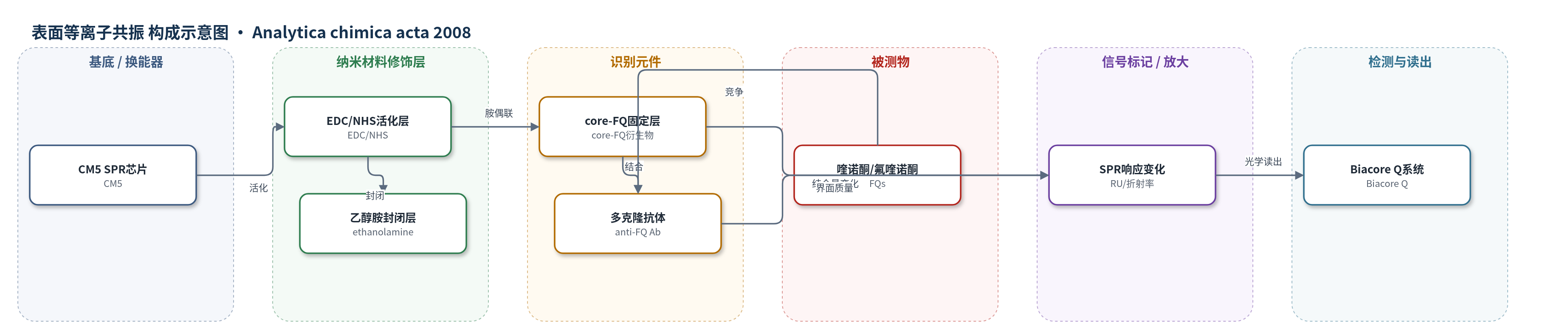
点击图片查看大图 · 依据论文自动绘制
传感器类型
表面等离子共振(SPR)生物传感器
检测对象
喹诺酮/氟喹诺酮(quinolones/fluoroquinolones,FQs),包括诺氟沙星(norfloxacin)、沙拉沙星(sarfloxacin)、二氟沙星(difloxacin)、环丙沙星(ciprofloxacin)、恩诺沙星(enrofloxacin)、氟甲喹(flumequine)、达氟沙星(danofloxacin)、马波沙星(marbofloxacin)、培氟沙星(pefloxacin)、依诺沙星(enoxacin)、洛美沙星(lomefloxacin)、氧氟沙星(ofloxacin)、奥立克酸(oxolinic acid);样品基质:鸡蛋、鱼、禽肉(鸡胸肉、鸭肉、火鸡肉)提取液
检测原理
该传感器采用SPR光学换能机制:光在芯片表面激发表面等离子体,形成倏逝场,表面结合质量改变局部折射率,引起SPR响应(RU)变化。芯片上通过EDC/NHS胺偶联固定core-FQ衍生物,作为捕获配体。样品中的抗诺氟沙星-氟甲喹多克隆抗体可与芯片上core-FQ结合;若样品中存在游离喹诺酮/氟喹诺酮,则与抗体结合,竞争性地降低抗体在芯片上的结合量。被测物浓度越高,抗体结合越少,SPR响应越低,形成抑制型校准曲线。每次注射后用10 mM NaOH再生芯片表面。方法未使用酶或核酸放大,灵敏度主要依靠双活性抗体的广谱交叉反应和SPR实时质量传感。
检测灵敏度
IC50 (buffer): 1.8 ng mL−1(诺氟沙星);线性范围: 0.1–10 µg kg−1(鸡蛋、禽肉提取液,诺氟沙星);0.1–100 µg kg−1(鱼提取液,诺氟沙星);IC50: 1 µg kg−1(禽肉)、1.5 µg kg−1(鸡蛋)、3.1 µg kg−1(鱼);CCα: 0.13 µg kg−1(禽肉)、0.29 µg kg−1(鸡蛋)、0.30 µg kg−1(鱼);r^2 = 0.96;slope = 0.96(与LC–MS/MS比较)
效应效果
方法对含哌嗪基喹诺酮交叉反应为41%–115%,氟甲喹在缓冲液中为7%,在鱼、鸡蛋、禽肉中为5%–11%;乙氧基喹啉和烟酸(50 µg/mL)无抑制,显示抗干扰性。同一SPR流道连续使用200个分析周期无明显活性损失。非特异背景为35±8 RU。实际残留样品与LC–MS/MS确认结果相关良好,r^2=0.96、斜率0.96;如鸡肌肉中氟甲喹LC–MS/MS 83/312 µg/kg,SPR 119/341 µg/kg。作者认为该法快速、简单,可在低于MRL水平筛查13种喹诺酮,阳性样品再经LC–MS/MS确证。
传感器的构成
- 基底/换能器:CM5传感器芯片,SPR光学换能表面,提供羧基用于共价固定
- 活化层:EDC/NHS混合液,活化CM5表面羧基,形成氨基反应性位点
- 识别元件固定层:core-FQ衍生物(2.5 mg/mL,硼酸盐pH 8.5),胺偶联固定,作为竞争捕获配体
- 封闭层:1 M乙醇胺,封闭未反应活化位点
- 识别元件:抗norfloxacin hapten-flumequine-BSA多克隆抗体(1:100 HBS-EP),与游离喹诺酮竞争结合
- 运行/再生介质:HBS-EP缓冲液(0.01 M HEPES pH 7.4、0.15 M NaCl、3 mM EDTA、0.005% Surfactant P20);10 mM NaOH再生液
中文摘要
本研究开发了一种基于表面等离子共振(SPR)原理的光学生物传感器抑制免疫分析方法,用于食品动物源样品中13种喹诺酮/氟喹诺酮(包括氟甲喹)的筛查。研究将多种喹诺酮衍生物固定于SPR传感器芯片表面,并系统评价不同多克隆抗体和工程抗体在有无游离喹诺酮存在时的结合行为。主要挑战是在保证其他化合物检测效果的同时检测氟甲喹。最终采用针对双表位免疫原(诺氟沙星半抗原-氟甲喹-BSA)制备的多克隆抗体,并在芯片上固定一种氟喹诺酮衍生物(core-FQ),首次报道了“双活性抗体”概念。方法在禽肉、鱼和鸡蛋三种基质中优化,样品经液相提取和两次清洗后检测。该快速简便方法可低于最大残留限量水平检测至少13种喹诺酮;以诺氟沙星为参考,鸡蛋和禽肉提取液线性范围为0.1–10 µg/kg,鱼提取液为0.1–100 µg/kg,中点分别约为1、1.5和3 µg/kg。
英文摘要
The aim of this study was to develop an optical biosensor inhibition immunoassay, based on the surface plasmon resonance (SPR) principle, for use as a screening test for 13 (fluoro)quinolones, including flumequine, used as veterinary drugs in food-producing animals. For this, we immobilised various quinolone derivatives on the sensor chip and tested binding of a range of different antibodies (polyclonal and one engineered antibody) in the presence and absence of free (fluoro)quinolones. The main challenge was to detect flumequine in an assay giving good results for the other compounds. One antigen-antibody combination proved satisfactory: polyclonal antibodies raised against a dual immunogen and, on the sensor chip, a fluoroquinolone derivative. It was the first time that this concept of the bi-active antibody was described in the literature. The assay, optimised for detection in three matrices (poultry muscle, fish, and egg), was tested on incurred samples prepared by liquid extraction followed by two washing steps. This rapid, simple method proved adequate for detecting at least 13 (fluoro)quinolones at concentrations below established maximum residue levels (MRLs). The reference molecule norfloxacin could be detected in the range of 0.1-10 microg kg(-1) in extracts of egg and poultry meat and in the range of 0.1-100 microg kg(-1) in extracts of fish. The determined midpoints of these calibration curves were about 1, 1.5 and 3 microg kg(-1) in poultry meat, egg and fish, respectively.