组成图示
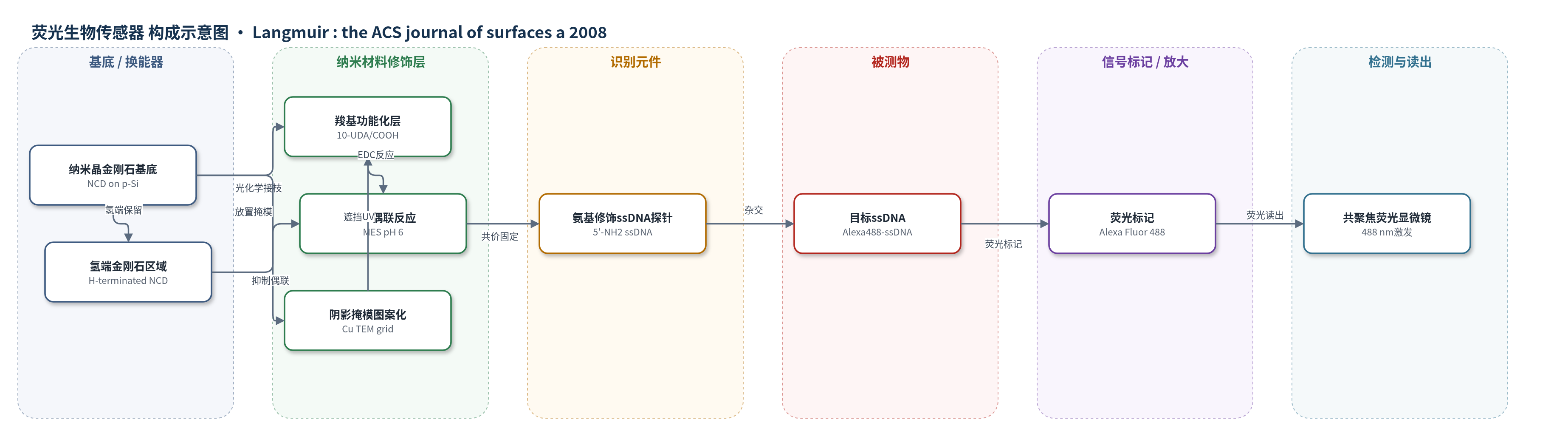
点击图片查看大图 · 依据论文自动绘制
传感器类型
荧光生物传感器
检测对象
目标单链DNA(target ssDNA,互补/1碱基错配/非互补序列);样品基质:MicroHyb杂交缓冲液及PBS/SSC洗涤缓冲液
检测原理
NCD表面先经254 nm光化学接枝10-UDA形成COOH端基,再用EDC在MES缓冲液中催化COOH与5′-NH2 ssDNA探针形成酰胺键,实现探针共价固定。目标Alexa Fluor 488标记ssDNA与表面探针杂交后形成dsDNA,表面荧光强度随互补目标结合量增加而增强;错配或非互补目标在严格洗涤后信号显著降低。共聚焦显微镜以488 nm激发、500–550 nm发射检测荧光,从而将DNA识别事件转换为光学信号。探针密度影响杂交可及性,约10^13–10^14 molecules/cm^2时兼顾密度与功能活性。未使用HCR/RCA等信号放大策略。
检测灵敏度
原文未报告LOD、线性范围、灵敏度斜率或相关系数。
效应效果
该界面选择性良好:80 ℃杂交并经75 ℃及室温0.2× SSC洗涤后,互补目标平均荧光为98.2±0.7%(N=6),1碱基错配为62.4±19.7%(N=3),可区分。100% COOH修饰NCD上互补杂交为64.1±7.3%,非互补为10.7±1.5%(N=3)。热乙酸与2× SSC/0.5% SDS洗涤可去除非特异DNA,EDC阳性68.0±5.5%、阴性9.5±1.5%(N=3)。共价酰胺键提供稳定、可重复使用界面,H端区域抑制固定并实现阴影掩模图案化,适用于高吞吐阵列DNA生物传感器及点突变/SNP检测。
传感器的构成
- 基底/换能器:p型Si(100)衬底上CVD纳米晶金刚石(NCD)薄膜,约300 nm,晶粒50–150 nm,提供化学惰性、生物电子兼容的共价修饰平台。
- 表面功能化层:10-十一烯酸(10-UDA)经254 nm光化学接枝形成COOH端基,热乙酸清洗去除非共价10-UDA,提供DNA锚定羧基。
- 偶联试剂:EDC(1-乙基-3-(3-二甲氨基丙基)碳二亚胺)在25 mM MES(pH 6)中催化COOH与5′-NH2形成酰胺键,实现ssDNA共价固定。
- 识别元件:5′-NH2修饰ssDNA探针(8 b或36 b),通过氨基端固定,用于杂交识别目标ssDNA。
- 信号标记物:Alexa Fluor 488标记目标ssDNA(29 b)或探针ssDNA(8 b),杂交后产生荧光信号。
- 封闭/洗涤体系:MicroHyb杂交缓冲液含BSA和非特异性DNA封闭,2× SSC/0.5% SDS及PBS洗涤去除非特异结合。
- 图案化掩模:Cu TEM网格阴影掩模在UV照射中遮挡部分区域,保留H端NCD,控制探针固定位置。
中文摘要
本文评估了纳米晶金刚石(NCD)表面DNA共价固定方法:先通过254 nm光化学接枝10-十一烯酸(10-UDA)在NCD表面引入羧基(COOH),再用1-乙基-3-(3-二甲氨基丙基)碳二亚胺(EDC)介导COOH与5′-氨基修饰单链DNA(ssDNA)偶联。研究以共聚焦荧光显微镜表征所得生物界面的稳定性、探针密度与功能活性,考察清洗缓冲液、探针长度、探针浓度及COOH连接基对ssDNA探针层的影响。结果表明,在COOH修饰NCD上施加300 pmol短ssDNA可获得最均匀、致密且具功能性的DNA层,而氢端NCD对DNA固定具有抗性。利用该表面功能依赖性,在光化学引入COOH时使用阴影掩模保留部分氢端区域,后续DNA固定形成与掩模相反的荧光图案。此外,含10-UDA与无COOH类似物的混合表面被用于降低非特异吸附和空间位阻,但纯COOH修饰并图案化H端区域、控制探针量的NCD最有效。
英文摘要
The covalent attachment method for DNA on nanocrystalline diamond (NCD), involving the introduction of COOH functionalities on the surface by photoattachment of 10-undecenoic acid (10-UDA), followed by the 1-ethyl-3-(3-dimethylaminopropyl)-carbodiimide (EDC)-mediated coupling to NH 2-labeled ssDNA, is evaluated in terms of stability, density, and functionality of the resulting biological interface. This is of crucial importance in DNA biosensor development. The covalent nature of DNA attachment will infer the necessary stability and favorable orientation to the ssDNA probe molecules. Using confocal fluorescence microscopy, the influence of buffer type for the removal of excess 10-UDA and ssDNA, the probe ssDNA length, the probe ssDNA concentration, and the presence of the COOH-linker on the density and functionality of the ssDNA probe layer were investigated. It was determined that the most homogeneously dense and functional DNA layer was obtained when 300 pmol of short ssDNA was applied to COOH-modified NCD samples, while H-terminated NCD was resistant for DNA attachment. Exploiting this surface functionality dependence of the DNA attachment efficiency, a shadow mask was applied during the photochemical introduction of the COOH-functionalities, leaving certain regions on the NCD H-terminated. The subsequent DNA attachment resulted in a fluorescence pattern corresponding to the negative of the shadow mask. Finally, NCD surfaces covered with mixtures of the 10-UDA linker molecule and a similar molecule lacking the COOH functionality, functioning as a lateral spacer, were examined for their suitability in preventing nonspecific adsorption to the surface and in decreasing steric hindrance. However, purely COOH-modified NCD samples, patterned with H-terminated regions and treated with a controlled amount of probe DNA, proved the most efficient in fulfilling these tasks.