组成图示
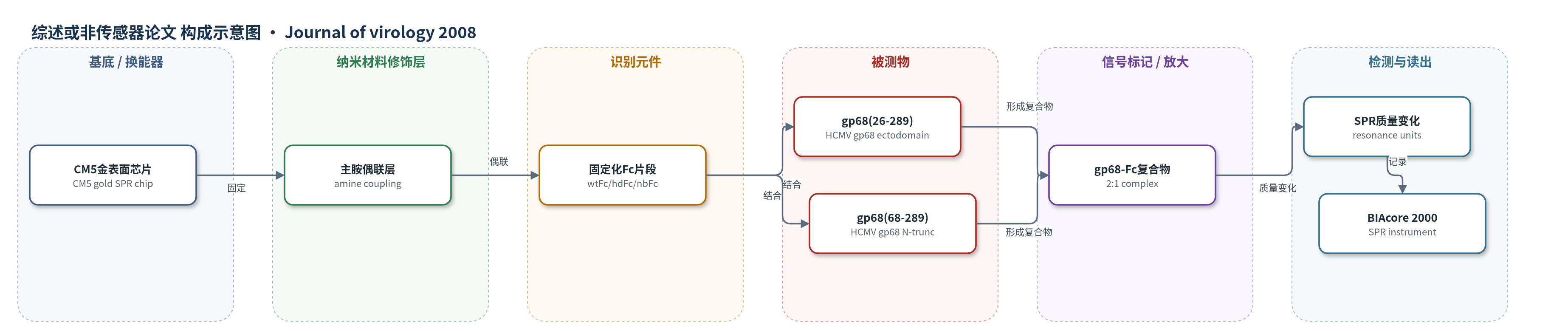
点击图片查看大图 · 依据论文自动绘制
传感器类型
综述或非传感器论文
检测对象
HCMV gp68 外域(gp68(26–289)、gp68(68–289)),样品基质为重组蛋白缓冲液(HEPES/NaCl/EDTA/P-20);结合对象为人IgG Fc片段(wtFc、hdFc、nbFc)
检测原理
SPR 芯片表面通过主胺偶联固定人 IgG Fc 片段(wtFc、hdFc 或 nbFc)。将不同浓度的 HCMV gp68 外域注入流动池后,gp68 识别并结合 Fc 二聚体 CH2-CH3 结构域界面;每个 Fc 二聚体可结合两个 gp68 分子,形成 2:1 复合物。结合导致芯片界面质量增加,SPR 共振单位(RU)上升;解离时 RU 回落至基线。通过浓度依赖的平衡结合或动力学曲线拟合,可得到 KD1/KD2。该体系不依赖 Fc N-连接糖基化,且 gp68/Fc 复合物在 pH 5.6–8.1 稳定,因此信号主要反映 gp68 与 CH2-CH3 界面的特异性结合。
检测灵敏度
未报告LOD、线性范围、灵敏度斜率或R^2。
效应效果
该研究未评估实际样品回收率、RSD或临床稳定性。选择性方面,gp34和gp68对去糖基化Fcγ仍保持结合,而宿主CD64结合显著下降;gp68结合wtFc和hdFc,但不结合CH2-CH3界面突变体nbFc,显示其识别CH2-CH3界面。SPR显示gp68(26–289)与wtFc的KD1/KD2为470/1600 nM,gp68(68–289)为140/240 nM;hdFc单点KD约300和85 nM。pH 6.0时KD约60 nM,pH 8.1约300 nM,复合物在pH 5.6–8.1稳定,不同于HSV-1 gE-gI。gp68不与金黄色葡萄球菌蛋白A竞争,且结合四种人IgG亚类,提示其可用于免疫逃逸机制研究。
传感器的构成
- 换能基底:BIAcore 2000 所用 CM5 金表面芯片,提供 SPR 光学换能表面
- 固定化修饰层:CM5 主胺偶联层,用于共价固定人 IgG Fc 片段
- 识别/配体层:人 IgG Fc 片段(wtFc、hdFc、nbFc),作为固定化配体捕获 gp68
- 分析物/识别元件:HCMV gp68 外域(gp68(26–289)、gp68(68–289)),与 Fc CH2-CH3 界面结合
- 运行缓冲液:50 mM HEPES、150 mM NaCl、3 mM EDTA、0.005% P-20,维持结合与解离条件
- 信号读出:SPR 共振单位(RU)随 gp68 结合/解离变化,由 BIAcore 2000 记录
中文摘要
免疫球蛋白G(IgG)的Fc段可被Fcγ受体识别并触发体液与细胞免疫。人巨细胞病毒(HCMV)编码两种表面Fcγ受体gp34和gp68,被认为可帮助病毒逃避IgG介导的免疫。本文显示,两种病毒Fcγ受体对Fcγ的识别不依赖Fcγ的N-连接糖基化,这与宿主Fcγ受体不同。通过gp68外域截短突变体筛选,将Fcγ结合位点定位在gp68第71至289位氨基酸区域,该区域包含一个免疫球蛋白样结构域。凝胶过滤和表面等离子共振(SPR)生物传感器结合实验表明,gp68与宿主Fcγ受体不同,而与单纯疱疹病毒1型gE-gI类似,以纳摩尔亲和力、2:1化学计量比结合IgG Fc二聚体的CH2-CH3结构域界面。与gE-gI在酸性内体pH下解离不同,gp68/Fcγ复合物在pH 5.6至8.1范围内稳定。这些结果说明HCMV gp68的Fc结合机制不同于宿主Fcγ受体和HSV-1 gE-gI,提示其具有不同的功能与识别特性。
英文摘要
Recognition of immunoglobulin G (IgG) by surface receptors for the Fc domain of immunoglobulin G (Fcgamma), FcgammaRs, can trigger both humoral and cellular immune responses. Two human cytomegalovirus (HCMV)-encoded type I transmembrane receptors with Fcgamma-binding properties (vFcgammaRs), gp34 and gp68, have been identified on the surface of HCMV-infected cells and are assumed to confer protection against IgG-mediated immunity. Here we show that Fcgamma recognition by both vFcgammaRs occurs independently of N-linked glycosylation of Fcgamma, in contrast with the properties of host FcgammaRs. To gain further insight into the interaction with Fcgamma, truncation mutants of the vFcgammaR gp68 ectodomain were probed for Fcgamma binding, resulting in localization of the Fcgamma binding site on gp68 to residues 71 to 289, a region including an immunoglobulin-like domain. Gel filtration and biosensor binding experiments revealed that, unlike host FcgammaRs but similar to the herpes simplex virus type 1 (HSV-1) Fc receptor gE-gI, gp68 binds to the C(H)2-C(H)3 interdomain interface of the Fcgamma dimer with a nanomolar affinity and a 2:1 stoichiometry. Unlike gE-gI, which binds Fcgamma at the slightly basic pH of the extracellular milieu but not at the acidic pH of endosomes, the gp68/Fcgamma complex is stable at pH values from 5.6 to pH 8.1. These data indicate that the mechanistic details of Fc binding by HCMV gp68 differ from those of host FcgammaRs and from that of HSV-1 gE-gI, suggesting distinct functional and recognition properties.