组成图示
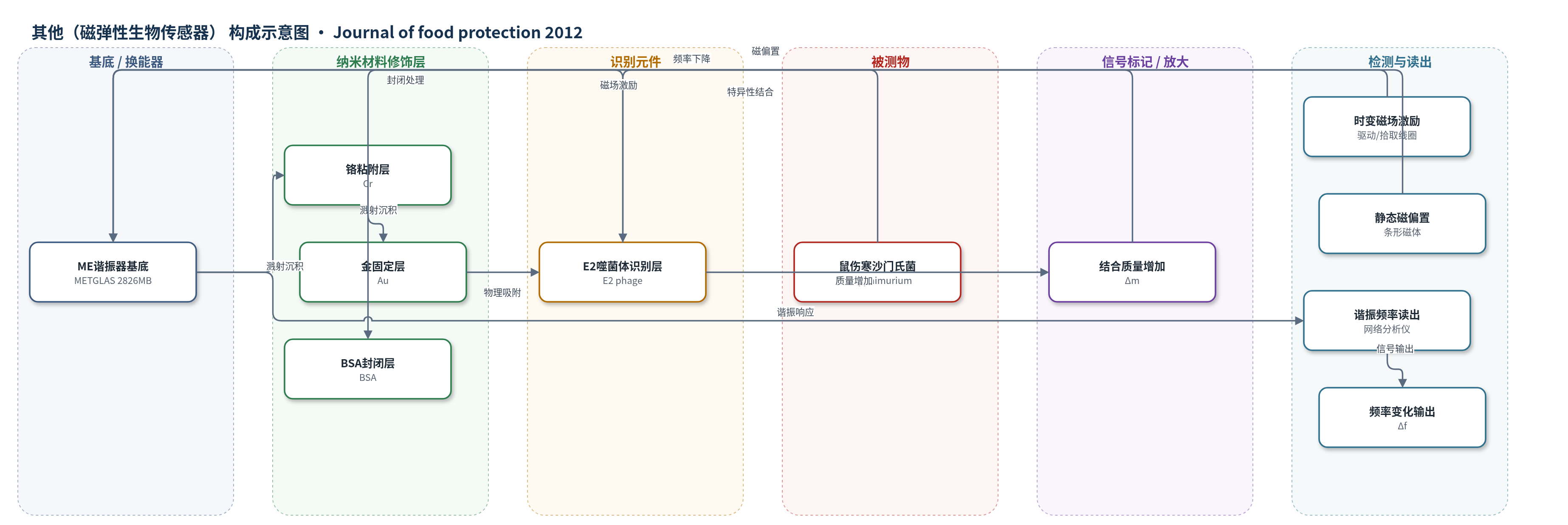
点击图片查看大图 · 依据论文自动绘制
传感器类型
其他(磁弹性生物传感器)
检测对象
鼠伤寒沙门氏菌(Salmonella Typhimurium);样品基质:鸡蛋壳表面(加标蛋壳,食品表面)
检测原理
E2噬菌体作为识别元件特异性结合蛋壳表面鼠伤寒沙门氏菌,使细菌固定在ME谐振器表面。结合事件增加谐振器有效质量,根据条状谐振器纵向振动频率公式,质量增加导致谐振频率下降,近似关系为Δf≈-fΔm/(2M)。外部时变磁场通过驱动/拾取线圈无线激励非晶铁磁合金发生机械共振,条形磁体提供静态磁偏置以增强输出信号,网络分析仪读取谐振频率变化。目标菌浓度越高,表面结合细胞越多,质量增量越大,频率下降越明显。无噬菌体对照传感器用于扣除环境漂移和非特异性结合。该过程无需标记和酶放大,依靠直接质量敏感机制实现检测。
检测灵敏度
LOD: 1.6 x 10^2 CFU/cm2 (160 CFU/cm2);检测范围: 1.6–1.6 x 10^7 CFU/cm2
效应效果
测量传感器与无噬菌体对照传感器比较,在1.6×10^2 CFU/cm2时频率变化仍有统计学差异(t检验置信水平97.45%),1.6×10^1 CFU/cm2无显著差异。SEM证实结合细胞数随加标浓度降低而减少,对照传感器表面基本无细菌。方法在95%湿度下总检测时间约30 min,可直接将传感器置于蛋壳表面,无需取样、纯化或浓缩。相比ELISA、PCR、FTIR和DESI,该方法快速、无标记、低成本;噬菌体识别元件比抗体更稳定、易储存。多传感器布置可缓解蛋壳表面细菌分布不均,1 mm传感器可检测超过95%蛋壳表面。
传感器的构成
- 基底/换能器:METGLAS 2826MB非晶铁磁合金条状ME谐振器(1×0.2×0.028 mm),经退火后作为无线质量敏感换能器
- 界面粘附层:Cr层,作为合金基底与Au层之间的粘附界面
- 金属固定层:Au层,提供耐腐蚀表面并用于E2噬菌体固定
- 识别元件:E2丝状噬菌体,物理吸附于Au表面,特异性识别并结合鼠伤寒沙门氏菌
- 封闭剂:BSA(牛血清白蛋白,1 mg/ml),封闭非特异性结合位点
中文摘要
本文报道利用无线磁弹性(ME)生物传感器快速、灵敏、直接检测蛋壳表面鼠伤寒沙门氏菌。该传感器由自由条状ME谐振器作为信号换能器,并以E2噬菌体作为生物分子识别元件,选择性结合鼠伤寒沙门氏菌。ME生物传感器属于质量敏感型传感器,可被外部时变磁场无线激励至机械共振。当传感器结合目标菌后,其质量增加,导致谐振频率下降。将多个E2噬菌体修饰的测量传感器置于不同浓度(1.6至1.6×10^7 CFU/cm^2)加标蛋壳表面,同时使用无噬菌体对照传感器补偿环境效应和非特异性结合。在95%湿度控制室中孵育20 min后,无线测量传感器谐振频率并与初始频率比较。测量传感器的频率变化与对照传感器在低至1.6×10^2 CFU/cm^2时仍有统计学差异,该值为本文检出限。扫描电镜证实频率变化与传感器表面结合细胞数量直接相关。总检测时间约30 min,无需前期取样即可实现快速检测。
英文摘要
This article presents rapid, sensitive, direct detection of Salmonella Typhimurium on eggshells by using wireless magnetoelastic (ME) biosensors. The biosensor consists of a freestanding, strip-shaped ME resonator as the signal transducer and the E2 phage as the biomolecular recognition element that selectively binds with Salmonella Typhimurium. This ME biosensor is a type of mass-sensitive biosensor that can be wirelessly actuated into mechanical resonance by an externally applied timevarying magnetic field. When the biosensor binds with Salmonella Typhimurium, the mass of the sensor increases, resulting in a decrease in the sensor's resonant frequency. Multiple E2 phage-coated biosensors (measurement sensors) were placed on eggshells spiked with Salmonella Typhimurium of various concentrations (1.6 to 1.6 × 10(7) CFU/cm(2)). Control sensors without phage were also used to compensate for environmental effects and nonspecific binding. After 20 min in a humidity-controlled chamber (95%) to allow binding of the bacteria to the sensors to occur, the resonant frequency of the sensors was wirelessly measured and compared with their initial resonant frequency. The resonant frequency change of the measurement sensors was found to be statistically different from that of the control sensors down to 1.6 × 10(2) CFU/cm(2), the detection limit for this work. In addition, scanning electron microscopy imaging verified that the measured resonant frequency changes were directly related to the number of bound cells on the sensor surface. The total assay time of the presented methodology was approximately 30 min, facilitating rapid detection of Salmonella Typhimurium without any preceding sampling procedures.