组成图示
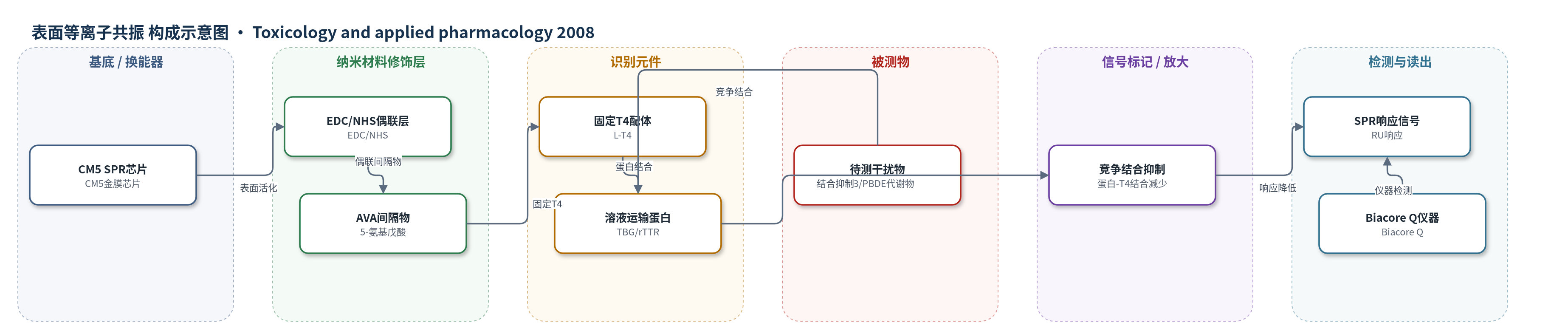
点击图片查看大图 · 依据论文自动绘制
传感器类型
表面等离子共振(SPR)生物传感器
检测对象
甲状腺激素运输干扰化学物质(thyroxine transport disrupting chemicals),包括甲状腺素(T4)、三碘甲状腺原氨酸(T3)、多氯联苯(PCBs)、多溴二苯醚(PBDEs)及其羟基化代谢物、卤化双酚 A(TCBPA/TBBPA)、卤化酚、药物和农药;样品基质为化学标准品溶液(DMSO/磷酸盐缓冲液稀释)
检测原理
该传感器采用竞争性抑制 SPR 原理。L-甲状腺素(T4)通过 AVA 间隔物固定于 CM5 芯片表面,作为运输蛋白结合配体。检测时,将待测化学物质与 TBG 或 rTTR 溶液预先混合,再注入 T4 芯片表面。若待测物与运输蛋白结合,则占据其 T4 结合位点,减少运输蛋白与表面 T4 的结合,使 SPR 响应降低;响应降低程度取决于待测物浓度及其对运输蛋白的亲和力。通过 T4 标准曲线计算 IC50,并以 T4 的 IC50 与待测物 IC50 之比得到相对效力(RP)。每个周期后用乙腈/NaOH 再生芯片表面。该方法无酶或标记放大,信号直接来自蛋白-配体结合质量变化。
检测灵敏度
原文未报告 LOD、线性范围、灵敏度斜率;报告 T4 IC50: 18.4±4.4 nM(TTR, n=15)、17.2±1.2 nM(TBG, n=10);RP 回归 R^2=0.86
效应效果
优化后的 SPR 运输蛋白检测每周期约 8 min,T4 芯片可稳定使用超过 1000 个周期。加入 OVA 后,rTTR 在 240 min 内响应下降由 43% 降至 12%;5 倍浓缩储备液使 rTTR 和 TBG 响应下降分别低于 5% 和 2%。2% DMSO 提高疏水化合物溶解性,2.8 mM 抗坏血酸防止代谢物氧化。62 种化合物中,TTR 检测 25 种活性(>50% 抑制),RP 0.02–2.5;TBG 检测 15 种活性,均弱于 T4,并发现 10 种新活性化合物,BDE 47/49/99 羟基化代谢物结合最强。与文献放射配体结合法相比,RP 定量有差异但定性趋势一致,如 T3 的 TTR RP 为 0.04,文献平均 0.06±0.03。作者认为该方法适合高通量筛选大型化学库及 REACH 甲状腺干扰物评估。
传感器的构成
- 换能器芯片:CM5 SPR 芯片,提供表面等离子共振信号读出
- 偶联化学层:EDC/NHS 胺偶联试剂盒,活化芯片表面羧基并偶联 T4 氨基
- 间隔物:5-氨基戊酸(AVA),连接 T4 丙氨酸侧链氨基与芯片表面
- 固定配体:L-甲状腺素(T4),固定于芯片表面作为运输蛋白结合位点
- 溶液识别元件:甲状腺素结合球蛋白(TBG)或重组转甲状腺素蛋白(rTTR),与 T4 结合并被待测物竞争抑制
- 稳定剂:卵白蛋白(OVA),加入运输蛋白储备液维持 TBG/TTR 结合活性
- 运行缓冲液:磷酸盐缓冲液(pH 8.5,含 NaCl),维持蛋白稳定与流动池环境
- 再生液:乙腈/0.1 M NaOH(1:4 v/v),破坏运输蛋白-T4 相互作用并再生芯片表面
中文摘要
普遍存在的化学物质可能干扰对脊椎动物发育和生理至关重要的甲状腺系统。本研究建立并优化了一种基于表面等离子共振(SPR)生物传感器的高通量筛选方法,用于快速检测具有甲状腺素(T4)运输干扰活性的化合物。该方法以固定于生物传感器芯片表面的 T4 为配体,分别利用主要甲状腺激素运输蛋白甲状腺素结合球蛋白(TBG)和转甲状腺素蛋白(TTR)构建两种竞争性抑制检测,并实现自动化运行。作者对包含天然甲状腺激素、多氯联苯(PCBs)、多溴二苯醚(PBDEs)及其代谢物、卤化双酚 A、卤化酚、药物、农药等 62 种环境相关化合物的化学库进行了筛选。TBG 检测发现 10 种新活性化合物,其中 BDE 47、BDE 49 和 BDE 99 的羟基化代谢物表现出最强结合;TTR 检测则确认了 PCBs/PBDEs 羟基化代谢物、卤化 BPA 和染料木黄酮的活性。结果表明,PBDEs 羟基化代谢物不仅干扰 TTR 介导的 T4 运输,也在人体 T4 主要循环载体 TBG 水平产生显著作用。优化后的 SPR 运输蛋白检测适合大规模筛选潜在甲状腺激素干扰物。
英文摘要
Ubiquitous chemicals may interfere with the thyroid system that is essential in the development and physiology of vertebrates. We applied a surface plasmon resonance (SPR) biosensor-based screening method for the fast screening of chemicals with thyroxine (T4) transport disrupting activity. Two inhibition assays using the main thyroid hormone transport proteins, T4 binding globulin (TBG) and transthyretin (TTR), in combination with a T4-coated biosensor chip were optimized and automated for screening chemical libraries. The transport protein-based biosensor assays were rapid, high throughput and bioeffect-related. A library of 62 chemicals including the natural hormones, polychlorinated biphenyls (PCBs), polybrominated diphenylethers (PBDEs) and metabolites, halogenated bisphenol A (BPA), halogenated phenols, pharmaceuticals, pesticides and other potential environmentally relevant chemicals was tested with the two assays. We discovered ten new active compounds with moderate to high affinity for TBG with the TBG assay. Strikingly, the most potent binding was observed with hydroxylated metabolites of the brominated diphenyl ethers (BDEs) BDE 47, BDE 49 and BDE 99, that are commonly found in human plasma. The TTR assay confirmed the activity of previously identified hydroxylated metabolites of PCBs and PBDEs, halogenated BPA and genistein. These results show that the hydroxylated metabolites of the ubiquitous PBDEs not only target the T4 transport at the TTR level, but also, and to a great extent, at the TBG level where most of the T4 in humans is circulating. The optimized SPR biosensor-based transport protein assay is a suitable method for high throughput screening of large libraries for potential thyroid hormone disrupting compounds.