组成图示
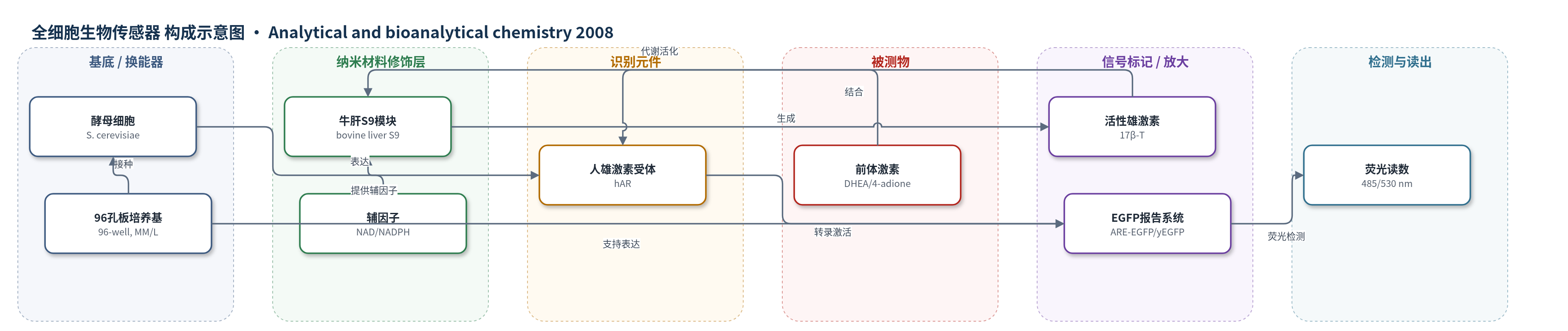
点击图片查看大图 · 依据论文自动绘制
传感器类型
全细胞生物传感器
检测对象
脱氢表雄酮(DHEA)、4-雄烯二酮(4-androstene-3,17-dione, 4-adione)、5-雄甾-2-烯-3,17-二醇(5-androstene-3,17-diol, 5-adiol)及其代谢产物17β-睾酮(17β-testosterone, 17β-T);样品基质为饲料补充剂/胶囊提取物及注射制剂
检测原理
样品提取物先与牛肝S9及NAD等辅因子孵育,S9中的3β-HSD/17β-HSD和细胞色素P450活性将DHEA、4-adione、5-adiol等前体激素转化为4-adione和17β-T等活性雄激素。活性雄激素进入表达人雄激素受体hAR的重组酵母细胞,与hAR结合后使受体从伴侣蛋白解离并转位至细胞核,结合雄激素响应元件ARE,招募共激活因子并启动ARE-EGFP报告基因转录。随着活性雄激素浓度升高,EGFP表达量增加,24 h后在485 nm激发、530 nm发射下测得荧光增强。该体系以细胞内受体-转录报告系统实现信号放大,并通过S9代谢活化将无直接活性的前体激素转化为可检测的雄激素信号。
检测灵敏度
原文未报告LOD、线性范围、灵敏度斜率或相关系数;报告EC50: 4-adione 6,900 nM、17β-T 92 nM、DHT 26 nM。
效应效果
该酵母雄激素生物测定具有高度雄激素特异性,酵母缺乏内源受体,可避免其他受体类型交叉干扰。直接检测中,DHEA和5-adiol无响应,4-adione、17β-T和DHT分别显示EC50为6,900 nM、92 nM和26 nM。经牛肝S9/NAD孵育后,DHEA、4-adione和5-adiol均产生雄激素活性;补充剂A无直接信号,活化后接近最大响应,补充剂B直接响应约600,活化后升至近最大。加标实验使用提取前5 µg/g 17β-T和提取后300 nM 17β-T,预期达到最大响应,但受DHEA拮抗作用影响,稀释后加标后信号增加。UPLC-TOFMS确认代谢物为4-adione和17β-T。作者认为该方法可用于饲料补充剂和运动兴奋剂前体激素筛查,替代动物实验。
传感器的构成
- 生物传感器细胞:重组酿酒酵母 Saccharomyces cerevisiae,表达人雄激素受体 hAR 与 yEGFP 报告系统,作为识别与信号转导单元
- 识别元件:人雄激素受体 hAR,结合雄激素配体后解离伴侣蛋白并转位至细胞核
- 信号报告元件:雄激素响应元件 ARE 耦合增强绿色荧光蛋白 EGFP/yEGFP,转录产生荧光
- 反应基质:96孔板与最小培养基 MM/L(酵母氮源、葡萄糖、硫酸铵、L-亮氨酸),维持酵母生长与报告基因表达
- 代谢活化模块:牛肝S9 fraction,含3β-HSD/17β-HSD和细胞色素P450活性,将前体激素转化为活性雄激素
- 辅因子/电子供体:NAD、NADH、NADP、NADPH,支持HSD氧化还原反应
- 读出装置:Synergy HT 多检测微孔板读数仪,485 nm激发、530 nm发射检测荧光
中文摘要
脱氢表雄酮(DHEA)等前体激素是类固醇前体,本身不显示激素活性。由于体内代谢强烈且代谢物难以显著高于内源水平,牛育肥中滥用这些前体激素难以证明。本研究旨在建立一种体外检测方法,用于检测饲料补充剂和注射制剂中可能存在的前体激素的间接激素活性。样品提取物先与牛肝S9组分孵育,以模拟体内代谢活化;随后将孵育后的提取物暴露于高度雄激素特异性的酵母生物测定系统中,以检测激素活性。DHEA、4-雄烯二酮(4-adione)和5-雄甾-2-烯-3,17-二醇(5-adiol)经代谢活化后雄激素活性增加,原因是形成了活性雄激素17β-睾酮(17β-T),并通过超高效液相色谱-飞行时间质谱准确质量测定得到证实。所建立体外系统可模拟羟类固醇脱氢酶(HSD)和细胞色素P450介导的体内代谢转化,从而无需动物实验即可评估生物活性并进行化学鉴定。对声称含有DHEA的未知补充剂样品进行筛查,成功实现生物活化并获得雄激素酵母生物传感器的阳性结果。
英文摘要
Prohormones such as dehydroepiandrosterone (DHEA) are steroid precursors that do not show hormonal activity by themselves. Abuse of these prohormones in cattle fattening is hard to prove because of strong in vivo metabolism and the difficulty to detect metabolites which are not significantly above endogenous levels. The aim of the present work was to develop an in vitro assay capable of detecting the indirect hormonal activity of prohormones that might be present in feed supplements and injection preparations. Sample extracts were incubated with a bovine liver S9 fraction in order to mimic the in vivo metabolic activation. Subsequently incubated extracts were exposed to a highly androgen-specific yeast bioassay to detect hormonal activity. Metabolic activation of DHEA, 4-androstene-3,17-dione (4-adione) and 5-androstene-3,17-diol (5-adiol) resulted in an increased androgenic activity caused by the formation of the active androgen 17beta-testosterone (17beta-T), as shown by ultra-performance liquid chromatography and time-of-flight mass spectrometry with accurate mass measurement. The developed in vitro system successfully mimics the hydroxysteroid dehydrogenase (HSD)- and cytochrome P450-mediated in vivo metabolic transitions, thus allowing assessment of both bioactivity and chemical identification without the use of animal experiments. Screening of unknown supplement samples claimed to contain DHEA resulted in successful bioactivation and positive screening results according to the androgen yeast biosensor.