组成图示
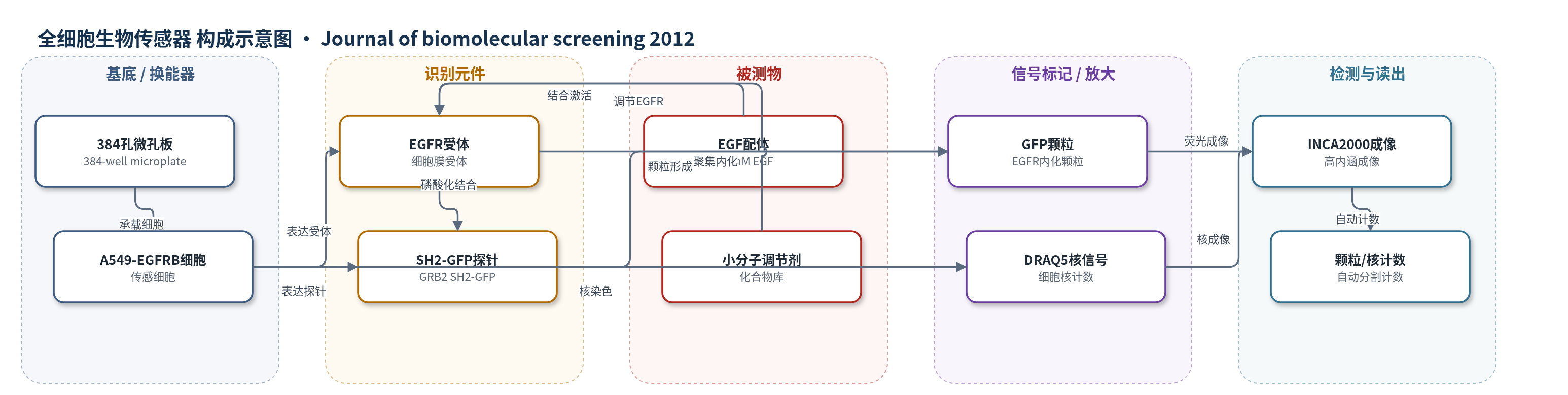
点击图片查看大图 · 依据论文自动绘制
传感器类型
全细胞生物传感器
检测对象
EGFR 功能活性(EGFR activity/function)、EGFR 小分子抑制剂/激活剂(EGFR inhibitors/activators);样品基质:活细胞培养体系(A549-EGFRB 细胞,384孔微孔板,1% DMSO 化合物库)
检测原理
A549-EGFRB 细胞表达 EGFR 和 GRB2 SH2-GFP 融合蛋白。加入 EGF 后,EGFR 二聚并自磷酸化,SH2 域结合磷酸化酪氨酸,使 SH2-GFP 随 EGFR 聚集、内化并在胞内形成 GFP 颗粒;颗粒数随 EGFR 激活程度增加。小分子抑制剂阻断 EGFR 激酶活性、成熟或转运时,颗粒形成减少;激活剂则使颗粒数增加。DRAQ5 标记细胞核,用于校正细胞数量与毒性。INCA2000 高内涵成像自动分割并计数 GFP 颗粒与细胞核,计算颗粒抑制率,从而在活细胞中定量 EGFR 功能变化。
检测灵敏度
—
效应效果
对照实验高/低对照颗粒数为10737和507,CV 13%/14%,S/N 21:1,Z′=0.56,核计数CV 11%/9%。6912化合物重复筛选重现性良好,初筛得82个抑制剂(1.2%)和66个激活剂(0.95%),12/13已知EGFR抑制剂确认。剂量反应确认13/27抑制剂、3/15激活剂;erlotinib、gefitinib、lapatinib IC50为0.21、0.38、0.59 µM,ZM-306416 EGFRB IC50=0.67 µM、体外EGFR激酶<0.01 µM。可识别细胞可渗透EGFR调节剂,支持耐药药物发现。
传感器的构成
- 细胞培养基底:384孔微孔板(384-well microplate)与细胞培养介质,承载 A549-EGFRB 细胞并支持 37°C 孵育。
- 传感细胞:A549-EGFRB 细胞,稳定表达 EGFR 与 SH2-GFP 融合蛋白,作为活细胞识别与信号报告平台。
- 识别元件:GRB2 的 SH2 域(SH2 domain of GRB2),特异性结合活化 EGFR 的磷酸化酪氨酸。
- 荧光报告元件:绿色荧光蛋白(GFP)与 SH2 域融合,EGFR 激活后随受体聚集、内化形成可成像颗粒。
- 刺激配体:表皮生长因子(EGF,500 nM),诱导 EGFR 激活、二聚、内化和颗粒形成。
- 细胞计数标记:DRAQ5 DNA 染料,标记细胞核,用于细胞数量与细胞毒性校正。
- 固定与成像介质:4% 多聚甲醛(PFA)固定细胞,PBS 洗涤后由 INCA2000 高内涵成像系统读取。
- 对照体系:1% DMSO 高对照与 10 µM gefitinib 低对照,用于计算颗粒抑制率。
中文摘要
激酶抑制剂的成功验证了其作为药物的价值,但发现过程因候选物缺乏细胞活性而失败率高。作者认为在活细胞中筛选可发现具有细胞渗透性的新型调节剂。为此,他们使用近期优化的表皮生长因子受体(EGFR)生物传感器检测法筛选 EGFR 活性调节剂。该检测法在 384 孔高通量筛选(HTS)条件下得到验证,信噪比为 21,Z′ 值为 0.56,表明其具有稳健的细胞检测性能。对 6912 个化合物库的初步筛选显示良好重现性,以 1.2% 和 0.95% 的初始命中率分别识别出 82 个抑制剂和 66 个激活剂。后续剂量反应研究确认库中 13 个已知 EGFR 抑制剂中的 12 个为阳性。血管内皮生长因子受体(VEGFR)拮抗剂 ZM-306416 被鉴定为强效 EGFR 功能抑制剂;flurandrenolide、beclomethasone 和 ebastine 被确认为 EGFR 功能激活剂。结果验证了该新方法,并展示其在发现潜在临床用新型激酶调节剂中的应用价值。
英文摘要
Early success of kinase inhibitors has validated their use as drugs. However, discovery efforts have also suffered from high attrition rates due to lack of cellular activity. We reasoned that screening for such candidates in live cells would identify novel cell-permeable modulators for development. For this purpose, we have used our recently optimized epidermal growth factor receptor (EGFR) biosensor assay to screen for modulators of EGFR activity. Here, we report on its validation under high-throughput screening (HTS) conditions displaying a signal-to-noise ratio of 21 and a Z' value of 0.56-attributes of a robust cell-based assay. We performed a pilot screen against a library of 6912 compounds demonstrating good reproducibility and identifying 82 inhibitors and 66 activators with initial hit rates of 1.2% and 0.95%, respectively. Follow-up dose-response studies revealed that 12 of the 13 known EGFR inhibitors in the library were confirmed as hits. ZM-306416, a vascular endothelial growth factor receptor (VEGFR) antagonist, was identified as a potent inhibitor of EGFR function. Flurandrenolide, beclomethasone, and ebastine were confirmed as activators of EGFR function. Taken together, our results validate this novel approach and demonstrate its utility in the discovery of novel kinase modulators with potential use in the clinic.