组成图示
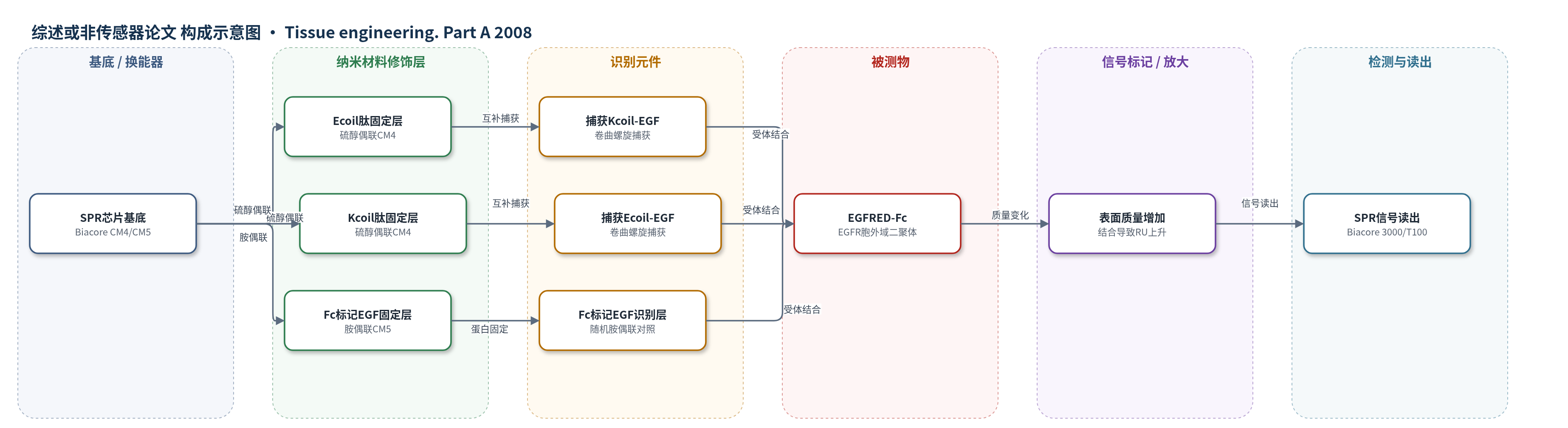
点击图片查看大图 · 依据论文自动绘制
传感器类型
综述或非传感器论文
检测对象
EGFR 胞外域二聚体(EGFRED-Fc);样品基质:HBS-T 缓冲液(10 mM HEPES pH 7.4、150 mM NaCl、3.4 mM EDTA、0.05% Tween 20)。表面配体为重组标记 EGF(Ecoil-EGF、Kcoil-EGF、Fc-EGF、EGF-Fc)。
检测原理
SPR 芯片表面先经化学修饰:CM4 芯片用 NHS/EDC/PDEA 硫醇偶联固定含半胱氨酸的 Ecoil 或 Kcoil 肽,CM5 芯片用胺偶联固定 Fc 标记 EGF。随后,coil-tagged EGF 通过 E/K 卷曲螺旋互补非共价结合被定向捕获在芯片上,形成约 100 RU 的识别层。流动相注入人工二聚化 EGFR 胞外域 EGFRED-Fc,其与表面 EGF 特异性结合,使传感器表面质量增加,引起 SPR 共振角/共振单位变化。EGFRED-Fc 浓度越高,结合量越大,RU 信号越强;解离阶段信号下降。该过程无酶或核酸放大,直接以质量传感读出结合动力学与亲和力。
检测灵敏度
原文未报告 LOD、线性范围、灵敏度斜率或相关系数。
效应效果
未报告抗干扰、RSD或实际样品回收率。细胞实验中,Ecoil-EGF 的 EC50 为 5.5 nM,接近未标记 EGF 的 4.3 nM;EGF-Fc 和 Kcoil-EGF 分别为 17 nM 和 63 nM,Fc-EGF 未诱导 EGFR 磷酸化。SPR 中,EGF-Fc 与 EGFRED-Fc 的表观 KD 为 16±0.5 nM,koff 为 1.11×10^-4 s^-1;Fc-EGF 结合弱且瞬时,KD>>100 nM。定向捕获的 Ecoil-EGF 和 Kcoil-EGF 表观 KD 分别为 44±5 pM 和 55±7 pM,最高浓度积累 410 与 360 RU。作者认为 E/K 卷曲螺旋定向固定优于随机胺偶联,HEK293 细胞可高效表达生物活性 EGF。
传感器的构成
- 换能器基底:Biacore CM4/CM5 传感器芯片表面,用于 SPR 实时检测表面结合。
- 表面修饰层:CM4 芯片经硫醇偶联固定 N 端含半胱氨酸的 Ecoil 或 Kcoil 肽(约 400 RU),形成互补卷曲螺旋捕获位点。
- 表面修饰层:CM5 芯片经胺偶联固定 Fc-EGF 或 EGF-Fc(2800/3900 RU),作为随机固定对照。
- 识别元件:通过 E/K 卷曲螺旋互补非共价捕获的 Ecoil-EGF 或 Kcoil-EGF(约 100 RU),用于结合 EGFR 胞外域。
- 识别元件:共价固定的 Fc-EGF 或 EGF-Fc,用于比较随机固定下 EGFR 胞外域结合。
- 信号读出:Biacore 3000/T100 SPR 仪监测共振单位(RU)变化。
中文摘要
为组织工程应用,将生长因子固定在细胞培养支架上可刺激细胞增殖并降低可溶性生长因子成本。为评估从头设计的 E/K 异源卷曲螺旋肽对用于表皮生长因子(EGF)接枝的潜力,作者利用哺乳动物细胞表达系统生产螺旋标记 EGF 嵌合体并纯化。通过体外细胞实验监测 EGFR 磷酸化,比较 E 或 K 螺旋类型对 EGF 生物活性的影响,并与 IgG 的 Fc 片段比较。结果表明标签类型和位置强烈影响生长因子生物活性(EC50 5.5–63 nM)。进一步 SPR 生物传感器实验显示,卷曲螺旋介导的定向固定 EGF 比随机固定更高效,螺旋标记 EGF 对人工二聚化 EGFR 胞外域的表观 KD 为 5 pM,而 Fc 标记 EGF 为 16 nM。总体而言,螺旋标记嵌合体为组织工程中生长因子定向固定提供了有吸引力的途径,HEK293 细胞可作为表达生物活性形式的稳健平台。
英文摘要
For tissue engineering applications, growth factor immobilization on cell culture scaffolds bears the potential to stimulate cell proliferation while minimizing costs associated to soluble growth factor supply. In order to evaluate the potential of a de novo-designed heterodimerization peptide pair, namely the E and K coils, for epidermal growth factor (EGF) grafting on various scaffolds, production of coil-tagged EGF chimeras using a mammalian cell expression system as well as their purification have been performed. The influence of the type of coil (E or K) upon EGF bioactivity, assessed in an in vitro cell assay, was compared to that of the fragment crystallizable (Fc) domain of immunoglobulin G by monitoring phosphorylation of EGF receptor (EGFR) upon chimeric EGF exposure. Our results demonstrate that the type and the location of the tag have a strong impact on growth factor bioactivity (EC50 ranging from 5.5 to 63 nM). Additional surface plasmon resonance-based biosensor experiments were conducted to test the ability of captured chimeric EGF to bind to their receptor ectodomain in vitro. These experiments indicated that the oriented coiled-coil-mediated immobilization of EGF was significantly more efficient than a random approach as coil-tagged EGF displayed enhanced affinities for artificially dimerized EGFR ectodomain when compared to Fc-tagged EGF (apparent KD of 5 pM vs. 16 nM). Altogether, our results highly suggest that coil-tagged chimeras represent an attractive avenue for the oriented immobilization of growth factors for tissue engineering applications and that HEK293 cells offer a robust platform for their expression in a bioactive form.