组成图示
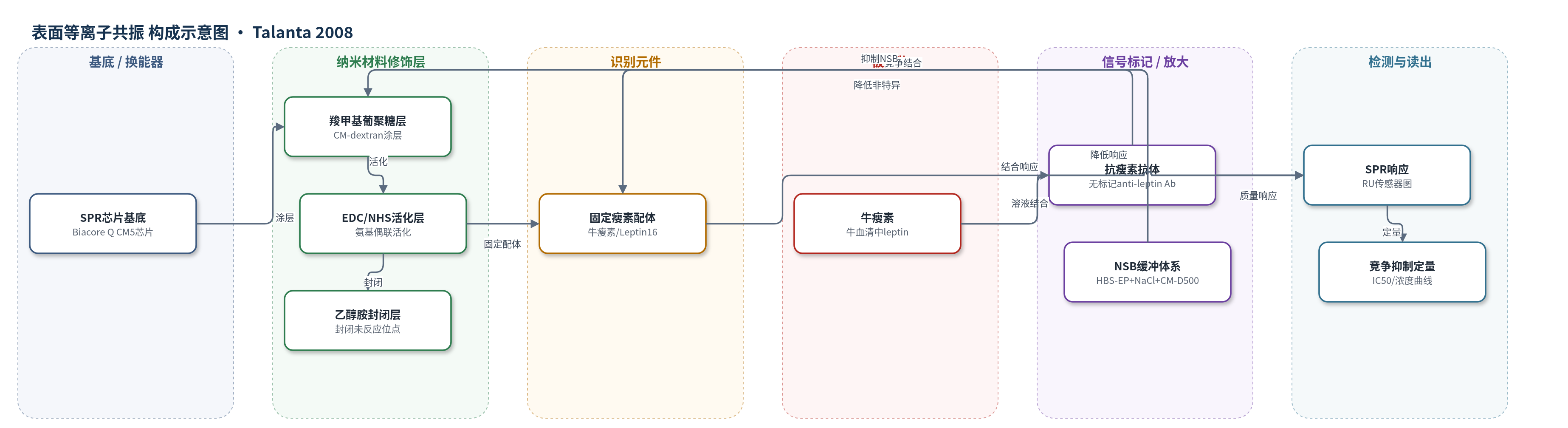
点击图片查看大图 · 依据论文自动绘制
传感器类型
表面等离子共振(SPR)生物传感器
检测对象
牛瘦素(bovine leptin, leptin);样品基质:牛血清(bovine serum)
检测原理
该 SPR 免疫分析采用竞争抑制模式。CM5 芯片表面的羧甲基葡聚糖经 EDC/NHS 活化后,共价固定重组牛瘦素或瘦素片段作为捕获配体,并用乙醇胺封闭。牛血清样品中的牛瘦素与加入的无标记抗瘦素抗体在溶液中结合,使自由抗体浓度下降;混合液流过芯片时,剩余自由抗体与固定配体结合,界面质量增加,引起 SPR 共振响应(RU)变化。被测物浓度越高,自由抗体越少,芯片响应越低,因此通过校准曲线(IC50)定量。NSB 缓冲体系通过高盐(0.5 M NaCl)削弱静电吸附,pH 9.0 使牛血清白蛋白带负电并与 CM-dextran 静电排斥,同时 0.005% CM-D500 竞争吸附位点,从而降低血清基质非特异结合,提高信噪比。
检测灵敏度
LOD: 约 1 × 10⁻² ng ml−1(1:100 稀释法);IC50: 38.8 ng ml−1(matrix curve)、26.5 ng ml−1(buffer curve)
效应效果
该体系在 20 份随机牛血清中稳定降低基质效应:未修饰 CM5 平均 NSB 降低 85.9%(±4.76),固定牛瘦素表面降低 87.3%(±5.71),最高 94%;组合优化下空白 CM5、Leptin 16、牛瘦素芯片分别最高降低 95%、88%、81%。0.5 M NaCl 使 Leptin 16 表面 NSB 从 1135 RU 降至 538 RU(53%),0.005% CM-D500 与 0.5 M NaCl 组合降低 75%。血清基质 IC50 为 38.8 ng ml−1,缓冲液为 26.5 ng ml−1。作者认为其可支持牛血清直接检测并减少蛋白污染。
传感器的构成
- 基底/换能器:Biacore Q SPR 芯片(CM5 research grade),提供表面等离子共振换能表面
- 聚合物修饰层:羧甲基葡聚糖(CM-dextran)涂层,提供可活化羧基并承载识别配体
- 化学活化层:EDC/NHS 混合液活化 CM-dextran 羧基,形成可偶联氨基的活性酯
- 识别元件:重组牛瘦素(recombinant bovine leptin)或合成瘦素片段(Leptin 16,77SNDLENLRDLLHLLAA92)固定于表面,作为捕获配体/竞争抑制参照
- 封闭层:乙醇胺(ethanolamine,pH 8.5)封闭未反应位点,降低后续非特异吸附
- 抗非特异缓冲层:NSB buffer(HBS-EP 含 0.5 M NaCl、0.005% CM-D500、pH 9.0),抑制牛血清蛋白对芯片的非特异结合
- 信号相互作用物:无标记抗瘦素抗体(anti-leptin antibody),与固定配体结合产生 SPR 质量响应
- 再生剂:50 mM NaOH 脉冲再生芯片表面,用于连续进样
中文摘要
表面等离子共振(SPR)生物传感器技术因快速、无标记、实时和可重复等优势,被广泛用于生命科学和食品/动物健康分析。然而,在牛血清等复杂生物样品中,血清蛋白与羧甲基葡聚糖(CM-dextran)芯片表面发生严重非特异性结合(NSB),限制了直接检测。本文以牛血清中牛瘦素(bovine leptin)的直接测量为模型,开发并优化了一种用于 Biacore SPR 系统的抗 NSB 缓冲体系。该体系基于 HBS-EP 缓冲液,含 0.5 M NaCl、0.005% CM-dextran(CM-D500),pH 9.0。通过优化样品稀释、离子强度、CM-D500 浓度和 pH,显著降低牛血清组分对 CM5 芯片的吸附。在 20 份随机牛血清样品中,未修饰 CM5 表面和固定牛瘦素的 CM5 表面平均 NSB 降低分别为 85.9% 和 87.3%,最高可达 94%。结果表明,缓冲液组成和 pH 对抑制基质效应至关重要,该体系可为复杂生物样品中 SPR 免疫分析提供通用模型。
英文摘要
Surface plasmon resonance (SPR) based biosensor technology has been widely used in life science research for many applications. While the advantages of speed, ruggedness, versatility, sensitivity and reproducibility are often quoted, many researchers have experienced severe problem of non-specific binding (NSB) to chip surfaces when performing analysis of biological samples such as bovine serum. Using the direct measurement of the bovine protein leptin, present in bovine serum samples as a model, a unique buffering system has been developed and optimised which was able to significantly reduce the non-specific interactions of bovine serum components with the carboxymethyl dextran chip (CM5) surface on a Biacore SPR system. The developed NSB buffering system comprised of HBS-EP buffer, containing 0.5M NaCl, 0.005% CM-dextran, pH 9.0. An average NSB reduction (n=20) of 85.9% and 87.3% was found on an unmodified CM5 surface and a CM5 with bovine leptin immobilised on the chip surface, respectively. A reduction in NSB of up to 94% was observed on both surfaces. The concentration of the constitutive components and pH of the buffer were crucial in achieving this outcome.