组成图示
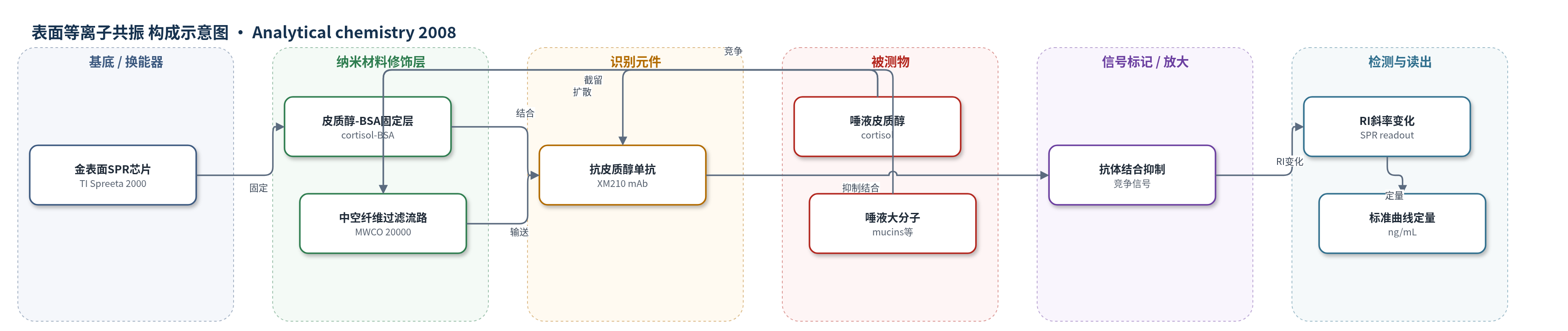
点击图片查看大图 · 依据论文自动绘制
传感器类型
表面等离子共振(SPR)生物传感器
检测对象
皮质醇(cortisol),样品基质:唾液(saliva)及PBS/PBST缓冲液
检测原理
该传感器基于SPR原理,通过监测金表面附近折射率(RI)变化实现检测。由于皮质醇是小分子,直接结合引起的RI变化很小,因此采用竞争法:将皮质醇-BSA偶联物固定于金表面,抗皮质醇单克隆抗体与之结合时增加界面质量并改变RI;样品中游离皮质醇与抗体竞争结合位点,浓度越高,抗体结合越少,RI-time初始斜率越低。参考BSA通道用于扣除整体RI、温度和非特异结合。唾液样品先经亲水中空纤维在线过滤,小分子皮质醇扩散进入抗体流路,黏蛋白等大分子被截留,降低背景且信号仅降低29%。最终通过斜率与无皮质醇对照比较生成标准曲线定量。
检测灵敏度
LOD: 0.36 ng/mL (1.0 nM)(缓冲液);LOD: 1.0 ng/mL (3.6 nM)(唾液);检测范围: 1.5–10 ng/mL (5.4–36 nM)(唾液)
效应效果
系统具有良好选择性,结构相似的雌三醇(estriol)加入后未显著干扰皮质醇抗体结合。在线过滤流路可将唾液大分子与传感表面隔离,NaCl扩散实验显示信号仅降低29%。唾液皮质醇经亲和柱脱除后由1.8±0.2 ng/mL降至0.20±0.05 ng/mL,二次脱除后为0.05±0.05 ng/mL,蛋白保留约90%。实验均做三次重复并计算标准差,表面试剂干燥保存至少一年。检测时间少于10 min,较需数小时的竞争ELISA和需慢速提取的LC-MS/MS更快速,适合现场、急诊及压力/疾病状态评估。
传感器的构成
- 基底/换能器:TI Spreeta 2000 金表面传感器芯片,作为SPR换能器检测界面折射率变化
- 捕获/固定层:皮质醇-牛血清白蛋白偶联物(cortisol-conjugated BSA)固定于金表面,作为竞争法固定靶标
- 封闭层:0.1% 酪蛋白(casein)PBS溶液封闭,降低非特异结合
- 保存稳定层:2.5% 海藻糖(trehalose)和2.5% 葡聚糖(dextran,平均分子量500000)Tris pH 8.0储存液,干燥后稳定至少一年
- 识别元件:小鼠抗皮质醇单克隆抗体(XM210,AbCam),1:15000稀释,与固定皮质醇-BSA结合
- 参考通道:BSA涂层金表面,用于扣除整体折射率、温度波动和非特异结合
- 在线过滤流路:亲水中空纤维膜(Minntech,MWCO 20000)置于PEEK管中,两端聚氨酯胶粘密封,截留唾液大分子并允许小分子扩散
- 样品缓冲:PBST(PBS加0.1% Tween-20)稀释唾液,NaCl用于验证小分子扩散
中文摘要
唾液是无创替代血液进行生物医学检测的有用样品,其皮质醇水平与压力状态相关。本文报道了一种用于检测唾液中皮质醇的便携式表面等离子共振(SPR)生物传感器系统。作者利用皮质醇特异性单克隆抗体建立竞争法,并在实验室设计的六通道便携式SPR生物传感器上实现检测。在实验室缓冲液中,皮质醇检出限为0.36 ng/mL(1.0 nM)。基于亲水中空纤维膜扩散的在线过滤器可在样品进入传感器表面前,将小分子从唾液复杂大分子基质中分离,使唾液黏蛋白等大分子不接触传感表面;与相同浓度分析物直接流过传感器相比,信号仅降低29%。在唾液中建立的标准曲线检出限为1.0 ng/mL(3.6 nM),足以满足临床应用。该系统也可用于复杂基质中小分子分析物的多种检测。
英文摘要
Saliva provides a useful and noninvasive alternative to blood for many biomedical diagnostic assays. The level of the hormone cortisol in blood and saliva is related to the level of stress. We present here the development of a portable surface plasmon resonance (SPR) biosensor system for detection of cortisol in saliva. Cortisol-specific monoclonal antibodies were used to develop a competition assay with a six-channel portable SPR biosensor designed in our laboratory. The detection limit of cortisol in laboratory buffers was 0.36 ng/mL (1.0 nM). An in-line filter based on diffusion through a hollow fiber hydrophilic membrane served to separate small molecules from the complex macromolecular matrix of saliva prior to introduction to the sensor surface. The filtering flow cell provided in-line separation of small molecules from salivary mucins and other large molecules with only a 29% reduction of signal compared with direct flow of the same concentration of analyte over the sensor surface. A standard curve for detection of cortisol in saliva was generated with a detection limit of 1.0 ng/mL (3.6 nM), sufficiently sensitive for clinical use. The system will also be useful for a wide range of applications where small molecular weight analytes are found in complex matrixes.