组成图示
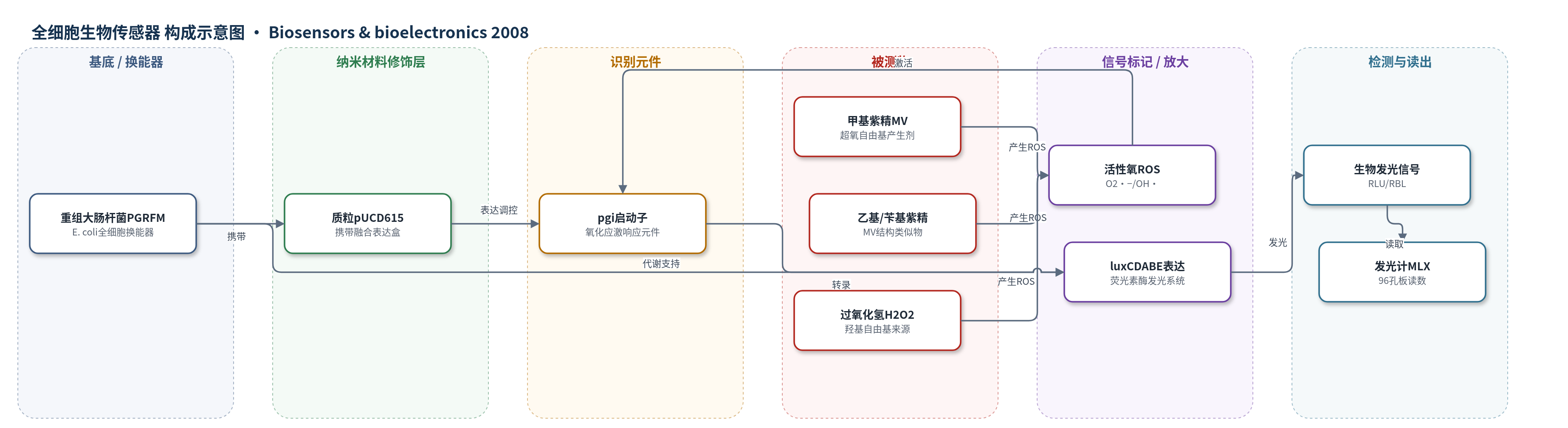
点击图片查看大图 · 依据论文自动绘制
传感器类型
全细胞生物传感器
检测对象
甲基紫精(methyl viologen, MV)、乙基紫精(ethyl viologen, EV)、苄基紫精(benzyl viologen, BV)、过氧化氢(hydrogen peroxide, H2O2);样品基质为 LB 培养基或最小培养基(含葡萄糖、葡萄糖酸盐、甘露醇、甘露糖)中的溶液样品
检测原理
氧化还原化学物质(MV、EV、BV)进入细胞后发生电子循环,将电子传递给 O2,产生超氧阴离子 O2•−;O2•− 经歧化或与 H2O2 反应可生成 H2O2 和羟基自由基 OH•。这些活性氧触发 SoxRS/OxyRS 相关氧化应激响应,激活 pgi 启动子。pgi 启动子驱动 luxCDABE 生物发光操纵子转录翻译,表达荧光素酶系统,利用细胞内底物产生光子。发光强度(RLU/RBL)随氧化应激诱导剂浓度增加而增加,呈剂量依赖;高浓度因细胞毒性饱和。通过改变碳源/营养状态调节细胞代谢和启动子活性,扩展动态范围。
检测灵敏度
LB 中 2 倍诱导最低 MV 浓度: 4.9 ppm;LB 剂量依赖响应范围: 4.9–625 ppm(至 5000 ppm 有响应但不再增加);最小培养基葡萄糖中可检测 MV 范围: 0.6–4.9 ppm(RBL=12.3–15.8);葡萄糖酸盐中可检测 MV 范围: 1.22–19.5 ppm(RBL=3.2–23.8);结论报告范围: 0.6–19.3 ppm。
效应效果
PGRFM 对 MV、EV、BV 和 H2O2 呈剂量依赖响应,而对膜损伤剂 4-氯苯酚(4-CLP)及 DNA 损伤剂丝裂霉素 C(MMC)、MNNG 仅弱响应,最大相对生物发光(RBL)分别为 3.7(50 ppm)、4.9(10 ppm)和 2.4(9.3 ppm),提示选择性主要针对活性氧介导的氧化应激。生长条件显著影响灵敏度:LB 中最低 2 倍诱导 MV 浓度为 4.9 ppm,剂量依赖至 625 ppm;最小培养基葡萄糖中最低 0.6 ppm,葡萄糖酸盐中最低 1.22 ppm,灵敏度提高 8 倍以上。EV 响应约为同浓度 MV 的 25–50%,BV 在 78 ppm 达最大 RBL=199,高浓度因毒性下降。作者认为可用于农药、药物等外源物监测,并可与 CCD/CMOS 便携化。
传感器的构成
- 换能/识别细胞:重组大肠杆菌 E. coli RFM443 衍生菌株 PGRFM,作为全细胞识别与信号转导单元
- 遗传表达盒:质粒 pUCD615 携带 pgi::luxCDABE 融合子,使 pgi 启动子控制 luxCDABE 表达
- 识别元件:pgi 基因启动子(pgi promoter),响应 O2•−/H2O2/OH• 诱导的氧化应激转录激活
- 信号标记物:luxCDABE 生物发光操纵子,表达荧光素酶系统并产生生物发光信号
- 反应介质:LB 培养基或最小培养基(MM),含葡萄糖、葡萄糖酸盐、甘露醇或甘露糖碳源,用于调节灵敏度与动态范围
- 读出平台:96 孔板与生物发光计 MLX(Dynex),读取相对发光单位 RLU/RBL
中文摘要
本研究利用大肠杆菌 pgi 基因启动子与 luxCDABE 报告子融合,构建了一种新型氧化应激响应型细菌生物发光生物传感器 PGRFM。该菌株对模型氧化还原化学物质甲基紫精(MV)呈剂量依赖性响应。PGRFM 对氧化还原化学物质的响应强烈依赖于可用碳源:在葡萄糖或葡萄糖酸盐营养限制条件下,可响应低浓度 MV(0.6–19.3 ppm),而在 LB 营养丰富培养基中仅响应较高浓度(4.9–625 ppm)。通过选择生长条件,可扩展应激诱导化学物质的检测浓度范围。PGRFM 还能响应 MV 的结构类似物乙基紫精和苄基紫精,表明其可响应超氧自由基,而不取决于产生自由基的具体化学物质;不同类似物的响应模式各异,可反映其诱导氧化应激的强度。暴露于过氧化氢时,PGRFM 也出现显著诱导,说明该菌株可同时响应超氧阴离子自由基(O2•−)和羟基自由基(OH•)。
英文摘要
A new oxidative stress-responsive bacterial biosensor was constructed using the promoter of the pgi gene fused to the luxCDABE reporter. This strain (PGRFM) responded in a dose-dependent manner to methyl viologen (MV), a model redox chemical that results in oxidative stress. The responses of strain PGRFM to redox chemicals was strongly dependent on the available carbon source. For example, when the strain was grown under nutrient-limited conditions in the presence of glucose or gluconate it was capable of responding to low MV concentrations (0.6-19.3ppm), whereas the same cells grown in LB (a nutrient rich media) only responded to higher concentrations (4.9-625ppm). This allowed us to select PGRFM's growth conditions and extend the range of concentrations at which a stress-inducing chemical could be detected. Further, strain PGRFM responded to structural analogs of MV (i.e., ethyl and benzyl viologen), demonstrating that this strain is responsive to the presence of superoxide radicals, regardless of the chemical by which they are generated. Strain PGRFM's response patterns to these analogs were distinct from each other, which determined their strength to induce oxidative stress. As well, a significant induction was seen when this strain was exposed to hydrogen peroxide, illustrating that strain PGRFM is responsive in the presence of both the superoxide (O(2)(-)) and hydroxyl (OH) radicals.