组成图示
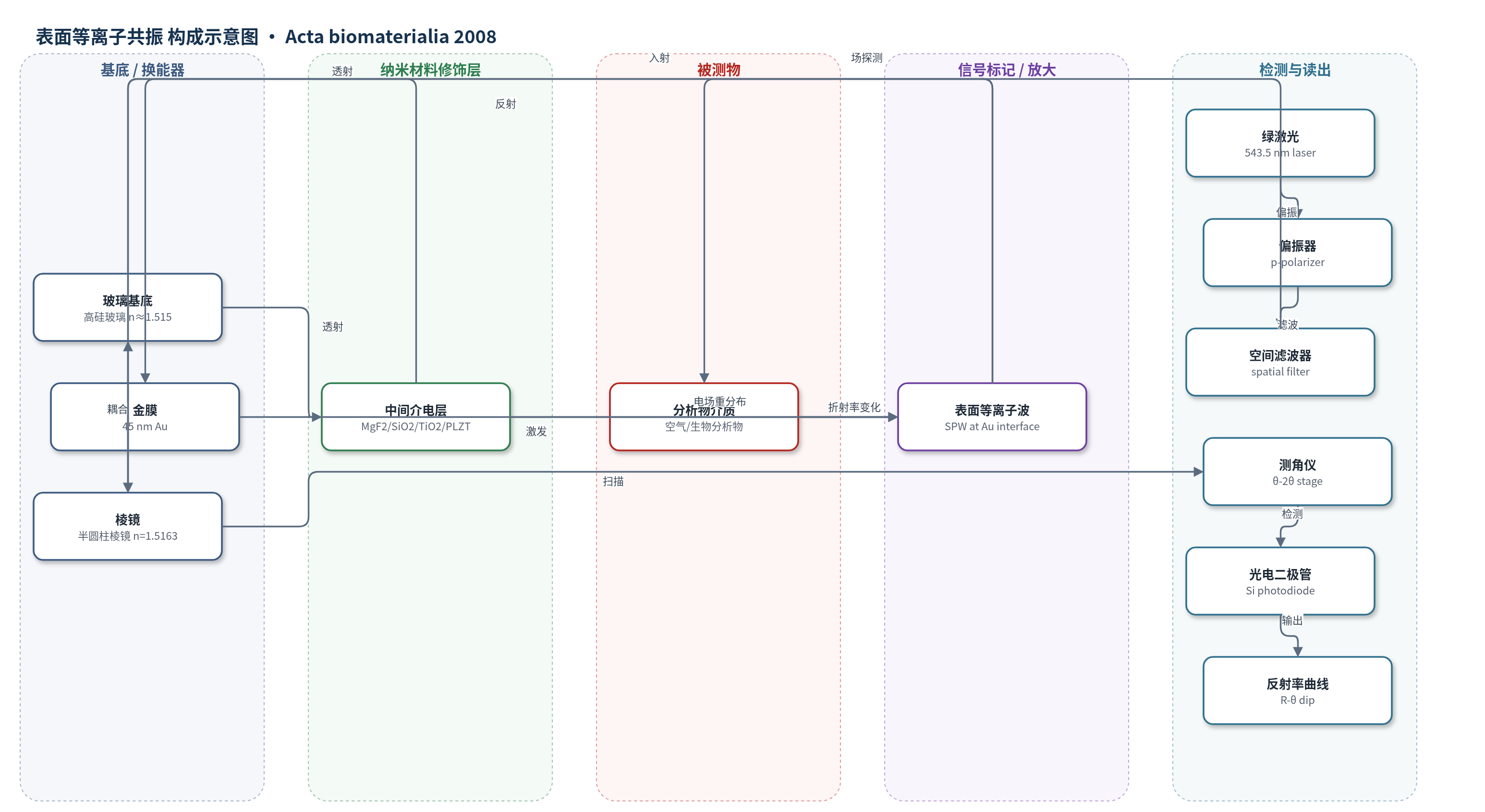
点击图片查看大图 · 依据论文自动绘制
传感器类型
表面等离子共振(SPR)生物传感器
检测对象
空气(air,参考介质)、生物分析物(bio-analyte,未具体指定,样品基质为生物样品/溶液)
检测原理
p偏振光经棱镜以Kretschmann几何入射到Au膜,满足动量匹配时激发Au/介质界面表面等离子波(SPW),光能转化为等离子体振荡,反射率出现尖锐下降。中间介电层改变SPW电场分布,使更多场强进入低损耗介质/分析物区域,降低共振宽度Δθ,提高角度分辨率。当分析物在Au表面结合或浓度变化时,界面附近折射率/等效厚度改变,SPW波矢变化,导致共振角θR、最小反射率Rmin和共振宽度Δθ变化;通过测量R-θ曲线位移/形状变化读出分析物信息。无酶/核酸放大,主要依靠多层结构增强场与锐化共振。
检测灵敏度
未报告LOD、线性范围、灵敏度斜率或相关系数。
效应效果
论文未报告选择性、稳定性、重现性、回收率或与ELISA/HPLC/qPCR对比。基本棱镜/45 nm Au/air配置θR=46.0°、Rmin=0.0517、Δθ=5.33°;加入中间介电层后θR约46.0±0.3°,Rmin约0.03–0.07。MgF2 100 nm使Δθ降至4.63°,500 nm为4.21°;TiO2 500 nm为3.12°;多孔SiO2 500 nm为3.52°;PLZT 500/800 nm为4.01/3.55°。实验宽度总体高于计算值但趋势一致。作者主张低或高折射率中间膜可锐化SPR共振,提高灵敏度与分辨率。
传感器的构成
- 基底:高硅玻璃基底(n≈1.515),承载薄膜并与棱镜耦合。
- 耦合棱镜:半圆柱棱镜(n=1.5163),通过折射率匹配油与基底接触,提供p偏振入射光。
- 中间介电修饰层:MgF2、MgO、致密SiO2、多孔SiO2、TiO2、PZT、PLZT、PZT–SiO2、BSZT、LNO等薄膜,厚度约100–800 nm,调节SPW电场分布并锐化共振。
- 金属换能层:45 nm Au膜,电子束蒸发沉积,作为SPR激发金属层。
- 样品介质层:空气或生物分析物介质,位于Au膜外侧,其折射率/厚度变化改变SPR共振特征。
中文摘要
本研究面向生物传感应用,系统考察中间介电薄膜对多层表面等离子共振(SPR)行为的影响。作者评估了10种简单氧化物、氟化物及复杂氧化物/氟化物材料,包括MgF2、MgO、SiO2、TiO2以及PZT家族介电材料,其折射率覆盖从多孔SiO2的1.19到TiO2的2.83。在固定入射波长543.5 nm的角度调制Kretschmann结构中测量多层SPR共振曲线。结果表明,中间介电层对SPR共振角和共振点最小反射率没有显著影响;但MgF2、多孔SiO2、TiO2和PLZT等中间介电膜可明显降低共振曲线宽度,使共振谷更尖锐。更窄的共振宽度对应更高灵敏度与分辨率,因此预期采用这些介电薄膜的多层SPR生物传感器将具有更好性能。
英文摘要
The effects of intermediate dielectric films on multilayer surface plasmon resonance (SPR) behavior were studied in terms of biosensing applications. Ten simple and complex oxides and fluoride, including MgF(2) and MgO, SiO(2), TiO(2) and complex PZT family dielectric materials, were evaluated. The materials cover a wide range of refractive indices, from 1.19 for the porous silica film to 2.83 for the TiO(2) film. The resonance curves of the multilayer SPR configurations were taken from an angular modulated Kretschmann set-up under a fixed incident wavelength of 543.5 nm. The intermediate dielectric layer has no strong effect on the SPR resonance angle and minimum reflectance at the resonance point. Some intermediate dielectric films, such as MgF(2), porous silica, TiO(2) and PLZT, apparently reduce the width of the resonance curves, resulting in sharper resonance dips. Better performance of the multilayer SPR biosensor incorporating these dielectric films is expected.