组成图示
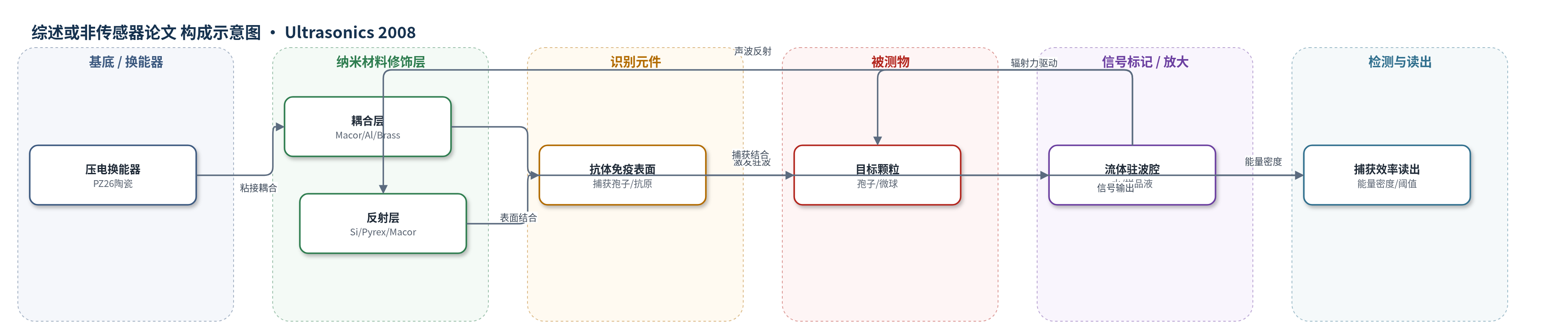
点击图片查看大图 · 依据论文自动绘制
传感器类型
综述或非传感器论文
检测对象
孢子(spores)、微球(microspheres)、聚苯乙烯颗粒(polystyrene particles);样品基质:水/微流控液体。
检测原理
压电换能器在耦合层与反射层之间激发超声,流体腔内形成驻波。粒子受到声辐射力,其大小取决于流体与粒子密度、压缩率差异及局部动能/势能梯度,通常向压力节点迁移。通过选择流体层、反射层和耦合层厚度,使四分之一波长或近四分之一波长模式的压力节点位于反射层或抗体涂层免疫表面附近,从而将孢子、微球等颗粒驱向表面并增强捕获。模型以阻抗传递关系计算各层声压、能量密度和节点位置,Q因子影响能量损耗与峰值能量,但节点位置对层厚更敏感。该装置不依赖化学标记或酶放大,信号表现为粒子捕获效率、声学能量密度或阈值电压变化。
检测灵敏度
未报告LOD、线性范围、灵敏度斜率或相关系数。
效应效果
实验与模型表明,四分之一波长谐振器的粒子捕获对反射层厚度高度敏感:980 μm反射层几乎无孢子捕获,1000 μm时捕获增加,约1100 μm达到峰值,1300 μm时显著下降;一维模型可解释该趋势并预测节点位置。原型近四分之一波长浓缩器采用 tr=1440 μm、tc=1040 μm,对1 μm颗粒实现约4倍浓缩,节点位置与高Q模型预测一致,但能量密度更接近低Q阻尼情况。耦合层材料黄铜、铝和Macor的峰值声学能量密度总体可比,厚度对节点位置和能量影响更大;Q因子主要改变能量密度,而节点位置相对稳健。文章指出横向声场变化是浓缩器性能的主要限制,并强调稳健设计对生物传感增强应用的价值。
传感器的构成
- 换能器:压电陶瓷换能器(Ferroperm PZ26,1 mm厚),产生超声激励。
- 耦合层:Macor、铝(Al)或黄铜(brass),隔离流体并匹配声学阻抗。
- 流体层:水或样品液,形成驻波腔并承载粒子。
- 反射层:硅(Si)、Pyrex玻璃或Macor,形成半波共振并反射声波。
- 识别元件:抗体涂层免疫传感器表面,用于捕获孢子/抗原颗粒。
- 读出方式:声学能量密度、压力节点位置或粒子捕获效率,用于评估装置性能。
中文摘要
本文讨论用于超声粒子操控的分层谐振器的一维建模方法,以支持微流控或芯片实验室应用中子波长谐振器的稳健设计。基于驻波的粒子操控装置中,谐振腔关键尺寸小于波长时,适合样品前处理、分选、单层细胞形成以及增强生物传感器检测能力。微流控谐振器尺寸小,对声压节点定位要求严格,并需高换能效率以保证功率可用性和温度稳定性;许多微加工方法成本高,难以迭代实验,因此设计高效、稳健且具有合适声能分布的子波长谐振器至关重要。作者采用阻抗传递关系建立一维模型,预测和解释谐振器行为,重点分析四分之一波长系统的设计难点,并利用模型解释观测趋势、预测不同耦合层材料下谐振器性能。结果表明,层厚、材料声阻抗和Q因子显著影响节点位置与能量密度,合理选择耦合层和反射层参数可改善稳健性。
英文摘要
Several approaches have been described for the manipulation of particles within an ultrasonic field. Of those based on standing waves, devices in which the critical dimension of the resonant chamber is less than a wavelength are particularly well suited to microfluidic, or "lab on a chip" applications. These might include pre-processing or fractionation of samples prior to analysis, formation of monolayers for cell interaction studies, or the enhancement of biosensor detection capability. The small size of microfluidic resonators typically places tight tolerances on the positioning of the acoustic node, and such systems are required to have high transduction efficiencies, for reasons of power availability and temperature stability. Further, the expense of many microfabrication methods precludes an iterative experimental approach to their development. Hence, the ability to design sub-wavelength resonators that are efficient, robust and have the appropriate acoustic energy distribution is extremely important. This paper discusses one-dimensional modelling used in the design of ultrasonic resonators for particle manipulation and gives example of their uses to predict and explain resonator behaviour. Particular difficulties in designing quarter wave systems are highlighted, and modelling is used to explain observed trends and predict performance of such resonators, including their performance with different coupling layer materials.