组成图示
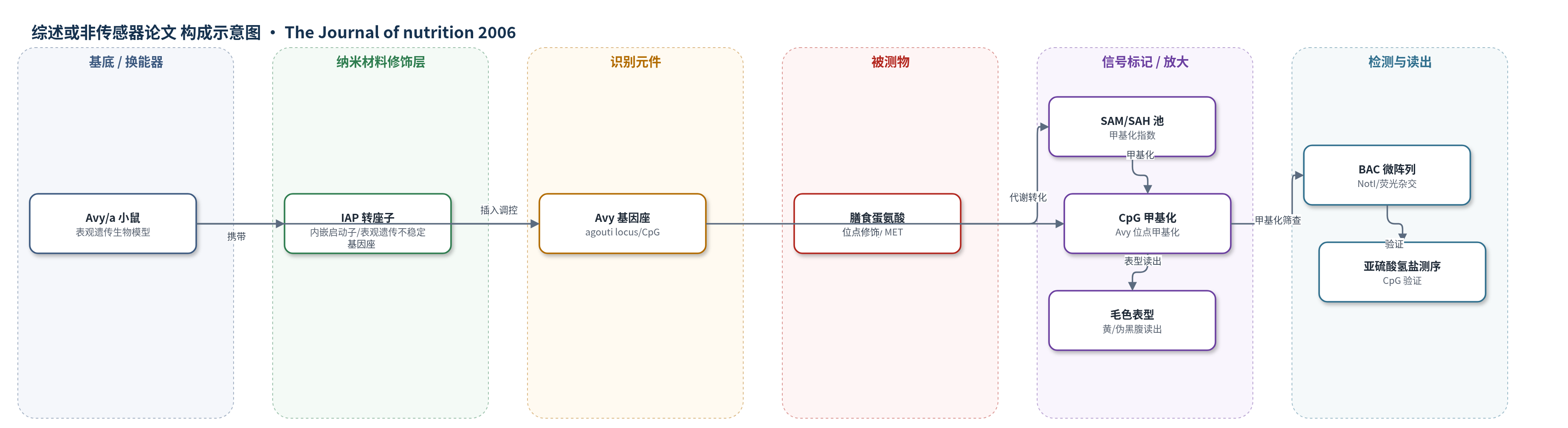
点击图片查看大图 · 依据论文自动绘制
传感器类型
综述或非传感器论文
检测对象
膳食蛋氨酸(dietary methionine, MET)及其代谢产物 SAM/SAH 水平;样品基质:动物饮食/饮水、肝、脑、血浆、基因组 DNA。
检测原理
高膳食蛋氨酸摄入改变一碳代谢,影响 SAM 与 SAH 的生成和清除,从而改变 SAM:SAH 甲基化指数。DNA 甲基转移酶(DNMT)以 SAM 为甲基供体,将 CpG 二核苷酸中的胞嘧啶甲基化并生成 SAH。在 Avy 小鼠中,Avy 基因座及 IAP 内嵌启动子的甲基化状态决定 agouti 表达,甲基化升高使毛色由黄色向伪黑腹转变,形成活体表型读出。对分子水平,BAC 微阵列先用甲基化敏感酶 NotI 和非甲基化敏感酶切基因组 DNA,未甲基化片段经荧光标记后杂交到 BAC 克隆,不同组比较可识别甲基化差异位点,再用亚硫酸氢盐测序验证。活体毛色和微阵列杂交提供表型与分子层面的信号放大。
检测灵敏度
原文未报告 LOD、线性范围、灵敏度斜率或 R^2;仅报告 BAC 微阵列方法可识别甲基化程度差异低至 40%(differed by as little as 40%)。
效应效果
该文为综述,未报告传感器 RSD、回收率、抗干扰或稳定性数据。作者主张 Avy/a 小鼠毛色可直观反映 Avy 位点甲基化,母代甲基供体补充可显著改变子代毛色;BAC 微阵列结合 NotI 可在全基因组水平识别低至 40% 的甲基化差异,并经亚硫酸氢盐测序验证。高蛋氨酸对肝 SAM/SAH 的影响在不同大鼠研究中不一致:1.5% MET 14 d 肝 SAM 升 7 倍、SAH 升 4 倍、比值升 80%;1.3% MET 10 d 肝 SAM 升 10 倍、SAH 升 30%、比值升约 8 倍;而 1.5% MET 7 d 肝 SAM 无变化、比值下降约 65%。
传感器的构成
- 换能/生物模型:Avy/a 小鼠(viable yellow agouti, Avy)作为表观遗传生物传感器,将位点甲基化状态转换为毛色表型。
- 识别元件:Avy 基因座(agouti locus)及 IAP 逆转录转座子(intracisternal A particle, IAP)内嵌启动子,其甲基化状态决定 agouti 表达。
- 信号标记物:毛色表型(clear yellow、mottled yellow、pseudoagouti)作为 Avy 甲基化水平的可视化信号。
- 分子检测层:BAC 微阵列(bacterial artificial chromosome, BAC microarray)用于全基因组 CpG 甲基化差异筛查。
- 酶切/标记层:甲基化敏感限制性内切酶 NotI 与荧光染料标记,用于区分甲基化/非甲基化 DNA 片段。
- 验证层:亚硫酸氢盐测序(bisulfite sequencing)用于验证特定 CpG 位点甲基化差异。
中文摘要
DNA甲基化发生在CpG二核苷酸的胞嘧啶上,是维持组织特异性基因表达的重要表观遗传机制。哺乳动物DNA甲基化所需甲基最终来源于蛋氨酸,因此高膳食蛋氨酸摄入理论上可能增加DNA甲基化。但蛋氨酸过量可能通过抑制同型半胱氨酸再甲基化而损害DNA甲基化。现有数据提示,蛋氨酸补充可在特定基因组区域诱导DNA高甲基化。由于位点特异性低甲基化与癌症和发育综合征有关,“促甲基化”膳食补充剂试验已在进行,但异常高甲基化可能有害。在viable yellow agouti(Avy)小鼠中,母代饮食通过扰动Avy不稳定表观等位基因甲基化影响子代毛色,因此Avy小鼠可作为敏感表观遗传生物传感器,评估膳食蛋氨酸补充对位点特异性DNA甲基化的影响。表观基因组方法可在全基因组水平检测位点特异性甲基化,为评估高蛋氨酸摄入的影响提供机会。
英文摘要
Methylation of DNA occurs at cytosines within CpG (cytosine-guanine) dinucleotides and is 1 of several epigenetic mechanisms that serve to establish and maintain tissue-specific patterns of gene expression. The methyl groups transferred in mammalian DNA methylation reactions are ultimately derived from methionine. High dietary methionine intake might therefore be expected to increase DNA methylation. Because of the circular nature of the methionine cycle, however, methionine excess may actually impair DNA methylation by inhibiting remethylation of homocysteine. Although little is known regarding the effect of dietary methionine supplementation on mammalian DNA methylation, the available data suggest that methionine supplementation can induce hypermethylation of DNA in specific genomic regions. Because locus-specific DNA hypomethylation is implicated in the etiology of various cancers and developmental syndromes, clinical trials of "promethylation" dietary supplements are already under way. However, aberrant hypermethylation of DNA could be deleterious. It is therefore important to determine whether dietary supplementation with methionine can effectively support therapeutic maintenance of DNA methylation without causing excessive and potentially adverse locus-specific hypermethylation. In the viable yellow agouti (Avy) mouse, maternal diet affects the coat color distribution of offspring by perturbing the establishment of methylation at the Avy metastable epiallele. Hence, the Avy mouse can be employed as a sensitive epigenetic biosensor to assess the effects of dietary methionine supplementation on locus-specific DNA methylation. Recent developments in epigenomic approaches that survey locus-specific DNA methylation on a genome-wide scale offer broader opportunities to assess the effects of high methionine intake on mammalian epigenomes.