组成图示
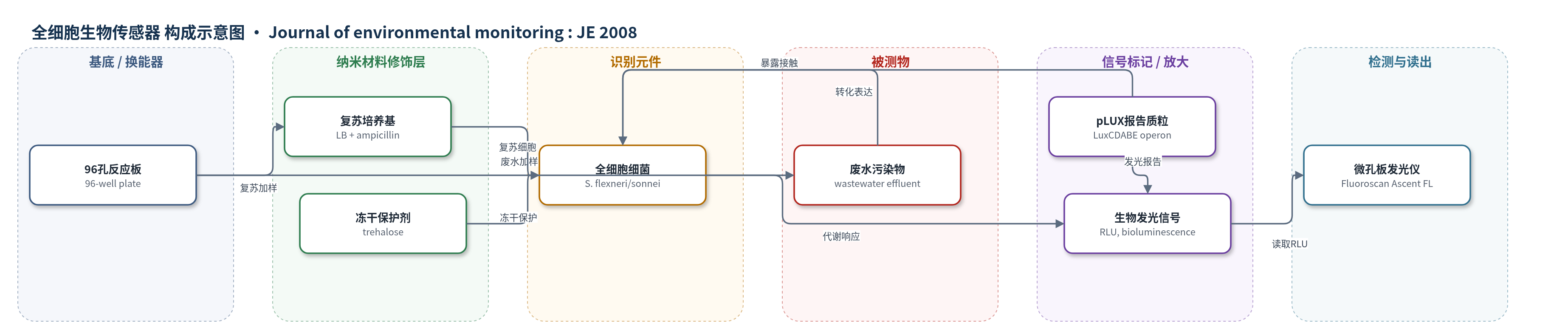
点击图片查看大图 · 依据论文自动绘制
传感器类型
全细胞生物传感器
检测对象
有机污染物(organic pollutants,以 COD 表征的废水有机物);样品基质:市政废水排放物(wastewater effluent)
检测原理
该传感器以全细胞细菌作为识别与代谢响应元件,pLUX 质粒中的 LuxCDABE 操纵子在细胞内表达荧光素酶及相关蛋白,催化底物氧化并产生冷光。当 S. flexneri 或 S. sonnei 暴露于废水排放物时,其中的有机污染物、毒性物质及其降解中间体会改变细胞膜完整性、代谢状态和发光酶活性,使生物发光强度发生抑制或诱导变化。原始高毒废水通常抑制发光,而随生物降解进行,毒性降低或产生可诱导代谢的产物,发光强度回升。信号通过微孔板发光仪以相对发光单位(RLU)读出,随污染物生物可利用性和降解程度变化。海藻糖冻干可维持细胞活性和 lux 基因表达,实现快速复苏与重复使用。
检测灵敏度
原文未报告LOD、线性范围、灵敏度斜率或相关系数。
效应效果
两种全细胞细菌生物传感器对废水高度敏感,发光趋势与 COD 化学分析一致。优化条件 COD 去除率第1、3、5天为28.28%、57.46%、73.07%,非优化为21.22%、48.86%、61.05%。S. flexneri 第1天发光降低76.37–90.97%,第5天降低19.91–47.19%;S. sonnei 在0.01%优化样品第3、5天发光增加579.65%和760.89%。海藻糖冻干30 min复苏,室温20–26 C稳定,可15 min实时监测。未报告RSD、回收率或选择性。作者认为可指示生物可利用性、原位监测和风险评估。
传感器的构成
- 细胞识别/换能层:S. flexneri 或 S. sonnei 全细胞,作为生物识别与代谢响应元件,接触废水污染物后改变生物发光
- 遗传报告层:pLUX 质粒(11335 bp,含 LuxCDABE operon 和 ampr),赋予细菌生物发光报告功能并便于氨苄青霉素筛选
- 复苏/维持层:LB 肉汤(Luria-Bertani broth)含 10 mg/mL ampicillin,用于复苏冻干细胞并维持 pLUX 表达
- 冻干保护层:trehalose(海藻糖),冻干保存时维持细胞膜相变耐受性和蛋白结构,保证复苏后生物传感活性
- 反应容器层:96-well microtitre plate(Nunc, ThermoLabsystems)白色圆底孔板,承载 10 倍稀释废水样品与 30 µL 生物传感器细胞
- 信号读出层:Fluoroscan Ascent FL 或 Bio-Orbit 1254 luminometer,以 RLU 读取生物发光信号
中文摘要
每年大量有毒物质随废水排入水陆环境,对动植物、微生物和人类构成风险,因此需要在最终排放前对废水中的污染物进行早期检测和持续监测。本研究以志贺氏菌 S. flexneri 和 S. sonnei 的感受态细胞为宿主,通过电转化导入携带 LuxCDABE 生物发光操纵子和氨苄青霉素抗性基因的 pLUX 质粒,构建两种全细胞细菌生物传感器,并利用微孔板发光仪测量其生物发光响应,评估其监测废水生物降解过程的潜力。结果表明,两种细菌生物传感器对废水样品均高度敏感,且在不同降解日呈现与化学需氧量(COD)去除率变化相一致的不同响应模式。总体上,降解后期生物发光值高于初期,0.1%(v/v)废水浓度下第5天生物发光最高增加571.76%;同时,所有采样日中随暴露时间延长,生物发光均呈稳定下降趋势。作者认为,这些构建体能够以化学分析无法实现的方式指示污染物的生物可利用性,并可用于原位监测生物降解,为市政污水处理最终排放前的风险评估和生物修复程度预测提供策略。
英文摘要
Significant amounts of toxic substances which are hazardous to animals, plants, microorganisms, and other living organisms including humans are released annually into aquatic and terrestrial environments, mostly from improper wastewater discharges. Early detection of such pollutants in wastewater effluents and proper monitoring before their final release into the environment is therefore necessary. In this study, two whole-cell bacterial biosensors were constructed by transforming competent cells of Shigella flexneri and Shigella sonnei with pLUX plasmids and evaluated for their potential to monitor wastewater samples undergoing degradation by measuring bioluminescence response using a microplate luminometer. Both bacterial biosensors were found to be extremely sensitive to the wastewater samples, with different patterns, concomitant with those of the COD removals demonstrated at the different days of the degradation. Generally higher bioluminescence values were obtained at the later days of the degradation period compared to the initial values, with up to 571.76% increase in bioluminescence value obtained at day 5 for 0.1% (v/v) effluent concentration. Also, a steady decrease in bioluminescence was observed for the bacterial biosensors with increasing time of exposure to the wastewater effluent for all the sampling days. These biosensor constructs could therefore be applicable to indicate the bioavailability of pollutants in a way that chemical analysis cannot, and for in situ monitoring of biodegradation. This has great potential to offer a risk assessment strategy in predicting the level of bioremediation required during municipal wastewater treatment before their final discharge into the aquatic milieu.